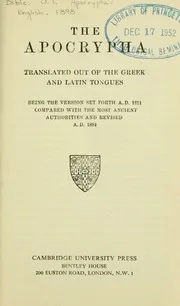
Die Bibel mit Apokryphen
 78
78

Die Bibel mit Apokryphen
The 1985 edition of 'Die Bibel mit Apokryphen' offers a valuable, albeit textually dense, compilation for those investigating the fringes of scriptural tradition. Its strength lies in its direct presentation of texts often relegated to footnotes or separate scholarly volumes, allowing for immediate comparative analysis. A notable limitation is the absence of extensive scholarly apparatus or interpretive commentary, which can leave readers without the necessary context to fully grasp the theological nuances of works like the Book of Tobit or the Wisdom of Solomon. The inclusion of the Apocrypha itself is its most significant contribution, providing a stark reminder of the fluidity of scriptural canons before their finalization. This edition serves as a raw resource, demanding significant prior knowledge from its user. It is a tool for the dedicated, not an introduction for the curious.
📝 Description
78
Published in 1985, 'Die Bibel mit Apokryphen' gathers biblical books with the Apocrypha for comparative study.
This 1985 compilation brings together the canonical biblical texts alongside the Apocrypha. Its purpose is to provide a unified resource for those studying religious literature that various traditions consider scripture but which often does not appear in standard Protestant or Catholic Bibles. The edition is intended for advanced theological students, researchers of comparative religion, and individuals interested in the broad spectrum of ancient Jewish and early Christian writings. It assists scholars who need access to texts that shaped religious thought and spiritual practitioners curious about the historical and textual foundations of different faiths. The inclusion of the Apocrypha has a complex history, notably with Martin Luther's separation of these books in the 16th century. This 1985 edition reflects a resurgence of academic focus on the Second Temple period and the varied religious writings of that era, influenced by discoveries like the Dead Sea Scrolls.
This collection situates itself within discussions of scriptural inclusivity and the boundaries of religious canons. The Apocrypha, often considered 'deutero-canonical' or 'apocryphal' depending on denominational perspective, contains texts that offer insights into Jewish thought between the Old and New Testaments. These writings were influential in early Christian circles and touch upon themes that resonate with Gnostic explorations of hidden knowledge and alternative religious traditions. By presenting these texts together, the volume allows for a broader examination of religious ideas circulating during a formative period for Western faiths, including those that diverged from mainstream development.
💡 Why Read This Book?
• Gain access to the Apocryphal texts, such as the Book of Tobit, which offer unique wisdom and historical narratives from the Second Temple period, providing context often missing in standard Bibles. • Understand the historical development of biblical canons by examining texts considered authoritative by some early Christian and Jewish communities but excluded from later standardized Bibles. • Explore diverse theological perspectives and literary styles present in early Jewish literature beyond the commonly studied Old Testament, enriching your understanding of ancient religious thought.
⭐ Reader Reviews
Honest opinions from readers who have explored this book.
❓ Frequently Asked Questions
What is the Apocrypha and why is it included in this Bible edition?
The Apocrypha refers to a collection of ancient Jewish texts written between the 3rd century BCE and the 1st century CE. They are included in this 1985 edition because they were considered canonical by many early Christians and were part of the Septuagint, the Greek translation of the Old Testament.
When was 'Die Bibel mit Apokryphen' first published?
This specific edition of 'Die Bibel mit Apokryphen,' which includes the Apocrypha, was first published in 1985.
Is this book suitable for beginners in religious studies?
While valuable, this edition is best suited for those with some background in religious studies or theology. The Apocryphal texts require contextual understanding, which this compilation does not extensively provide.
What is the historical significance of the Apocrypha?
The Apocrypha provides crucial insights into the religious and cultural landscape of Judaism during the Second Temple period, influencing the development of both Jewish and Christian thought and offering a bridge between the Old and New Testaments.
Are there any specific theological doctrines derived solely from the Apocrypha?
While the Apocrypha contains theological ideas, particularly regarding angels and the afterlife, many Protestant traditions do not consider them authoritative for doctrine, unlike canonical scripture. However, they are historically significant for understanding the broader religious milieu.
What does the term 'Apocrypha' mean in this context?
In this context, 'Apocrypha' refers to ancient Jewish religious writings that were included in the Septuagint but later excluded from the Hebrew Bible and most Protestant Bibles. Their status varied historically among different religious traditions.
🔮 Key Themes & Symbolism
Canon Formation and Diversity
This compilation directly confronts the concept of scriptural canonicity, highlighting its historical contingency. Unlike modern Bibles that present a fixed canon, 'Die Bibel mit Apokryphen' showcases texts deemed authoritative by various groups in antiquity but later excluded by others. It illustrates that the boundaries of sacred scripture were fluid for centuries, particularly during the Second Temple period and the early Christian era. Examining the Apocrypha alongside canonical books reveals the diverse theological currents and narrative traditions that coexisted and competed for acceptance.
Wisdom Literature and Ethical Teachings
The Apocryphal sections, such as the Wisdom of Solomon and Ecclesiasticus (Sirach), offer profound ethical and philosophical reflections distinct from the prophetic or historical narratives of the Old Testament. These texts explore themes of divine justice, the nature of wisdom, the rewards of righteousness, and the consequences of sin with a philosophical bent. They provide a bridge between Hebraic thought and Hellenistic philosophy, reflecting the intellectual environment of the diaspora. Their inclusion invites readers to consider a broader spectrum of ancient ethical guidance.
Historical and Apocalyptic Narratives
Works like the Book of Tobit and the Books of Maccabees offer narratives with significant historical and cultural value, providing context for Jewish life and resistance during periods of foreign rule, such as the Seleucid Empire. The Book of Tobit, for instance, blends folk tale elements with spiritual instruction and angelic intervention. Other Apocryphal texts, like 2 Esdras, examine apocalyptic visions, addressing questions of divine providence and the end times. These narratives illuminate the anxieties, hopes, and theological interpretations prevalent among ancient Jewish communities.
Theological Development and Interpretation
By presenting a wider array of texts, this edition facilitates the study of theological development within Judaism and early Christianity. Concepts such as the nature of God, the role of intermediaries (like angels, as seen in Tobit), the understanding of the afterlife, and messianic expectations are explored in diverse ways within the Apocrypha. This allows for a comparative analysis of how different authors and communities interpreted divine revelation and addressed fundamental theological questions, revealing a richer, more complex range of ancient religious thought than a single-canon Bible might suggest.
💬 Memorable Quotes
Direct passages from the work, attributed to the author.
“Give unto them, Lord, according to their deeds, and according to the wickedness of their hands.”
— A concept found in texts like the Prayer of Manasses, this reflects an understanding of divine justice as retributive, where actions have direct, often severe, consequences, aligning with older covenantal frameworks.
“For many great men have been found from among men, and not without understanding; in whose time the world hath been habitable.”
— This sentiment, present in books like Ecclesiasticus, highlights the historical importance of wise individuals in shaping societies and maintaining order, suggesting a divine providence working through human intellect and virtue.
“For the leaf also of every tree doth rot on the sudden.”
— A simple yet profound observation, likely from a wisdom text, illustrating the transience of all earthly things and the inevitability of decay, serving as a reminder of mortality and the need for spiritual focus.
💡 Key Ideas
Editorial paraphrase of the work's core concepts — not direct quotes.
For God gave us not the spirit of fear, but of power, and of love, and of a sound mind.
This line, often attributed to 2 Timothy but found echoed in similar sentiments within Apocryphal wisdom literature, emphasizes inner strength and clarity as divine gifts, contrasting with timidity or confusion.
For the union of the dead is a naming of the name of the Lord, to declare the vengeance of his punishments.
This passage, reflecting ideas found in certain Apocryphal books, speaks to a communal understanding of divine judgment and retribution that extends even into the afterlife, connecting the departed with God's ultimate justice.
🌙 Esoteric Significance
Tradition
While not explicitly aligned with a single esoteric lineage like Hermeticism or Kabbalah, 'Die Bibel mit Apokryphen' serves as a foundational resource for understanding the textual diversity that informed later esoteric developments. Its inclusion of texts like the Wisdom of Solomon and Tobit, with their angelic lore and explorations of divine providence, touches upon themes that resonate with Gnostic and later magical traditions. It offers a glimpse into the broader scriptural landscape from which various mystical interpretations later emerged, providing primary source material for comparative esoteric study.
Symbolism
The Book of Tobit, for instance, features the archangel Raphael and the demon Asmodeus, representing divine guidance and protective intervention versus destructive, possessive forces. The fish’s heart and liver, used to ward off demons, function as potent talismans within the narrative. The concept of Wisdom itself, personified in texts like the Wisdom of Solomon, acts as a divine emanation or intermediary, a motif common in Gnostic and Neoplatonic thought, symbolizing the path to divine knowledge and connection.
Modern Relevance
Contemporary scholars and practitioners interested in the historical Jesus, early Christian origins, and the development of Western esotericism find value in these texts. They inform studies on angelology, demonology, and the evolution of concepts like the soul and afterlife. Mystical groups exploring the fringes of Abrahamic traditions or seeking deeper historical roots for their practices might consult these books for alternative interpretations of divine interaction and cosmic order, recognizing them as precursors to more systematized esoteric doctrines.
👥 Who Should Read This Book
• Advanced theological students and comparative religion researchers seeking to understand the historical development and diversity of biblical canons. • Esoteric practitioners interested in the textual roots of angelology, demonology, and ancient concepts of divine wisdom that influenced later mystical traditions. • Historians and scholars of the Second Temple period looking for primary source material that illuminates Jewish life, thought, and resistance during periods of foreign occupation.
📜 Historical Context
The 1985 publication of 'Die Bibel mit Apokryphen' emerged during a period of significant academic re-evaluation of biblical texts and their historical contexts. Following the mid-20th century explosion of Dead Sea Scrolls scholarship, interest surged in the diverse literature of the Second Temple period. This era saw a flourishing of Jewish religious thought, with many texts considered scripture by some communities but not others. The Apocrypha, long present in the Septuagint and thus influential in early Christianity, faced increasing marginalization in Protestantism following Martin Luther's 16th-century decision to place them in an appendix. This 1985 edition can be seen as a response to scholarly trends that sought to reintegrate these 'intertestamental' writings into a broader understanding of ancient Israelite and early Christian religious life, challenging the established Protestant canon. Contemporaries like Geza Vermes were actively exploring the Jewish context of Jesus and the Gospels, implicitly validating the study of texts like these.
📔 Journal Prompts
The concept of Wisdom's personification in the Apocrypha, how does it compare to later Gnostic Sophia?
Reflect on the narrative of Raphael's guidance in the Book of Tobit, considering divine intervention.
Analyze the ethical teachings within Ecclesiasticus concerning justice and societal order.
Consider the historical context of the Maccabean Revolt as depicted in the Books of Maccabees.
Examine the Apocryphal views on the afterlife and their divergence from later canonical texts.
🗂️ Glossary
Apocrypha
A collection of ancient Jewish religious texts written between the 3rd century BCE and the 1st century CE. They were included in the Septuagint but excluded from the Hebrew Bible and most Protestant Bibles.
Septuagint
The ancient Greek translation of the Hebrew Bible (Old Testament), produced in the 3rd and 2nd centuries BCE. Many Apocryphal books were part of this collection.
Canonicity
The process by which religious texts are officially recognized as authoritative scripture within a particular religious tradition. The canon of the Bible evolved over centuries.
Second Temple Period
The era of Jewish history from the rebuilding of the Second Temple in Jerusalem (c. 516 BCE) until its destruction by the Romans in 70 CE. A period of diverse religious thought.
Wisdom Literature
A genre of literature, found in both canonical (e.g., Proverbs, Job) and Apocryphal (e.g., Wisdom of Solomon, Sirach) texts, that focuses on ethical teachings, practical advice, and philosophical reflection on life.
Intertestamental Literature
Writings produced during the period between the end of the Old Testament canon and the beginning of the New Testament era. The Apocrypha is a major part of this corpus.
Hellenistic Judaism
The form of Judaism that developed in the Hellenistic period (following Alexander the Great's conquests) among Jews living in Greek-speaking environments, often blending Jewish traditions with Greek philosophy and culture.