Better sight without glasses
 73
73

Better sight without glasses
Harry Benjamin's Better Sight Without Glasses offers a curious counterpoint to the ubiquity of optical prescriptions. Benjamin challenges the notion that declining eyesight is an immutable fact of aging or genetics. His central argument, that conscious practice can restore visual acuity, is presented with a conviction that echoes earlier proponents of natural vision improvement like Dr. William Bates. The book's strength lies in its systematic exploration of eye-muscle relaxation and mental focus as agents of change. However, its limitation is the lack of robust scientific validation for its more ambitious claims, relying heavily on anecdotal evidence and a philosophical rather than empirical framework. A particularly striking concept is the emphasis on the 'palming' technique, where covering the eyes with warm hands is suggested to induce deep relaxation and restore visual function. While not a replacement for professional medical advice, Benjamin's work provides an interesting perspective on the potential for self-directed change in physical well-being.
📝 Description
73
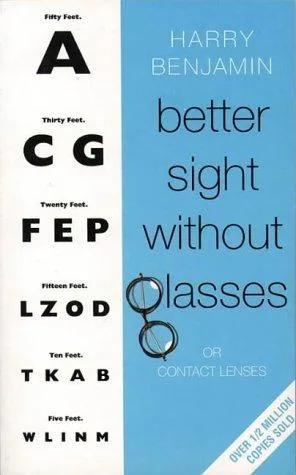
Harry Benjamin's 1984 book, Better Sight Without Glasses, suggests vision improvement through mental and physical practices.
This 1984 work by Harry Benjamin proposes a method for improving eyesight without relying on conventional glasses or lenses. Benjamin argues that our ability to see clearly is tied to our overall physical health and mental state, advocating for a holistic approach to eye care. The book details conscious practices designed to relax the eyes and influence visual function. It posits that eyesight is not static but a dynamic process that can be retrained through awareness of habits, perception, and physical tension.
The book is for readers interested in alternative approaches to vision enhancement, particularly those drawn to the mind-body connection and self-guided healing. It will appeal to individuals skeptical of standard corrective lenses and open to exploring less common techniques. Those with an interest in self-mastery over physical conditions and esoteric philosophy will find the material relevant.
Benjamin's work follows in a tradition that questions purely mechanical interventions for ailments, emphasizing the body's capacity for self-repair when properly understood and guided. This perspective aligns with a broader interest in holistic health and alternative therapies that emerged in the late 20th century.
Benjamin's book draws from a lineage of thought that predates modern optometry, echoing figures like William Bates from the early 20th century. His approach aligns with a broader esoteric belief in the body's inherent ability to heal and adapt when individuals cultivate specific awareness and practices. This tradition often posits that physical conditions are influenced by mental states and habits, suggesting that self-mastery over the body is achievable through internal work rather than solely external aids.
💡 Why Read This Book?
• Understand the mind-body link in vision: Learn how conscious relaxation and mental focus, as described in Benjamin's techniques, can influence eye strain and potentially improve visual clarity, offering an alternative perspective to conventional optometry. • Explore historical alternative health practices: Gain insight into the methods proposed by Harry Benjamin, reflecting a broader interest in natural healing modalities that were gaining momentum in the late 20th century. • Challenge assumptions about physical limitations: Discover how the book encourages a proactive approach to vision care, suggesting that understanding physiological habits, as detailed in its chapters, can empower individuals to influence their own sight.
⭐ Reader Reviews
Honest opinions from readers who have explored this book.
❓ Frequently Asked Questions
What is the primary premise of Better Sight Without Glasses?
The book's main idea is that improved eyesight can be achieved through conscious mental and physical practices, rather than solely relying on external corrective lenses. Harry Benjamin suggests a holistic approach linking eye health to overall well-being.
Who was Harry Benjamin and when was his book first published?
Harry Benjamin was an author interested in alternative health and self-improvement. His work, Better Sight Without Glasses, was first published in 1984, presenting his theories on natural vision enhancement.
Does the book advocate for completely abandoning glasses?
While the title suggests this possibility, the book primarily aims to offer methods for improving vision that may reduce or eliminate the need for glasses. It encourages exploration and practice rather than outright prescription.
What kind of exercises or techniques are discussed?
The book details various techniques focusing on eye relaxation, conscious blinking, movement, and mental visualization. These practices are designed to counteract the strain and habits associated with modern visual demands.
Is this book scientifically proven to restore vision?
Better Sight Without Glasses is based on principles of mind-body connection and anecdotal evidence rather than rigorous clinical trials. While many readers report benefits, it is not a substitute for professional medical diagnosis or treatment.
What is the connection to earlier vision improvement methods?
Benjamin's work aligns with and builds upon earlier natural vision improvement systems, notably those of Dr. William Bates, which also emphasized relaxation and eye exercises from the early 20th century.
🔮 Key Themes & Symbolism
Mind-Body Synergy
The work strongly asserts that mental states and physical habits are intrinsically linked, particularly concerning the eyes. Benjamin posits that tension, stress, and ingrained visual habits contribute significantly to poor sight. By cultivating mental calm and conscious awareness, individuals can influence their physiological state, leading to improved ocular function. This theme moves beyond a purely mechanical view of the eye, framing it as an organ deeply responsive to the individual's internal landscape and practices.
Conscious Perception and Relaxation
A central tenet is the practice of conscious relaxation for the eyes. This involves actively releasing strain, a state often unconsciously adopted due to prolonged focus on screens or reading. Benjamin details techniques like 'palming'—covering the eyes with warm hands—and gentle eye movements to restore natural visual function. The emphasis is on perceiving without undue effort, suggesting that clarity arises from a state of relaxed attention rather than forceful concentration.
Holistic Health Principles
Better Sight Without Glasses is rooted in a holistic understanding of health, viewing the eyes not in isolation but as part of the entire organism. It suggests that overall physical vitality, adequate rest, and a positive mental outlook are foundational for good vision. This perspective aligns with broader esoteric and alternative health movements that advocate for the body's inherent capacity for self-healing when provided with the right conditions and awareness.
Challenging Conventional Norms
The book implicitly and explicitly challenges the widely accepted reliance on corrective lenses as the primary solution for vision problems. By offering alternative methods, Benjamin encourages readers to question established medical paradigms and explore the potential for self-directed improvement. This critical stance invites individuals to investigate the root causes of vision issues rather than merely compensating for symptoms.
💬 Memorable Quotes
Direct passages from the work, attributed to the author.
“The eyes are not separate organs, but an integral part of the whole person.”
— This statement highlights Benjamin's holistic approach, emphasizing that eye health is interconnected with the body's overall condition and mental state, moving away from a purely mechanical or isolated view of vision.
“Strain is the enemy of clear sight.”
— This concise phrase captures the essence of Benjamin's method, suggesting that the primary cause of poor vision is often physical and mental tension, and that relaxation is key to restoration.
“Conscious relaxation allows the eyes to return to their natural state.”
— This interpretation of Benjamin's core technique underscores the belief that the eyes possess an inherent ability to see clearly, which is often obscured by habitual tension and can be regained through mindful practice.
“The habit of staring is detrimental to visual health.”
— This points to a specific behavioral pattern that Benjamin identifies as harmful, suggesting that sustained, unblinking focus contributes to eye strain and visual fatigue, necessitating techniques to break this habit.
💡 Key Ideas
Editorial paraphrase of the work's core concepts — not direct quotes.
Perception is an active process, but it need not be a strenuous one.
This quote differentiates between active engagement with the visual world and the muscular effort often associated with it, advocating for a more effortless, relaxed mode of seeing.
🌙 Esoteric Significance
Tradition
While not strictly adhering to a single esoteric lineage, Benjamin's work draws from Hermetic principles of 'as above, so below,' suggesting that internal states (mind) directly influence external physical conditions (eyesight). It aligns with Neoplatonic ideas of the soul's influence on the body and the broader Hermetic tradition's emphasis on understanding and mastering natural laws through applied knowledge and will.
Symbolism
The 'eye' itself serves as a potent symbol, representing not just physical sight but also inner perception and consciousness. The act of 'seeing clearly' extends metaphorically to understanding and enlightenment. Techniques like 'palming,' where darkness and warmth envelop the eyes, symbolize a return to a primal state of rest and potential renewal, a symbolic shedding of external visual 'noise.'
Modern Relevance
Benjamin's ideas find echoes in contemporary wellness practices that emphasize mindfulness, stress reduction, and the mind-body connection. Practices like yoga and meditation often incorporate visual relaxation techniques. Furthermore, the growing awareness of digital eye strain and the search for non-invasive health solutions keep Benjamin's holistic approach relevant for those exploring alternative self-care modalities.
👥 Who Should Read This Book
['Individuals experiencing eye strain or discomfort from prolonged screen use, seeking practical techniques to alleviate symptoms through relaxation and conscious visual habits.', 'Students of alternative health and mind-body practices, interested in historical perspectives on self-healing and the integration of mental discipline with physical well-being.', 'Readers skeptical of conventional optometry, looking for alternative viewpoints and self-directed methods to understand and potentially improve their vision.']
📜 Historical Context
Published in 1984, Harry Benjamin's Better Sight Without Glasses emerged during a period of burgeoning interest in holistic health and alternative therapies, a stark contrast to the increasingly specialized and technologically driven medical landscape. This era saw figures like Dr. William Bates, whose natural vision improvement methods gained popularity in the early-to-mid 20th century, influencing subsequent authors like Benjamin. While mainstream ophthalmology focused on prescriptions and surgery, a counter-current explored the body's innate healing capabilities. Benjamin's work can be seen as participating in this broader movement, offering a perspective that, while not widely adopted by conventional medicine, resonated with individuals seeking self-empowerment over physical conditions. Unlike purely scientific treatises, his approach incorporated elements of mental discipline and self-awareness common in esoteric traditions.
📔 Journal Prompts
The concept of 'strain' as the primary enemy of clear sight: how does this apply to your daily visual experiences?
Visualizing clarity: describe a time when your vision felt sharpest and what conditions (mental or physical) were present.
The practice of 'palming': reflect on the sensation of warmth and darkness and its potential for eye rest.
Habits of staring: identify instances where you engage in prolonged, unblinking focus and consider alternatives.
The eye as a symbol of consciousness: how might improving physical sight relate to inner perception or understanding?
🗂️ Glossary
Palming
A relaxation technique where one gently cups their hands over their closed eyes, blocking out light and warmth, to induce deep rest and restore visual energy.
Conscious Blinking
Intentionally blinking with full closure and relaxation, as opposed to the shallow, incomplete blinks often associated with screen use, to lubricate and rest the eyes.
Central Fixation
The tendency to stare intently at a single point, which Benjamin suggests leads to strain; the practice encourages shifting focus and embracing peripheral vision.
Mental Palate
The concept of mentally visualizing or imagining a state of relaxation and clarity for the eyes, often used in conjunction with physical palming.
Visual Strain
The physical and mental tension experienced by the eyes due to prolonged focus, inadequate blinking, or improper visual habits, believed by Benjamin to be a primary cause of poor sight.
Natural Vision
Refers to the state of eyesight achieved through the body's inherent capabilities, without the aid of corrective lenses or surgical intervention, as promoted by Benjamin's methods.
Ocular Muscles
The small muscles that control eye movement and focus. Benjamin's work emphasizes the need for these muscles to be relaxed and functioning without tension.
🔮 Readers Also Liked
Browse all →









More by Harry Benjamin
All books →
More Free Occult Philosophy Books
View all →