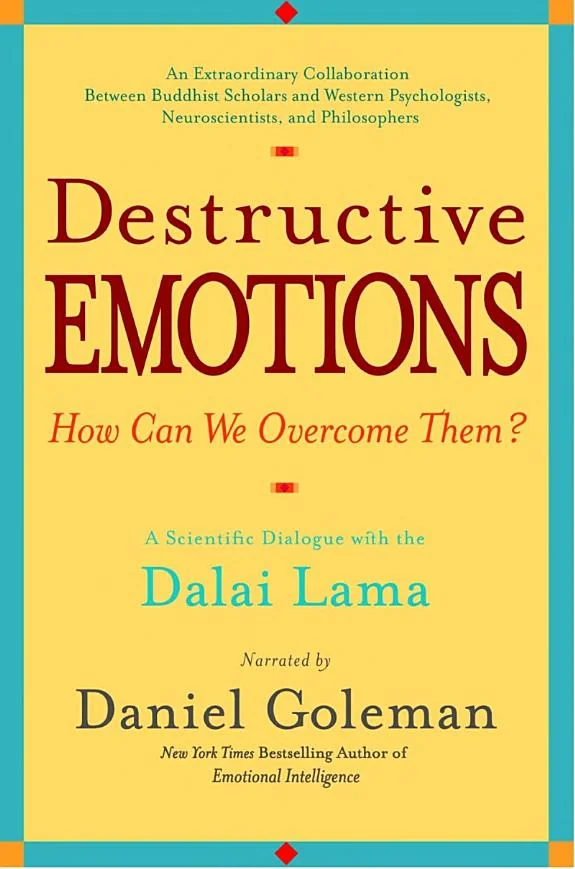
Destructive Emotions
 73
73

Destructive Emotions
The strength of 'Destructive Emotions' lies in its direct presentation of the Dalai Lama's responses to scientific queries. Witnessing the pragmatic, yet deeply rooted, Buddhist perspective engage with empirical data is illuminating. A notable passage details the Dalai Lama’s explanation of how habitual thought patterns, akin to neurological pathways, can be deliberately rerouted through meditative practice. However, the book occasionally suffers from a certain academic formality; the scientific contributions, while rigorous, sometimes lack the immediacy of the Dalai Lama's own reflections. The limitation is that the dialogue format, while authentic, can sometimes feel less like a cohesive argument and more like a series of distinct contributions. Ultimately, it serves as a valuable bridge between two vastly different modes of understanding the human mind.
📝 Description
73
In 2004, dialogues between the Dalai Lama and scientists explored the nature of destructive emotions.
This book documents a series of dialogues where the 14th Dalai Lama met with scientists and philosophers. Their conversations dissected negative emotions, examining their roots in psychology and neuroscience. The discussions proposed methods for transforming these states, drawing on Buddhist philosophy.
The work connects empirical research with contemplative traditions. It provides a structure for understanding and managing internal emotional states. The book is for people interested in the overlap of science and spirituality, especially those looking for ways to alleviate emotional suffering.
Students of psychology, neuroscience, and comparative religion, as well as Buddhist meditation practitioners, will find this relevant. It is also for anyone curious about how contemplative practices might help with mental distress and how science can inform or validate these methods.
This book emerges from the Tibetan Buddhist contemplative tradition, specifically the Mahayana lineage. It engages with concepts like kleshas (afflictive emotions) and the potential for mental cultivation to alter emotional states. The dialogues reflect a long history within Buddhism of investigating the mind and developing practices for ethical and psychological well-being. This tradition views the mind not as fixed but as malleable through focused attention and ethical discipline.
💡 Why Read This Book?
• Learn how the Buddhist concept of 'deconstruction' of emotional patterns, as discussed in the dialogues, offers a specific method for dismantling negative states that goes beyond simple suppression, a technique explored in the 2004 publication. • Understand the scientific perspectives on neuroplasticity presented in the book, which align with Buddhist meditation practices, providing empirical backing for mental cultivation discussed with scientists. • Gain insight into the Dalai Lama's approach to transforming 'kleshas' (afflictive emotions), a core tenet of Buddhist philosophy, offering practical applications for managing psychological distress.
⭐ Reader Reviews
Honest opinions from readers who have explored this book.
❓ Frequently Asked Questions
What is the central aim of the dialogues in 'Destructive Emotions'?
The central aim is to unite Buddhist contemplative insights with scientific research in psychology and neuroscience to understand, transform, and eliminate destructive emotions.
Who are the primary participants in the discussions featured in the book?
The primary participants include His Holiness the 14th Dalai Lama, along with a group of scientists and philosophers.
When was 'Destructive Emotions' first published?
'Destructive Emotions' was first published in 2004, marking a significant moment for interdisciplinary dialogue on emotions.
What fields of study are integrated in this work?
The book integrates research from education, psychology, and neuroscience with Buddhist practice and philosophy.
What is the key Buddhist concept discussed regarding emotions?
A key Buddhist concept is the understanding and transformation of 'kleshas,' often translated as afflictive or destructive emotions.
How does the book propose coping with negative emotions?
It proposes coping through a combination of scientific understanding of emotional mechanisms and Buddhist practices aimed at mental transformation and cultivation.
🔮 Key Themes & Symbolism
Neuroscience of Affliction
The book examines how the brain processes and perpetuates destructive emotions like anger and desire. It explores concepts from neuroscience that describe habitual thought patterns as akin to neurological pathways. This perspective aligns with Buddhist notions of karma and mental conditioning, suggesting that just as these patterns are formed, they can be deliberately altered through sustained practice, a core idea discussed in the 2004 publication.
Buddhist Psychology of Transformation
Central to the work is the Buddhist framework for understanding the mind, particularly the concept of 'kleshas' or afflictive emotions. The dialogues study how these states arise from ignorance and attachment, and how practices like mindfulness and analytical meditation can cultivate wholesome states such as compassion and wisdom. This approach seeks not merely to suppress negative feelings but to fundamentally transform the mind's habitual responses.
Dialogue Between Disciplines
The book is a significant artifact of the interdisciplinary dialogue movement, particularly between contemplative traditions and Western science. It showcases the 14th Dalai Lama engaging directly with researchers and philosophers, bridging the gap between subjective, experiential knowledge and objective, empirical data. This cross-pollination aims to create a more holistic understanding of human consciousness and well-being.
Practical Application of Contemplation
Beyond theoretical discussion, 'Destructive Emotions' emphasizes the practical application of contemplative techniques for emotional regulation and mental health. It posits that insights gained from meditation, when informed by scientific understanding and vice-versa, can lead to tangible improvements in psychological resilience and happiness. The book offers a roadmap for integrating ancient wisdom with modern scientific findings for personal betterment.
💬 Memorable Quotes
Direct passages from the work, attributed to the author.
“Our mind is like a garden. If we plant seeds of anger, we will harvest suffering.”
— This analogy highlights the principle of causality in mental states. It suggests that our thoughts and emotions are cultivated through intentional or unintentional 'planting,' emphasizing personal responsibility for our inner world.
“Destructive emotions are not inherent parts of our being, but rather transient states that can be understood and changed.”
— This interpretation underscores the Buddhist doctrine of impermanence applied to mental afflictions. It provides a hopeful framework, suggesting that negative emotions are not immutable but amenable to transformation through insight and practice.
“The dialogue between science and Buddhism can reveal common ground in the understanding of human suffering and its alleviation.”
— This statement points to the book's core mission: to find synergistic perspectives between empirical research and contemplative traditions, validating the efficacy of both in addressing psychological distress.
“Understanding the neurological basis of emotions can inform and strengthen contemplative practices.”
— This highlights the reciprocal relationship explored in the book. Scientific findings about brain function can provide concrete mechanisms that explain how meditative techniques achieve their effects, enhancing their perceived validity and application.
“Transforming our emotions requires not just intellectual understanding, but also consistent, practical effort.”
— This emphasizes that genuine change in emotional patterns demands more than theoretical knowledge. It requires active engagement with practices that retrain the mind, integrating cognitive insights with experiential work.
🌙 Esoteric Significance
Tradition
While not strictly an esoteric text in the Western Hermetic or Kabbalistic sense, 'Destructive Emotions' draws heavily from Mahayana Buddhism, a tradition rich in contemplative practices and philosophical depth often considered 'esoteric' by outsiders. It represents a modern attempt to translate and validate these ancient teachings within a scientific paradigm, making them accessible beyond traditional practitioners and engaging with concepts like mind-training and emptiness.
Symbolism
The primary 'symbolism' lies in the conceptual framework itself: the mind as a 'garden' to be cultivated, representing the potential for growth and transformation. Destructive emotions are akin to 'weeds' that choke the wholesome 'flowers' of compassion and wisdom. The dialogue format itself symbolizes the bridging of disparate areas of knowledge – the subjective experience of the contemplative and the objective analysis of the scientist.
Modern Relevance
This work remains highly relevant today, influencing contemporary fields like positive psychology, contemplative neuroscience, and secular mindfulness. Thinkers and practitioners continue to draw upon the dialogues to inform research on emotional regulation, stress reduction, and the development of empathy. The book's emphasis on the practical application of mental training aligns with the growing demand for accessible, science-backed techniques for improving mental health and well-being in a fast-paced world.
👥 Who Should Read This Book
• Students of comparative religion and philosophy seeking to understand the practical application of Buddhist ethics and psychology. • Researchers and practitioners in psychology and neuroscience interested in the empirical investigation of meditation and emotional transformation. • Individuals seeking practical, secularly-informed methods for managing personal distress and cultivating emotional resilience, informed by dialogue with the Dalai Lama.
📜 Historical Context
First published in 2004, 'Destructive Emotions' emerged from dialogues facilitated by the Mind and Life Institute, a key organization in bridging Buddhist thought and Western science. This period saw a surge of interest in neuroplasticity, a concept that provided fertile ground for discussions on how contemplative practices could reshape the brain. The book arrived at a time when Western psychology was beginning to move beyond purely behavioral or Freudian models, embracing cognitive and mindfulness-based approaches. It offered a counterpoint to purely materialist views of consciousness, engaging with thinkers who were exploring the mind-body connection. Unlike earlier, more philosophical engagements, this work featured direct conversations with His Holiness the 14th Dalai Lama and leading scientists, providing empirical grounding for ancient techniques. Its reception was largely positive within academic and spiritual circles, contributing to the growing acceptance of meditation as a valid tool for mental well-being, though some secular skeptics still viewed it with caution.
📔 Journal Prompts
The mind as a garden: how have you cultivated or neglected specific emotional states?
Deconstruction of anger: identify a recent instance and analyze its components as explored in the book.
Contrast the Buddhist view of 'kleshas' with Western psychological diagnoses of emotional disorders.
Reflect on the concept of neuroplasticity in relation to your own long-held beliefs or habits.
Analyze the role of ignorance in perpetuating your own destructive emotions.
🗂️ Glossary
Kleshas
Sanskrit term for afflictive, disturbing, or poisonous emotions and mental states, such as anger, attachment, pride, and ignorance, which cloud the mind and lead to suffering.
Neuroplasticity
The brain's ability to reorganize itself by forming new neural connections throughout life. This concept is central to understanding how meditation and mental training can alter emotional responses and cognitive functions.
Mindfulness
A mental state achieved by focusing one's awareness on the present moment, while calmly acknowledging and accepting one's feelings, thoughts, and bodily sensations. It is a key practice discussed in the book.
Analytical Meditation
A type of meditation involving focused contemplation and reasoning about a specific topic (e.g., impermanence, the nature of self) to gain insight, distinct from concentration or mindfulness practices.
Contemplative Practice
A broad term encompassing various methods, often rooted in religious or spiritual traditions, designed to cultivate specific mental states, insights, or wisdom through focused attention and reflection.
Deconstruction (of emotions)
A process discussed in the book, involving the analytical breakdown of destructive emotions to understand their causes and conditions, enabling their transformation rather than mere suppression.
Wholesome states
Mental qualities and emotions that are beneficial, constructive, and lead to well-being and happiness, such as compassion, wisdom, and equanimity, often cultivated in contrast to destructive emotions.
This book appears in 1 collection
🔮 Readers Also Liked
Browse all →









From the “Buddhism” Collection
View all →






More Free Occult Philosophy Books
View all →