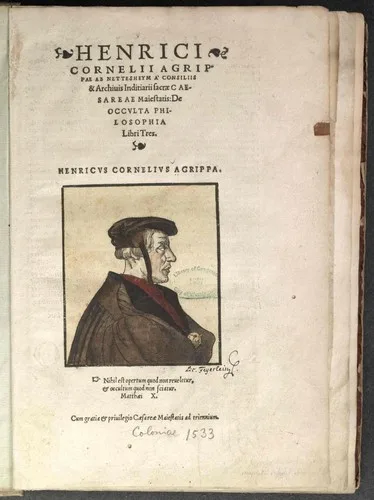
De Occulta Philosophia
 74
74

De Occulta Philosophia



Aurelia Blackwood (Occult Philosophy Critic) — Agrippa's *De Occulta Philosophia* remains an indispensable cornerstone of Western esotericism. Its comprehensive synthesis of diverse magical and philosophical currents is unparalleled for its era. Agrippa masterfully navigates complex doctrines, presenting a coherent framework for understanding the hidden mechanics of the universe. The work's strength lies in its systematic approach, detailing celestial influences, elemental magic, and the power of symbolic language. While dense, it offers profound insights for serious students of Hermeticism, Kabbalah, and Renaissance magic. This is essential reading for anyone seeking to grasp the intellectual lineage of modern occult practices and the philosophical underpinnings of magic.
📝 Description
74
Heinrich Cornelius Agrippa's *De Occulta Philosophia* was completed in 1531, seeking to reconcile magic with Christian theology.
Heinrich Cornelius Agrippa von Nettesheim wrote *De Occulta Philosophia* in the early 16th century. The work attempts to systematize and legitimize the practice of magic within a Christian framework. Agrippa draws heavily on Neoplatonic and Hermetic sources, as well as Kabbalah and ancient magical traditions. He explains the universe as a unified system governed by correspondences, linking the celestial spheres, the earthly realm, and the human spirit. The book details the use of symbols, numbers, and celestial influences as tools for understanding and interacting with these hidden forces.
Agrippa presents magic not as mere superstition, but as a legitimate branch of natural philosophy. He discusses natural magic, which works through the inherent properties of things, and ceremonial magic, which involves invoking spiritual entities. The text covers topics such as astrology, alchemy, talismans, and the creation of sigils. Its aim is to guide the serious student toward spiritual and intellectual elevation through a deeper comprehension of the cosmos.
Written in the early 1530s, *De Occulta Philosophia* emerged during the Renaissance, a period of renewed interest in classical pagan traditions and mystical philosophies. Agrippa sought to bridge the gap between occult practices and Christian doctrine, presenting magic as a divinely ordained art. He integrated Neoplatonic ideas of emanation and correspondence with Hermetic cosmology and Kabbalistic principles. This placed his work within a broader current of Renaissance esotericism that aimed to recover ancient wisdom and find hidden meanings in nature and scripture.
💡 Why Read This Book?
Embark on a transformative journey through the foundational texts of Western magic. *De Occulta Philosophia* offers unparalleled insight into Renaissance occult thought, revealing the intricate connections between the divine, the cosmos, and humanity. Ideal for scholars, practitioners, and seekers of hidden wisdom who wish to understand the roots of magical philosophy and explore the power of symbolism.
⭐ Reader Reviews
Honest opinions from readers who have explored this book.
❓ Frequently Asked Questions
What is the primary focus of 'De Occulta Philosophia'?
The book primarily focuses on the philosophical underpinnings of occultism, exploring magic, natural philosophy, astrology, Kabbalah, and the symbolic language of the universe. It seeks to reveal the hidden connections and forces that govern existence.
Is this book suitable for beginners in occult studies?
While foundational, 'De Occulta Philosophia' is a complex and dense text. Beginners may find it challenging without prior exposure to philosophical or esoteric concepts. It is best approached with a dedicated study ethic or guidance.
What languages was this work originally written in?
Heinrich Cornelius Agrippa von Nettesheim originally wrote 'De Occulta Philosophia' in Latin.
What is the significance of sigils in Agrippa's work?
Sigils, in Agrippa's context, are potent symbolic representations derived from celestial influences or divine names. They are used as tools to invoke or channel specific energies and powers, acting as a bridge between the material and spiritual realms.
How does this book relate to modern occult practices?
It is a foundational text that has profoundly influenced generations of occultists. Many modern magical systems and practices draw directly or indirectly from Agrippa's synthesis of esoteric traditions, particularly in areas like ceremonial magic and symbolic correspondences.
🔮 Key Themes & Symbolism
The Three Worlds and Their Interconnection
Agrippa posits a tripartite division of reality: the Intellectual (divine realm), the Celestial (astral and planetary influences), and the Terrestrial (physical world). A central theme is the intricate web of correspondences that binds these realms together. He illustrates how macrocosmic forces manifest in the microcosm of humanity and how understanding these connections allows for the manipulation and harmonisation of energies, forming the basis for practical magic and spiritual ascent. This interconnectedness is key to unlocking the hidden powers of nature and the divine.
The Power of Symbolism and Divine Names
This work places immense emphasis on the potency of symbols, sacred geometry, and divine names. Agrippa argues that these elements are not mere representations but possess intrinsic power, acting as conduits for spiritual forces. He looks at the language of creation, suggesting that by understanding and correctly employing these symbolic forms, the magician can commune with higher intelligences, influence natural phenomena, and achieve miraculous effects. The careful construction and application of sigils, talismans, and divine appellations are central to this theme.
Natural Magic and Elemental Harmony
Agrippa explores the concept of 'natural magic,' which involves understanding and working with the inherent forces and qualities of the natural world. This includes the influence of the four elements, the virtues of plants, stones, and metals, and the astrological significance of celestial bodies. The goal is to achieve a state of elemental harmony and balance, both within oneself and in one's environment, thereby facilitating the manifestation of divine will and the attainment of esoteric wisdom through the intelligent manipulation of natural laws.
💬 Memorable Quotes
Direct passages from the work, attributed to the author.
“For there is nothing in the superior world which is not also in the inferior world.”
— This highlights the core Hermetic principle of 'as above, so below,' emphasizing the fundamental interconnectedness and mirroring of patterns between the macrocosm (universe) and the microcosm (human being).
“Magic is a secret science, which by the conjunction of the powers of the world, doth effect wonderful works.”
— Agrippa defines magic as a profound, hidden discipline that harnesses the combined energies of the universe to achieve extraordinary and miraculous outcomes, suggesting a systematic and intellectual approach to its practice.
“The universe is but one being, and all things are but one thing.”
— This statement reflects a pantheistic or panentheistic worldview, suggesting the underlying unity of all existence and the interconnectedness of every element within the grand cosmic range.
“The tongue of the wise is the pen of the scribe.”
— This emphasizes the importance of clear, insightful communication and the preservation of knowledge. It suggests that wisdom, when articulated effectively, can be recorded and transmitted, ensuring its continuity through generations.
💡 Key Ideas
Editorial paraphrase of the work's core concepts — not direct quotes.
The wise man is the interpreter of nature, and the servant of God.
This quote captures Agrippa's view of the enlightened individual as one who possesses deep understanding of the natural world and aligns their will with divine purpose, serving as a bridge between the earthly and celestial.
🌙 Esoteric Significance
Tradition
Agrippa's work is a monumental synthesis of Western esoteric traditions, primarily Hermeticism, Neoplatonism, and Kabbalah. It represents a high point of Renaissance occult philosophy, seeking to provide a comprehensive, philosophical framework for understanding and practicing magic. It bridges ancient wisdom with contemporary intellectual currents, presenting magic not as mere superstition, but as a profound science rooted in divine principles and the interconnectedness of all creation.
Symbolism
The text is replete with intricate symbolism drawn from various sources. Key symbols include celestial bodies (planets, stars) and their astrological influences, geometric forms, divine names (especially Hebrew), alchemical symbols, and the four elements. Agrippa uses these symbols to represent divine powers, cosmic forces, and the hidden virtues of nature, constructing a symbolic language that acts as a key to unlocking the secrets of the universe and facilitating magical operations.
Modern Relevance
Despite its age, *De Occulta Philosophia* remains remarkably relevant to modern esoteric practitioners and scholars. It offers a profound exploration of symbolic language, the power of intention, and the interconnectedness of all things, concepts that resonate deeply with contemporary spiritual and magical thought. Its systematic approach to understanding cosmic influences and its philosophical depth continue to inspire those seeking a robust intellectual foundation for their spiritual and magical pursuits.
👥 Who Should Read This Book
Scholars and historians of esotericism will find an indispensable primary source for understanding Renaissance occultism. Aspiring occult practitioners and ceremonial magicians can benefit from its foundational principles of divine magic, symbolism, and the interconnectedness of the cosmos. Seekers of hidden knowledge and philosophical depth will appreciate Agrippa's erudite exploration of the universe's hidden architecture. However, due to its complexity and dense philosophical arguments, beginners are advised to approach it with patience and possibly with supplementary study materials.
📜 Historical Context
Written in the early 16th century, *De Occulta Philosophia* emerged during the European Renaissance, a period of fervent intellectual curiosity, rediscovery of classical texts, and a burgeoning interest in humanism and the esoteric. Agrippa’s work synthesized a vast array of philosophical and magical traditions, including Hermeticism, Neoplatonism, Kabbalah, and alchemy, which were being revived and reinterpreted. It appeared at a time when the boundaries between science, philosophy, and magic were blurred, and when the study of the cosmos was deeply intertwined with spiritual and mystical pursuits. The book was highly influential, circulating in manuscript form before its publication, and shaped the trajectory of Western occult thought for centuries, impacting figures like John Dee and later occult revivalists.
📔 Journal Prompts
Reflect on a personal experience that felt like a powerful 'correspondence' between different areas of your life. How did you perceive the connection?
Choose a symbol from nature (e.g., a tree, a river, a star) and explore its potential hidden meanings and connections to other elements in the universe.
Consider the concept of 'divine names' or 'power words' in your own spiritual or philosophical practice. What makes certain words or sounds feel potent?
How does the idea of 'as above, so below' manifest in your daily life or within your understanding of the human body and mind?
Agrippa speaks of magic as a 'secret science.' What are the 'secret sciences' or hidden potentials you believe exist within the natural world or within yourself?
🗂️ Glossary
Hermeticism
A philosophical and religious tradition based on the writings attributed to Hermes Trismegistus. It emphasizes divine wisdom, the interconnectedness of all things, and the pursuit of spiritual enlightenment through esoteric knowledge and practices.
Kabbalah
A system of Jewish mysticism that explores the nature of God and the universe through symbolic interpretation of scripture, particularly the Torah. It involves concepts like the Tree of Life and divine emanations.
Neoplatonism
A philosophical school of thought originating from Plato, emphasizing the existence of a supreme, transcendent 'One' from which all reality emanates. It influenced many mystical and esoteric traditions.
Sigil
A symbol or magical sign, often created by combining letters or forms, believed to represent and channel specific magical intentions or energies. In Agrippa's work, they are often derived from divine names or celestial influences.
Geomancy
A divinatory art that interprets patterns of earth or figures formed by casting soil or stones. It involves casting points or lines to form sixteen figures, which are then interpreted.
This book appears in 3 collections
🔮 Readers Also Liked
Browse all →







More by Heinrich Cornelius Agrippa von Nettesheim
All books →





From the “Tarot” Collection
View all →









More Free Divination & Tarot Books
View all →