Henry Cornelius Agrippa's fourth book of occult philosophy and geomancy. Magical elements of Peter de Abano. Astronomical geomancy: The nature of spirits; and arbatel of magic

 63
63

Henry Cornelius Agrippa's fourth book of occult philosophy and geomancy. Magical elements of Peter de Abano. Astronomical geomancy: The nature of spirits; and arbatel of magic



Ophelia Vance (Mystical Literature Reviewer) — Agrippa's 'Fourth Book' is an indispensable lodestone for any serious practitioner of Western esotericism. It masterfully synthesizes crucial elements of geomancy, spirit lore, and the potent magic of Arbatel, offering a rare glimpse into the architectonics of the spiritual universe. The integration of Peter de Abano's magical insights enriches the text with a distinct, yet complementary, flavor of occult science. Its strength lies in its systematic approach to complex metaphysical concepts, demanding diligent study but rewarding the diligent seeker with profound understanding. Ideal for advanced students and seasoned practitioners ready to deepen their engagement with classical occult traditions.
📝 Description
63
Heinrich Cornelius Agrippa's 'Fourth Book' was published posthumously, detailing magical elements and geomancy.
This text compiles several distinct occult treatises, including Agrippa's own Fourth Book of Occult Philosophy and Geomancy. It also incorporates magical elements associated with Peter de Abano and the practice of astronomical geomancy. The book discusses the nature of spirits and their influence, alongside the Arbatel of Magic, a work known for its discussions of angelic hierarchies and invocation.
Agrippa connects astrological correspondences with divine emanations and practical techniques for acquiring hidden knowledge. The content addresses the structure of creation from the earthly to the celestial. This work is intended for serious students of magic, offering insights into the principles of occult philosophy, celestial language, and spiritual power.
Published after Agrippa's death, this compilation falls within the Western esoteric tradition, particularly the Renaissance Neoplatonism and Hermeticism that influenced figures like Agrippa. It draws upon magical theories that sought to understand the cosmos as a divinely ordered system, where celestial bodies and terrestrial phenomena were interconnected through sympathetic and astrological principles. The inclusion of geomancy and discussions on spirits aligns with practices aimed at accessing hidden knowledge and divine influence through ritual and symbolic systems.
💡 Why Read This Book?
This book is essential for those seeking to unlock the secrets of practical geomancy, understand the hierarchical nature of spirits, and engage with the profound magic described in Arbatel. It offers a direct conduit to Agrippa's synthesis of ancient wisdom, perfect for scholars, ritualists, and anyone yearning to grasp the fundamental forces governing our reality. Explore the celestial architecture and divine mechanics that underpin all existence.
⭐ Reader Reviews
Honest opinions from readers who have explored this book.
❓ Frequently Asked Questions
What is geomancy according to Agrippa?
Geomancy, in Agrippa's context, is a divinatory art that interprets figures cast by chance, reflecting celestial influences and earthly patterns. It is a system for discerning hidden truths and future events through the arrangement of points.
What is the significance of Peter de Abano's magical elements?
Peter de Abano's contributions provide a crucial link to earlier Renaissance magical thought, enriching Agrippa's work with specific formulae and philosophical underpinnings related to the operation of celestial influences and the manipulation of subtle energies.
How does the book approach the nature of spirits?
The text explores the various orders and natures of spiritual beings, their roles in the cosmos, and how they can be understood and sometimes interacted with through specific magical practices and divinatory arts, emphasizing their connection to planetary and elemental forces.
What is Arbatel of Magic known for?
Arbatel is renowned for its detailed system of angelic magic, presenting a framework for understanding and invoking specific intelligences or 'spirits' associated with the seven planets, offering pathways to knowledge, power, and spiritual attainment.
Is this book suitable for beginners in occult studies?
While foundational, this work is dense and intellectually demanding. It is best approached by those with some prior exposure to metaphysical concepts or a strong commitment to rigorous study, rather than absolute novices.
🔮 Key Themes & Symbolism
The Art of Geomancy
Agrippa presents geomancy not merely as a predictive tool, but as a profound system of understanding the divine order reflected in earthly patterns. It details the creation of figures from chance, their interpretation through astrological and elemental correspondences, and their application in discerning hidden knowledge, future outcomes, and the will of higher powers. This section emphasizes the symbolic language of the earth and its connection to the celestial spheres, offering a practical yet deeply philosophical approach to divination.
The Nature and Hierarchy of Spirits
This volume meticulously explores the diverse classes and essences of spiritual beings that populate the cosmos, from elemental spirits to celestial intelligences. Agrippa delineates their characteristics, their spheres of influence, and the intricate relationships they hold with the material world and human destiny. Understanding these entities is presented as crucial for any aspirant seeking to harness occult forces, work through the unseen realms, and engage in effective spiritual work, highlighting their role as intermediaries between the divine and the mundane.
Arbatel of Magic: Angelic and Planetary Systems
The inclusion of Arbatel of Magic offers a focused examination of a powerful system of angelic invocation and planetary magic. It details specific practices, rituals, and the intelligences associated with the seven planets, providing a framework for the magician to access divine knowledge, gain specific powers, and achieve spiritual enlightenment. This section underscores the belief that through precise alignment with cosmic laws and the invocation of higher beings, profound transformations and manifestations are possible, making it a vital component for serious practitioners of ceremonial magic.
💬 Memorable Quotes
Direct passages from the work, attributed to the author.
“For all things are connected, and the least part is related to the greatest.”
— This aphorism highlights the interconnectedness of all existence, a core tenet of esoteric philosophy where macrocosm and microcosm mirror each other, and understanding one reveals insights into the other.
“The celestial intelligences do not err in their operations.”
— This suggests the inherent perfection and divine order within the cosmic plan, implying that deviations or perceived chaos are often a result of human misunderstanding rather than flaws in the celestial mechanics.
“Nature is the art of God.”
— This profound statement elevates the natural world to a divine creation, a manifestation of God's will and intelligence, inviting reverence and study of its intricate workings as a pathway to understanding the divine.
“The true magician is a philosopher.”
— This emphasizes that genuine magical practice is not mere trickery, but a deep philosophical pursuit grounded in wisdom, understanding of universal laws, and a profound connection to the spiritual dimensions.
“Seek, and ye shall find; knock, and it shall be opened unto you.”
— This classic spiritual imperative underscores the importance of active pursuit and sincere effort in the quest for hidden knowledge and spiritual attainment, promising that genuine seeking will be met with revelation.
🌙 Esoteric Significance
Tradition
This work is a core part of the Western Esoteric Tradition, particularly within the Hermetic, Neoplatonic, and Renaissance magical lineages. It represents a critical synthesis of occult philosophy, drawing heavily on ancient sources and tying them into a cohesive system. Agrippa's approach bridges theoretical understanding with practical application, making it vital for comprehending the development and practice of ceremonial magic, astrology, and divinatory arts within this rich tradition.
Symbolism
The book is replete with detailed symbolism, from the geometric patterns of geomancy to the planetary and angelic correspondences in Arbatel. These symbols are not mere decorations but are seen as keys to unlocking spiritual realities and understanding the underlying structure of the universe. The figures, the celestial spheres, and the names of intelligences all function as a symbolic language, allowing the practitioner to engage with and manipulate the subtle energies and forces that govern existence.
Modern Relevance
Despite its historical origins, Agrippa's 'Fourth Book' remains remarkably relevant for contemporary seekers. Its exploration of consciousness, spirit, and the interconnectedness of all things resonates deeply in a world seeking meaning beyond materialism. The principles of geomancy and the study of spiritual hierarchies offer valuable frameworks for personal growth, intuitive development, and understanding the energetic dynamics of our environment. It provides a timeless guide for those who wish to engage with the deeper currents of existence.
👥 Who Should Read This Book
This profound text is a must-read for seasoned practitioners of Western esotericism, ritual magicians, and advanced students of occult philosophy who wish to look at the practical applications of geomancy and the intricate lore of spiritual intelligences. Scholars of Renaissance intellectual history and comparative religion will find invaluable insights into the period's metaphysical worldview. While challenging, dedicated seekers with a strong foundation in esoteric principles will benefit immensely from its systematic approach to understanding the hidden architecture of the cosmos and the nature of spiritual power.
📜 Historical Context
Published in the early 16th century, Heinrich Cornelius Agrippa's 'Fourth Book' emerged during the height of the Renaissance, a period of intense intellectual and spiritual ferment. This era witnessed a resurgence of interest in classical texts, Neoplatonism, Kabbalah, and Hermeticism, all of which deeply influenced Agrippa's synthesis of occult knowledge. The book reflects the era's fascination with astrology, alchemy, and the belief in a divinely ordered cosmos governed by intricate correspondences. It stands as a evidence of the intellectual landscape where philosophy, theology, and what we now term 'occultism' were often intertwined, a period where scholars and mystics sought to understand God's creation through its hidden mechanisms and symbolic language.
📔 Journal Prompts
Reflect on the concept of 'Nature is the art of God.' How does this perspective influence your understanding of the natural world and your place within it?
Consider the geomantic figures presented. If you were to cast a figure, what question would you ask, and what initial interpretations arise from its visual structure?
Agrippa discusses various orders of spirits. Imagine encountering an elemental spirit; what would be your initial approach and what ethical considerations would guide your interaction?
How does the principle of interconnectedness, 'the least part is related to the greatest,' manifest in your daily life or in broader societal patterns?
The Arbatel section emphasizes specific invocations. What personal qualities or knowledge would you seek to cultivate if you were to engage with such a system, and why?
🗂️ Glossary
Geomancy
A system of divination that interprets figures derived from the random casting of points, reflecting celestial influences and earthly patterns to discern hidden knowledge or future events.
Arbatel
A grimoire or text detailing a system of angelic magic, particularly focusing on the intelligences associated with the seven planets and their invocation for various purposes.
Celestial Intelligences
Spiritual beings or divine emanations believed to govern the movements and influences of the celestial spheres, acting as intermediaries between the divine and the material realms.
Hermeticism
A philosophical and religious tradition based on writings attributed to Hermes Trismegistus, emphasizing divine knowledge, alchemy, astrology, and the interconnectedness of the cosmos.
Neoplatonism
A philosophical school that reinterpreted Plato's ideas, focusing on the concept of 'The One' as the ultimate source of all being and the emanation of reality through various levels of existence.
This book appears in 4 collections
🔮 Readers Also Liked
Browse all →






More by Heinrich Cornelius Agrippa von Nettesheim
All books →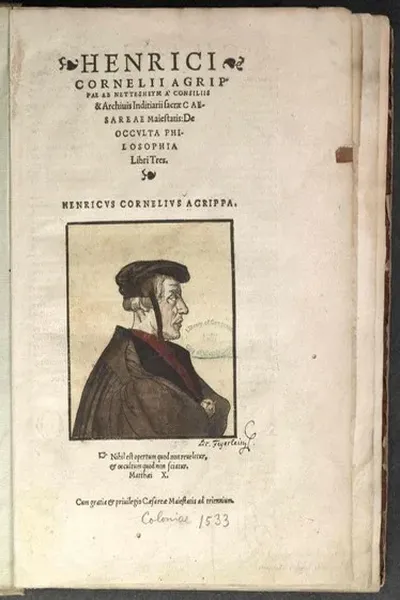





From the “Occultism” Collection
View all →




More Free Divination & Tarot Books
View all →






![The New-England primre [sic] improved.](/img/thumb/the-new-england-primre-sic-improved.webp)