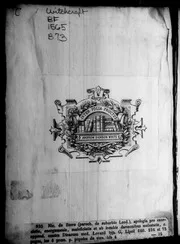
De natvra daemonvm libri IIII. Io. Lavrentii Ananiae ... 1581: Iss 39

 81
81

De natvra daemonvm libri IIII. Io. Lavrentii Ananiae ... 1581: Iss 39



Alaric Kestrel (Metaphysical Studies Reviewer) — Giovanni Lorenzo d'Anania's 'De Natura Daemonum' stands as a cornerstone of early modern demonology, offering a rigorous, albeit often chilling, exploration of the infernal. Anania masterfully synthesizes ancient wisdom and contemporary fears, presenting a detailed taxonomy of daemonic beings and their operations. Its strength lies in its comprehensive approach, appealing to scholars of religion, history, and the occult. While dense, the work rewards diligent study with profound insights into the spiritual anxieties and theological debates of its era. Essential reading for anyone seeking to understand the historical underpinnings of Western esoteric thought on spiritual adversaries.
📝 Description
81
Giovanni Lorenzo d'Anania's 1581 treatise, 'De Natura Daemonum Libri IIII,' investigates the hierarchy and influence of daemonic entities.
Published in 1581, Giovanni Lorenzo d'Anania's 'De Natura Daemonum Libri IIII' examines the nature and organization of daemonic beings. Anania, a scholar of Renaissance occultism, drew upon classical sources, biblical commentary, and contemporary demonological thought. The work discusses the spiritual forces influencing human life and the wider cosmos, moving beyond simple notions of evil.
This text reflects a period keenly interested in the divisions between the sacred and the profane. It invites serious study into spiritual conflict and the subtle actions of infernal powers. The book provides insight into the intellectual climate of the late 16th century and its engagement with the unknown.
This work fits within the tradition of Renaissance demonology, a field that sought to systematically categorize and understand supernatural beings. Scholars like d'Anania combined theological arguments, philosophical reasoning, and often folklore to construct elaborate systems of spiritual hierarchies. These studies were not always condemnatory, sometimes acting as attempts to comprehend forces believed to shape the world. The book engages with a discourse prevalent in the late 16th century, a time when the boundaries between natural philosophy, theology, and the occult were frequently blurred.
💡 Why Read This Book?
Uncover forgotten daemonic lore and the esoteric worldview of the Renaissance. 'De Natura Daemonum' offers a rare glimpse into the structure and influence of infernal forces as understood by a scholarly mind of the era. Ideal for history buffs, occult researchers, and practitioners interested in the roots of demonology and spiritual warfare.
⭐ Reader Reviews
Honest opinions from readers who have explored this book.
❓ Frequently Asked Questions
What is the primary focus of 'De Natura Daemonum'?
The book primarily focuses on the nature, classification, hierarchy, and influence of daemonic entities within the cosmos, as understood through Renaissance theological and occult frameworks.
Who was Giovanni Lorenzo d'Anania?
Giovanni Lorenzo d'Anania was an Italian scholar and author active in the 16th century, known for his contributions to demonology and occult studies.
What historical period does this book represent?
The book represents the late Renaissance, a period characterized by intense intellectual curiosity, religious upheaval, and a fascination with the mystical and the occult.
Is this book suitable for beginners in occult studies?
While a foundational text, its dense scholarly nature and historical context might make it more challenging for absolute beginners. It is best suited for those with some prior knowledge or a strong academic interest.
What kind of 'daemons' are discussed in the book?
The book discusses entities often referred to as demons, fallen angels, or malevolent spirits, exploring their perceived roles and powers in spiritual and earthly affairs.
🔮 Key Themes & Symbolism
The Infernal Hierarchy and Powers
Anania meticulously maps out the perceived structure and ranks of daemonic legions, detailing their respective influences, domains, and methods of operation. This exploration studies the intricate political and spiritual field of the infernal realms, presenting them not as chaotic forces, but as organized entities with distinct roles and responsibilities within a grand, albeit dark, cosmic order. Understanding this hierarchy is crucial for comprehending the author's views on spiritual warfare and the subtle ways these beings are believed to interact with the human plane.
Spiritual Warfare and Human Influence
A central theme is the constant, often unseen, battle between spiritual forces, particularly the influence of daemons on human thoughts, actions, and destinies. Anania examines how these entities are believed to tempt, deceive, and manipulate individuals, as well as their potential for greater societal disruption. The book provides insights into the methods of spiritual defense and the theological understanding of the human soul's vulnerability and resilience in the face of infernal machinations.
Ancient Wisdom and Occult Synthesis
This work is a proof of the Renaissance's approach to knowledge, synthesizing classical philosophical texts, biblical exegesis, and contemporaneous occult traditions. Anania draws upon a vast array of sources, combining Neoplatonic ideas, Gnostic fragments, and Christian demonology to create a comprehensive, albeit biased, picture of the daemonic. It highlights the intellectual climate where the study of the hidden and the esoteric was intertwined with theological inquiry.
💬 Memorable Quotes
Direct passages from the work, attributed to the author.
“Subtlety is their greatest weapon, deception their constant art.”
— Highlights the perceived insidious nature of daemonic influence, emphasizing their reliance on psychological manipulation and misdirection rather than brute force.
“Know thy enemy, and the spiritual battleground shall be clearer.”
— Implies that understanding the nature and tactics of daemonic entities is essential for reading through the spiritual challenges of life.
“From the abyss, whispers of dominion arise.”
— Evokes the hidden, pervasive nature of daemonic influence, suggesting a constant threat emanating from darker spiritual dimensions.
“The veil between worlds is thinner than many perceive.”
— Suggests that the spiritual realm and its inhabitants are more accessible or influential in human affairs than commonly acknowledged.
💡 Key Ideas
Editorial paraphrase of the work's core concepts — not direct quotes.
The infernal legions are not without their ordered ranks.
This quote underscores the author's belief in a structured, hierarchical organization within the daemonic realm, contrary to a simple notion of chaotic evil.
🌙 Esoteric Significance
Tradition
This work is deeply rooted in the Western esoteric tradition, specifically within the lineage of Renaissance demonology and occult philosophy. It bridges Christian theology with elements of Neoplatonism and ancient magical theories, reflecting a period where such distinctions were often blurred. Anania's meticulous cataloging and analysis of daemonic entities contribute to the broader lore concerning spiritual hierarchies and the unseen forces that govern existence.
Symbolism
The book is rich with symbolic interpretation, viewing daemons not merely as literal beings but as representations of primal forces, psychological archetypes, and spiritual challenges. Their hierarchies symbolize cosmic order, albeit a fallen one, and their actions often mirror human vices and temptations. The exploration of their influences serves as a symbolic map of the human psyche's darker potentials and the spiritual battles one must wage within themselves.
Modern Relevance
In contemporary occultism and esoteric studies, 'De Natura Daemonum' remains a vital historical document. It offers invaluable context for understanding the evolution of Western demonology, its philosophical underpinnings, and its impact on subsequent occult traditions. For practitioners, it provides a historical perspective on spiritual warfare, protective practices, and the symbolic language used to describe internal and external adversarial forces.
👥 Who Should Read This Book
This profound work is essential for scholars of religious history, demonology, and Renaissance intellectualism. Occult practitioners, particularly those interested in the historical development of spiritual warfare doctrines and the symbolic representations of dark forces, will find it clear. Seekers of hidden knowledge who are prepared for a dense, scholarly exploration of the infernal will benefit greatly. While challenging for absolute beginners, it offers a foundational understanding for anyone dedicated to delving deep into the esoteric currents of Western thought.
📜 Historical Context
Published in 1581, 'De Natura Daemonum Libri IIII' emerges from the heart of the late Renaissance, a period marked by profound intellectual ferment, religious upheaval, and a burgeoning interest in the occult and the esoteric. The era of the Reformation and Counter-Reformation fostered intense theological debate, often leading to increased scrutiny of spiritual phenomena and the perceived presence of malevolent forces. This intellectual climate, combined with a renewed engagement with classical antiquity, led scholars like Anania to synthesize ancient philosophical traditions, biblical interpretations, and contemporary demonological beliefs into comprehensive treatises. The book reflects a worldview where the spiritual and the material were intimately connected, and understanding the unseen forces was paramount for navigating both earthly and eternal destinies. Its existence speaks to a society both fascinated and fearful of the unknown, seeking order and understanding even in the darkest corners of existence.
📔 Journal Prompts
How does Anania's concept of an 'infernal hierarchy' differ from or resemble modern understandings of spiritual or psychological forces?
Reflect on a time you felt influenced by subtle, perhaps even 'daemonic,' forces. How does Anania's description resonate with that experience?
Consider the 'subtlety' and 'deception' of daemons as described. In what modern contexts do these tactics manifest?
How might understanding the historical context of demonology inform our current interpretations of 'evil' or negative influences?
If daemons represent aspects of the human psyche, what do Anania's descriptions suggest about the 'shadow self'?
🗂️ Glossary
Daemons
In this context, refers to supernatural beings, often translated as demons, fallen angels, or malevolent spirits, believed to possess distinct hierarchies and influences within the spiritual and earthly realms.
Infernal
Pertaining to hell or the underworld; characterized by extreme wickedness, torment, or a diabolical nature. In this book, it refers to the realm and inhabitants associated with daemons.
Neoplatonism
A philosophical system originating in the 3rd century AD, based on the teachings of Plato but incorporating mystical and other elements. It often deals with emanations from a supreme, transcendent 'One'.
Exegesis
Critical explanation or interpretation of a text, especially of the Bible. Anania employs exegesis to support his theological and demonological arguments.
Spiritual Warfare
The concept of an ongoing, often unseen, conflict between spiritual forces, particularly between good and evil, or divine and daemonic powers, often involving the human soul.
This book appears in 2 collections
🔮 Readers Also Liked
Browse all →






From the “Witchcraft” Collection
View all →



More Free Witchcraft & Paganism Books
View all →