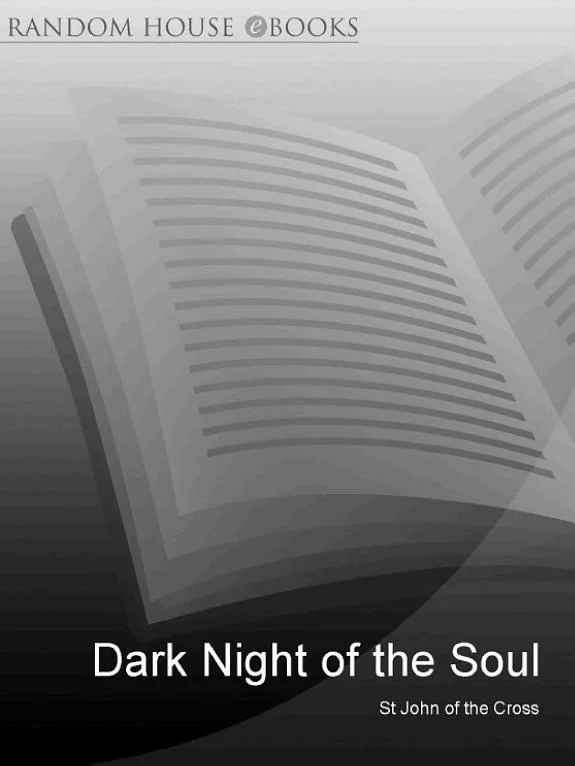
Dark Night of the Soul
 83
83

Dark Night of the Soul
St. John of the Cross's *Dark Night of the Soul* remains a stark and unflinching account of spiritual desolation. Peers' translation, bolstered by over 176 footnotes, offers a scholarly yet accessible portal into the Saint's stark vision. The text directly confronts the reader with the often-uncomfortable reality of spiritual dryness, refraining from platitudes. A particularly arresting passage describes the soul's state during the passive purification of the spirit, where God himself becomes the source of torment, not out of malice, but to burn away the last vestiges of self-will. The limitation, for some modern readers, might be the intensely Christocentric framework, which, while the work's foundation, can present a barrier for those from other spiritual or secular backgrounds seeking wisdom on spiritual purification. Nonetheless, its directness and theological rigor offer a potent corrective to superficial spiritualities. It is a severe, necessary examination of the soul's crucible.
📝 Description
83
Saint John of the Cross wrote 'Dark Night of the Soul' in the late 16th century.
This edition presents Saint John of the Cross's influential text, 'Dark Night of the Soul.' It describes the soul's passage through spiritual dryness and desolation, known as the 'dark night.' The book consists of two poems and their extensive commentaries, detailing the process of spiritual purification. It is aimed at those seeking a deeper connection with the divine, particularly those experiencing spiritual aridity or faith challenges during life changes.
The work emerged from the Carmelite reform and the Counter-Reformation period in Spain. Saint John, a mystic and contemporary of Teresa of Ávila, faced suspicion for his writings despite his collaboration on monastic reform. The book's core ideas concern the active and passive purification of the senses and spirit. This 'dark night' is depicted as a divine method for detaching the soul from worldly concerns and imperfect spiritual comforts, a painful but necessary step toward union with God.
Saint John of the Cross's 'Dark Night of the Soul' is a central work in Christian mysticism, specifically within the Carmelite tradition. It articulates a path of spiritual growth that involves deliberate suffering and detachment from worldly and even spiritual consolations. This process, the 'dark night,' is understood not as abandonment by God, but as a divine surgery to prepare the soul for direct, unmediated union. It is a practical guide to transcending the limitations of the ego and the senses to achieve a higher state of contemplative prayer.
💡 Why Read This Book?
• You will learn about the distinct stages of spiritual purification, specifically the active and passive nights of the senses and spirit, as detailed by St. John of the Cross in the 16th century. • You will gain an understanding of how divine detachment, though painful, serves as a crucial catalyst for deeper union with God, as articulated in the Saint's commentaries. • You will explore the concept of spiritual aridity not as a failing, but as a divinely orchestrated process for refining faith, a perspective central to the Carmelite tradition's mystical theology.
⭐ Reader Reviews
Honest opinions from readers who have explored this book.
❓ Frequently Asked Questions
Who was St. John of the Cross and why is his 'Dark Night of the Soul' significant?
St. John of the Cross (1542-1591) was a Spanish Carmelite friar and mystic. His *Dark Night of the Soul* is a foundational text in Christian mysticism, detailing the soul's painful but necessary purification process to achieve union with God.
What is the 'dark night' described in the book?
The 'dark night' refers to periods of spiritual desolation and dryness where the soul feels abandoned by God. St. John of the Cross explains this as a divinely guided process of purification for deeper spiritual intimacy.
Is this book only for devout Christians?
While rooted in Christian theology, the book's exploration of spiritual struggle, purification, and the search for ultimate meaning offers profound insights applicable to anyone on a deep spiritual or existential path.
What makes the E. Allison Peers translation notable?
The E. Allison Peers translation is renowned for its clarity and fidelity to the original Spanish. This edition further enhances it with over 176 footnotes, providing scholarly context and explanations for readers.
How does the book help readers through difficult life stages?
By framing spiritual dryness and hardship as stages of purification, the book offers a theological framework that can help readers find meaning and anchor their faith during challenging periods of life.
When was 'Dark Night of the Soul' originally written?
St. John of the Cross likely wrote *Dark Night of the Soul* between 1578 and 1579, during his imprisonment in Toledo, Spain, though the exact dating is debated among scholars.
🔮 Key Themes & Symbolism
The Twofold Purification
The work meticulously outlines the soul's journey through two primary purifications: the night of the senses and the night of the spirit. The former involves detaching from sensory pleasures and imperfect attachments, while the latter addresses deeper, more profound spiritual ego and reliance on God alone. This structured approach distinguishes it within mystical literature, offering a clear, albeit arduous, path.
Spiritual Aridity as Divine Action
Contrary to common perception, the 'dark night' is not a sign of God's absence but His active presence in a way that transcends the soul's current capacity to perceive. The feeling of emptiness is interpreted as God preparing the soul for a higher, purer form of union, stripping away spiritual consolations that might impede true dependence on Him.
The Nature of Union with God
The ultimate aim described is union with God, not as a mere emotional experience, but as a profound transformation of the soul. This union is characterized by faith, hope, and charity, where the soul, purified of self-love and worldly desires, is oriented entirely towards the divine will.
The Role of Faith and Hope
During the dark nights, faith and hope become the primary means of spiritual progress. The text emphasizes that the soul must proceed without the sensible presence of God, relying solely on the theological virtues. This reliance on unseen realities underscores the intellectual and volitional aspects of the spiritual life.
💬 Memorable Quotes
Direct passages from the work, attributed to the author.
“On a dark night, Kindled in love with yearnings--oh, happy chance!-- I went forth without being observed, My house being now at rest.”
— This opening stanza expresses the essence of the spiritual journey described: an initiated, often solitary, movement towards the divine fueled by an inner spiritual yearning, occurring when the external world and the soul's own faculties are quiescent.
“The soul, in this night, is like a lamp burning in the wind; if the wind blows, it puts out the flame, and if it ceases, the lamp dies.”
— This metaphor illustrates the soul's precarious state during the passive purification. It highlights the soul's vulnerability and dependence, suggesting that without divine grace (the cessation of the wind's disruptive force), its spiritual life cannot be sustained or grow.
“God transforms the soul by the privation of the senses and the spirit.”
— This is a concise statement of the book's central thesis: that the painful process of spiritual dryness and detachment is not an abandonment, but a transformative action by God to prepare the soul for a higher state of being.
“The passive night is the night of the spirit, where God Himself operates in the soul.”
— This distinguishes the more profound spiritual night from the earlier sensory purification. It emphasizes that in this stage, the soul's transformation is directly and powerfully influenced by God's own action, often beyond the soul's direct control or understanding.
“The journey through the dark night requires faith, hope, and charity.”
— This highlights the essential virtues for reading through the desolation. It asserts that spiritual progress during periods of dryness is sustained not by emotional comfort, but by the steadfast exercise of these theological virtues, anchoring the soul in divine truth.
🌙 Esoteric Significance
Tradition
The work is a core part of Christian mysticism, a branch of the Western Esoteric Tradition. It fits within the lineage of contemplative prayer and mystical theology, drawing from Neoplatonic influences common in earlier Christian thought and emphasizing direct, unmediated experience of the divine, aligning with Hermetic ideals of inner transformation and divine knowledge.
Symbolism
The 'dark night' itself is a potent symbol of spiritual trial and purification, representing the soul's journey through unknowing towards divine light. The 'lamp' symbolizes the soul's spiritual life, flickering yet persistent amidst the winds of trial. The 'house' signifies the soul's earthly dwelling, from which it must depart in love for the divine.
Modern Relevance
Contemporary practitioners of contemplative prayer, mindfulness, and certain schools of depth psychology find resonance in St. John's rigorous exploration of the ego's dissolution and the process of spiritual maturation. His work informs modern discussions on psychological integration and the pursuit of authentic spiritual experience beyond superficial sentimentality.
👥 Who Should Read This Book
• Students of Christian Mysticism: Those seeking to understand the foundational texts of contemplative spirituality and the Carmelite tradition will find this an indispensable primary source. • Seekers of Spiritual Depth: Individuals experiencing spiritual dryness or questioning their faith will find a theological framework that validates and guides them through such challenging periods. • Scholars of Comparative Religion: Researchers interested in the universal themes of purification, detachment, and divine union across different religious traditions will find a powerful Christian perspective.
📜 Historical Context
Written likely between 1578 and 1579, *Dark Night of the Soul* emerged from the intense spiritual climate of 16th-century Spain, a period marked by the Counter-Reformation and a flourishing of mystical theology. Saint John of the Cross, a key figure in the Carmelite reform alongside Teresa of Ávila, penned this work, possibly during his imprisonment in Toledo. His writings addressed the direct, experiential path to God, contrasting with more scholastic or purely devotional approaches. While influential, his mystical doctrines sometimes attracted scrutiny from ecclesiastical authorities, reflecting the era's theological debates and suspicions surrounding direct mystical experience. His emphasis on the 'nothingness' required for union with God pushed the boundaries of contemporary spiritual discourse, setting his work apart from the more outwardly focused piety prevalent in some circles.
📔 Journal Prompts
The soul's yearning, kindled in love, during its 'dark night.'
The paradox of God's presence felt as absence in the passive purification.
The 'lamp burning in the wind' as a metaphor for the soul's resilience.
The transformation achieved through the privation of sensory and spiritual consolations.
The necessity of proceeding by faith and hope when the house is at rest.
🗂️ Glossary
Dark Night of the Soul
A spiritual state of desolation and dryness where the soul feels detached from God, experienced as a process of purification.
Active Purification
The initial stage where the individual consciously works to detach from sensory pleasures and imperfect spiritual habits.
Passive Purification
A deeper stage where God Himself actively purifies the soul, often causing intense spiritual suffering and a sense of abandonment.
Spiritual Aridity
A lack of spiritual consolation or feeling of God's presence, often a hallmark of the dark night.
Union with God
The ultimate goal of the spiritual life, a state of profound communion and transformation with the Divine.
Theological Virtues
Faith, Hope, and Charity; considered essential for spiritual progress, especially during periods of dryness.
Sensory Night
The initial purification focused on detaching the senses and appetites from worldly attachments.