Cujo
 81
81

Cujo
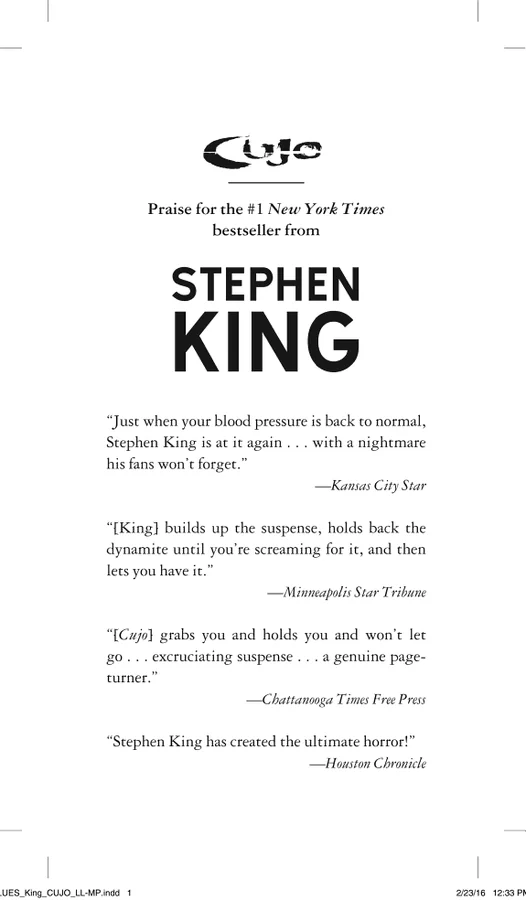
Stephen King’s *Cujo* offers a stark, visceral descent into primal terror, largely sidestepping supernatural machinations for a more grounded, terrifying scenario. The novel excels in its claustrophobic atmosphere, effectively trapping the reader alongside Donna Trenton and her son Tad within the confines of their broken-down Pinto. King’s ability to render the mundane terrifying—a car, a dog, a summer heatwave—is on full display. The relentless physical and psychological pressure cooker King creates is palpable. However, the narrative occasionally falters in its pacing, particularly in the prolonged middle sections where the sheer endurance of the siege can feel repetitive. The character of Joe Trenton, while serving a narrative purpose, feels somewhat underdeveloped compared to Donna’s harrowing ordeal. A particularly effective passage is the detailed description of Cujo’s physical deterioration and the increasing evidence of his rabid state, making the horror undeniably real. It’s a grim, effective piece of survival horror that showcases King’s talent for situational dread.
*Cujo* is a masterclass in sustained tension, even if its narrative arc occasionally slackens.
📝 Description
81
Stephen King's 1981 novel *Cujo* traps a family in a car with a rabid dog.
Stephen King's 1981 novel *Cujo* chronicles the harrowing ordeal of the Trenton family, trapped in their Ford Pinto by a rabid St. Bernard. While appearing as a straightforward horror story about a beloved pet turned monster, the book functions as an allegory for the collapse of domestic security and the intrusion of primal chaos into everyday life.
The narrative methodically builds suspense, concentrating on the physical and psychological confinement of its characters, particularly Donna Trenton. Their world constricts to the suffocating space of the car. The story examines themes of powerlessness, the precariousness of safety, and the chilling realization that those meant to protect can become agents of destruction. It is a stark look at survival against an overwhelming, instinctual threat.
This work appeals to readers who enjoy psychological horror that dissects the unraveling of the ordinary. It is for those who value King's earlier, more grounded writing style, before his stories leaned more heavily into the overtly supernatural. The book suits individuals who find terror not just in the monstrous, but in the plausible corruption of the familiar and the stark realities of confronting pure, instinct driven aggression.
Published in 1981, *Cujo* appeared during a period when horror fiction increasingly focused on visceral terror and anxieties rooted in domestic settings, moving away from earlier gothic or purely supernatural narratives. King's novel tapped into a cultural undercurrent of unease about personal safety and the unpredictable nature of the world. The story's depiction of an ordinary situation escalating into extreme violence reflects a broader societal concern with the potential for everyday life to unravel, mirroring anxieties about the breakdown of social order and the emergence of uncontrollable, instinctual forces.
💡 Why Read This Book?
• Understand the terrifying transformation of the familiar into the monstrous, as seen in Cujo's descent from beloved pet to rabid killer, illustrating how easily order can collapse. • Experience the extreme psychological pressure of confinement and helplessness, specifically through Donna Trenton's ordeal in the 1980 Ford Pinto, a microcosm of survival. • Analyze King's early narrative style focusing on palpable, grounded horror rather than overt supernatural elements, as demonstrated in the meticulous depiction of rabies' effects in 1981.
⭐ Reader Reviews
Honest opinions from readers who have explored this book.
❓ Frequently Asked Questions
What specific event leads to Cujo's transformation?
Cujo contracts rabies after being bitten by a rabid bat. This bite initiates the rapid physical and behavioral changes that turn him into a vicious, deadly animal.
Where does the primary action of Cujo take place?
The main setting is the claustrophobic interior of a broken-down 1980 Ford Pinto, where Donna and Tad Trenton are trapped, with Cujo lurking just outside.
What is the significance of the name Cujo?
Cujo is the name of the St. Bernard before he contracts rabies. The name itself, while seemingly innocuous, becomes a chilling reminder of the dog's former gentle nature.
How does the book Cujo differ from typical Stephen King stories?
Unlike many of King's more supernatural tales, *Cujo* relies on a grounded, realistic horror derived from animalistic rage and the physical decay caused by rabies.
When was Stephen King's novel Cujo first published?
Stephen King's novel *Cujo* was first published in 1981.
What are the main themes explored in Cujo?
The novel explores themes of domestic terror, the fragility of safety, primal instinct versus domestication, and a mother's fierce will to protect her child.
🔮 Key Themes & Symbolism
The Corrupted Familiar
The novel masterfully explores the terror that arises when the familiar and trusted turns malevolent. Cujo, the once-beloved family pet, becomes a symbol of this corruption. His transformation, driven by rabies, illustrates how instinctual, primal forces can override learned behavior and affection. This theme taps into a deep-seated human fear: that the things we rely on for comfort and security can become sources of extreme danger. The breakdown of Cujo mirrors the potential fragility of order and the unpredictable nature of the wild lurking beneath domestication, presenting a stark visual of a broken covenant.
Confinement and Survival
The narrative's core tension is built around the physical and psychological confinement experienced by Donna and Tad Trenton. Their 1980 Ford Pinto transforms from a mode of transport into a suffocating prison, a desperate refuge against the predatory presence of Cujo. This extreme isolation amplifies their vulnerability and forces a primal focus on survival. The limited space and dwindling resources underscore the precariousness of their situation, turning everyday objects and the oppressive summer heat into instruments of psychological torment. It's a potent depiction of being trapped, stripped of agency, and forced to confront raw survival instincts.
Primal Rage vs. Domesticity
At its heart, *Cujo* is a battle between primal, instinctual rage and the concept of domesticity. The St. Bernard, a breed often associated with loyalty and companionship, becomes the vessel for pure, unreasoning aggression. The rabies virus acts as the catalyst, stripping away Cujo's learned behaviors and unleashing a raw, territorial fury. This conflict highlights the thin line between animal instinct and the socialized behaviors of domesticated creatures. The novel uses this to explore the inherent wildness that can lie dormant, a potent reminder of the untamed forces that can surface unpredictably, challenging the illusion of complete control.
The Fragility of Sanctuary
King uses the Trenton family's farm and home as a setting that should represent safety, only to have it violently breached. The narrative systematically dismantles the idea of domestic sanctuary, showing how external threats, like a rabid animal, can shatter the illusion of security. The farm, isolated and seemingly peaceful, becomes the stage for a horrific siege. This subversion of the safe haven trope plays on fundamental anxieties about vulnerability within our most personal spaces. The breakdown of this sanctuary forces the characters into a desperate fight for survival, highlighting how easily perceived safety can evaporate.
💬 Memorable Quotes
Direct passages from the work, attributed to the author.
“The world was a bad place, and it was getting worse.”
— This sentiment, reflecting Donna Trenton's growing despair, expresses the novel's bleak outlook. It speaks to the pervasive sense of unease and the breakdown of perceived safety, where even familiar environments become threatening, mirroring anxieties about societal decay.
“Rabies was a bad thing. It was a terrible thing.”
— This simple, stark observation from the text emphasizes the visceral horror and physical reality of the disease. It grounds the narrative in a tangible, biological threat, highlighting the terrifying physical deterioration and mental corruption that rabies inflicts.
“The Pinto was a tomb.”
— This powerful metaphor describes the Trenton's car during their ordeal. It perfectly captures the suffocating, inescapable nature of their confinement, transforming a symbol of freedom and travel into a deadly, claustrophobic prison.
“He was a monster, and she knew it.”
— This realization by Donna signifies the complete severance of Cujo's former identity as a pet. It marks the point where he is perceived not as a sick animal, but as a pure, unadulterated force of destruction.
“The dog had broken her.”
— This interpretation speaks to the profound psychological toll the siege takes on Donna. It suggests a near-breaking point, where the relentless terror and physical exhaustion threaten to shatter her spirit entirely.
🌙 Esoteric Significance
Tradition
While not explicitly an esoteric text, *Cujo* can be interpreted through the lens of primal forces and the breakdown of the mundane veil. It speaks to a Gnostic understanding of the material world as potentially corruptible and the 'demiurge' (here, the rabies virus) as a force that twists creation into something monstrous. The dog's transformation can be seen as the manifestation of a chaotic, unaligned energy disrupting the ordered (domesticated) sphere, a concept familiar in discussions of shadow aspects and the uncontrolled id.
Symbolism
Cujo himself symbolizes the corrupted familiar, the sacred animal (often a guardian or guide in mythic traditions) turned into a predatory force. The 1980 Ford Pinto represents the fragile, man-made sanctuary that fails under duress, becoming a tomb rather than a refuge. The oppressive summer heat functions as an external force, amplifying the internal decay and pressure, akin to alchemical processes where heat is used to transmute or break down substances.
Modern Relevance
Contemporary horror literature and film continue to explore the themes of corrupted innocence and the terror of the familiar. Thinkers interested in the psychology of fear, the nature of animal consciousness, and the breakdown of societal order find *Cujo* a compelling case study. Its raw depiction of survival against an instinct-driven antagonist speaks to modern explorations of humanity's relationship with the natural world and the primal fears that lurk beneath the surface of civilization.
👥 Who Should Read This Book
• Readers interested in psychological horror that grounds terror in realistic scenarios, rather than overt supernatural elements. • Students of Stephen King's early works, examining his development of suspense and character under extreme duress. • Individuals fascinated by the darker aspects of animal behavior and the primal fear of the corrupted familiar.
📜 Historical Context
Published in 1981, Stephen King's *Cujo* arrived at a zenith of his early career, following the success of *Carrie* (1974), *'Salem's Lot* (1975), and *The Shining* (1977). The novel tapped into a contemporary fascination with visceral, grounded horror, moving away from the more gothic or supernatural elements that had dominated earlier decades of the genre. While King was establishing himself as a master of modern horror, authors like Dean Koontz were also exploring similar themes of everyday terror and domestic anxieties. *Cujo*'s reception was strong, cementing King's reputation, though some critics noted its relentless bleakness compared to more overtly allegorical works. The novel's focus on animalistic terror and the breakdown of domestic safety resonated with a public grappling with anxieties about unpredictable violence and the perceived erosion of security in the late 20th century.
📔 Journal Prompts
The rabid Cujo's relentless focus on the Pinto.
Donna Trenton's maternal ferocity within the car.
The oppressive summer heat as a narrative element.
The stark contrast between Cujo the pet and Cujo the monster.
The isolation of the Trenton farm.
🗂️ Glossary
Rabies
A viral disease that infects the nervous system of mammals, causing aggression, hydrophobia, and paralysis. In *Cujo*, it is the catalyst for the dog's transformation into a deadly predator.
St. Bernard
A breed of large working dog originating in the Swiss Alps, known for its gentle temperament and historical use as a rescue dog. In the novel, this breed's characteristics are horrifically subverted.
Ford Pinto
A subcompact car produced by Ford from 1971 to 1980. In the novel, a malfunctioning 1980 model becomes the central site of confinement and terror.
Domesticated Wild
The concept explored in the novel where an animal, previously tamed and integrated into human life, reverts to its primal, untamed instincts.
Siege Narrative
A story structure where characters are trapped in a confined space, defending against an external threat. *Cujo* is a prime example, focusing on the Trentons' entrapment.
Primal Fear
A fundamental, instinctual fear rooted in basic survival instincts, such as the fear of predation, confinement, or the unknown.
Sanctuary
A place of refuge or safety. The novel explores the terrifying violation of domestic sanctuary when the farm and car become dangerous instead of secure.
This book appears in 1 collection
🔮 Readers Also Liked
Browse all →








From the “Demonology” Collection
View all →







More Free Occult Philosophy Books
View all →