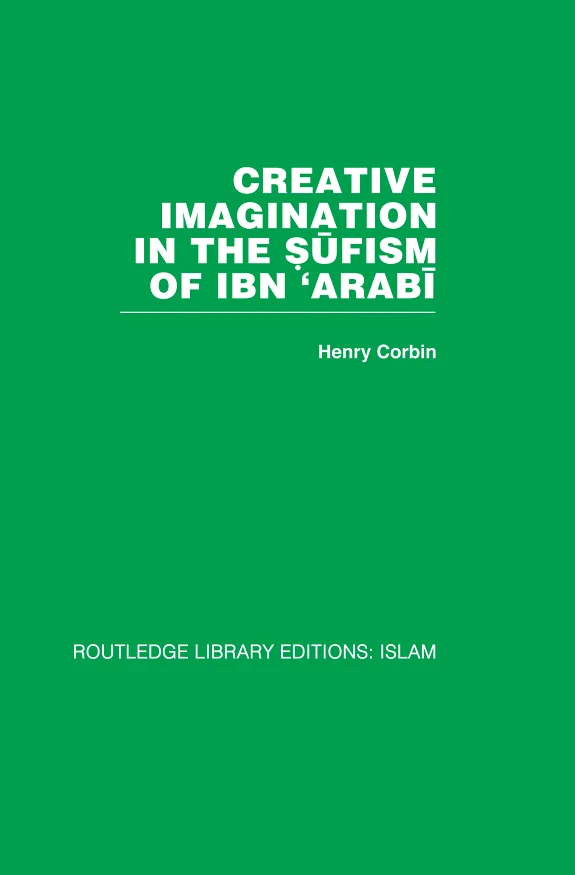
Creative Imagination in the Sufism of Ibn 'Arabi
 81
81

Creative Imagination in the Sufism of Ibn 'Arabi
Henry Corbin's "Creative Imagination in the Sufism of Ibn 'Arabi" offers a vital corrective to Western misapprehensions of Islamic spirituality. Corbin compellingly argues that for figures like Ibn 'Arabi, imagination was not a flight from reality but the very organ of spiritual perception, enabling access to the 'alam al-mithal,' or the imaginal world. He masterfully highlights how philosophy and religion were unified in Ibn 'Arabi's thought, a stark contrast to the schism often seen in Western intellectual history. A particular strength lies in Corbin's detailed exploration of Ibn 'Arabi's cosmology and the role of the prophet-saints. While the academic density can be challenging for newcomers to Corbin's dense prose, the reward is a profound understanding of a mystical framework where the inner vision is paramount. The book provides essential context for appreciating the sophistication of Sufi metaphysics. Corbin's analysis offers a singular lens on the profound integration of knowledge and gnosis within Islamic esoteric traditions.
📝 Description
81
Henry Corbin's 1977 work investigates Ibn 'Arabi's concept of creative imagination in Sufism.
First translated into English in 2013, Henry Corbin's study meticulously examines the role of imagination in the Sufi tradition, focusing on the teachings of the 13th-century mystic Ibn 'Arabi. The book differentiates between the exoteric, legalistic aspects of Islam and its interior, spiritual dimensions. Corbin argues that Ibn 'Arabi understood creative imagination not as simple fantasy, but as a crucial faculty for the mystic. This faculty allows for the perception of divine realities and the 'imaginal' realm, populated by intermediary beings and landscapes. Corbin situates Ibn 'Arabi's thought within the intellectual milieu of 12th and 13th-century Islamic philosophy, a period where religious and philosophical discourse flourished across regions from Andalusia to Persia, before a later separation occurred in Western thought. The work is valuable for scholars of Islamic philosophy, comparative religion, and esoteric studies, as well as for serious practitioners of Sufism and those interested in the philosophical underpinnings of mystical experience.
This book engages with the rich tradition of Islamic mysticism, Sufism, and specifically the complex thought of Ibn 'Arabi, a central figure often referred to as the 'Great Master.' Corbin's work is part of a broader scholarly effort to understand the esoteric dimensions of Islam, moving beyond purely legalistic or historical interpretations. It highlights the concept of the imaginal, a reality accessible through spiritual discipline and imaginative faculty, which plays a significant role in various mystical traditions worldwide. The study places Ibn 'Arabi's ideas within the historical context of Islamic intellectual history, underscoring the continuity of esoteric thought.
💡 Why Read This Book?
• Gain insight into Ibn 'Arabi's concept of the 'imaginal world' ('alam al-mithal'), a key element in understanding his complex cosmology and the nature of divine perception. • Understand the historical nexus of philosophy and religion in the medieval Islamic world, particularly the 13th century, as Corbin contrasts it with Western intellectual traditions. • Discover the specific function of 'creative imagination' as an esoteric faculty for spiritual knowledge, distinct from mere fantasy or rational thought.
⭐ Reader Reviews
Honest opinions from readers who have explored this book.
❓ Frequently Asked Questions
When was Henry Corbin's "Creative Imagination in the Sufism of Ibn 'Arabi" first published in English?
The English translation of Henry Corbin's seminal work was first published on October 18, 2013, making its profound insights accessible to a wider Anglophone audience.
What is the primary focus of Corbin's analysis of Ibn 'Arabi?
Corbin focuses on the role of creative imagination in Ibn 'Arabi's Sufism, exploring how it functions as a spiritual faculty for perceiving divine realities and the imaginal realm.
How does Corbin differentiate between exoteric and esoteric Islam in this book?
Corbin distinguishes between the outward, legalistic aspects of Islam (exoteric) and its deeper, inner spiritual and philosophical dimensions (esoteric), highlighting Ibn 'Arabi's focus on the latter.
What is the 'alam al-mithal' as discussed by Corbin?
The 'alam al-mithal,' or the imaginal world, is a key concept referring to an intermediary realm of symbolic forms and spiritual landscapes that mystics can perceive through creative imagination.
What historical period does Corbin's study of Ibn 'Arabi primarily address?
Corbin's study addresses the intellectual and spiritual climate of the medieval Islamic world, particularly the 12th and 13th centuries, focusing on the Andalusian mystic Ibn 'Arabi.
Does the book include original translations of Sufi texts?
Yes, the volume features a valuable section of notes and appendices containing original translations of numerous Sufi treatises relevant to the themes discussed.
🔮 Key Themes & Symbolism
The Imaginal Realm
Corbin elucidates Ibn 'Arabi's concept of the 'alam al-mithal,' a visionary landscape accessible through the creative imagination. This realm is not a mere psychological construct but a real, albeit spiritual, dimension where divine truths are symbolized and experienced. It bridges the gap between the sensible world and the purely intellectual, serving as a crucial stage in the mystic's journey toward divine knowledge.
Philosophy and Religion Unified
The work emphasizes that in the intellectual milieu surrounding Ibn 'Arabi in the 13th century, philosophy and religion were not seen as conflicting forces but as integrated paths to understanding ultimate reality. Corbin contrasts this with the Western historical trajectory, highlighting the unique synthesis achieved in Islamic esoteric thought where metaphysical speculation directly informed spiritual practice.
Creative Imagination as Spiritual Faculty
Corbin redefines imagination not as a frivolous capacity but as a potent spiritual organ. He argues that for Ibn 'Arabi, the 'aql al-muthayyal' (creative imagination) is essential for the visionary apprehension of spiritual realities, enabling the mystic to receive and interpret divine revelations and to read through the symbolic universe.
Ibn 'Arabi's Cosmology
The book offers a detailed exposition of Ibn 'Arabi's intricate cosmology, which includes a hierarchical understanding of existence, the role of divine names and attributes, and the journey of the soul. Corbin guides the reader through this complex system, showing how the creative imagination is fundamental to its very structure and understanding.
💬 Memorable Quotes
Direct passages from the work, attributed to the author.
“In the Islamic world, during this period, philosophy and religion were inseparably linked.”
— This statement underscores Corbin's historical argument, differentiating the medieval Islamic intellectual landscape from the later Western separation of reason and faith, emphasizing their synthesis in figures like Ibn 'Arabi.
“The 'alam al-mithal' is a world of symbolic forms and spiritual landscapes.”
— This defines the crucial concept of the imaginal world, presented by Corbin as a tangible, albeit spiritual, dimension that mystics can access, shaping their understanding of divine reality.
“Corbin analyzes the function of the creative imagination ('aql al-muthayyal').”
— This points to the book's focus on a specific term and concept within Sufi psychology, emphasizing imagination's active role in spiritual cognition rather than passive reception.
“The notes and appendices include original translations of numerous Sufi treatises.”
— This factual statement highlights the scholarly apparatus of the book, indicating the inclusion of primary source material for readers seeking deeper engagement with the texts.
💡 Key Ideas
Editorial paraphrase of the work's core concepts — not direct quotes.
The imagination is not a faculty of illusion, but the organ of the soul by which the intelligible realities are perceived.
This paraphrased concept highlights Corbin's central thesis: imagination in Sufism, particularly for Ibn 'Arabi, functions as a divine tool for spiritual perception, not a source of delusion.
🌙 Esoteric Significance
Tradition
This work is firmly situated within the esoteric lineage of Islamic Sufism, specifically the 'Gnosis of the Prophets' and the philosophical Sufism pioneered by Ibn 'Arabi. Corbin connects this to broader Hermetic and Neoplatonic currents that influenced Islamic thought, though his primary focus remains on the unique articulation within the Persian and Arabic traditions.
Symbolism
Central symbols explored include the 'Heart' as the locus of divine perception, the 'Imaginal World' ('alam al-mithal') as a field of spiritual forms, and the 'Prophet-Saint' as an archetype of spiritual attainment. These symbols function not merely as allegories but as keys to understanding the structure of reality and the human soul's journey.
Modern Relevance
Contemporary thinkers in fields ranging from comparative mysticism to depth psychology and even speculative fiction draw upon Corbin's interpretation of Ibn 'Arabi. His work on the imaginal realm and the creative power of imagination continues to inspire those exploring consciousness, spirituality, and the nature of reality beyond empirical constraints.
👥 Who Should Read This Book
• Students of Islamic philosophy and Sufism seeking a nuanced understanding of Ibn 'Arabi's thought, particularly his integration of imagination and metaphysics. • Scholars of comparative religion and esoteric traditions interested in the historical relationship between philosophy and religion in the medieval Islamic world. • Mystics and spiritual seekers who wish to explore the concept of the imaginal realm and the role of creative imagination in spiritual perception.
📜 Historical Context
Henry Corbin's study of Ibn 'Arabi emerges from mid-20th century scholarship, a period marked by a renewed Western interest in Islamic philosophy and mysticism, often through the lens of comparative religion and phenomenology. Corbin was a leading figure in this field, alongside scholars like Louis Massignon. This work was written against the backdrop of post-colonial intellectual currents and a desire to understand non-Western spiritual traditions on their own terms. Corbin's distinct contribution was his emphasis on the imaginative and visionary aspects of Sufism, challenging more rationalist or legalistic interpretations. The reception of Ibn 'Arabi himself has varied; while revered by many Sufis, his philosophical system also faced criticism and scrutiny from more orthodox Islamic scholars throughout history.
📔 Journal Prompts
The nature of the 'alam al-mithal' as a perceived reality.
Ibn 'Arabi's synthesis of philosophy and religion.
The function of creative imagination in spiritual insight.
Contrasting Western and Islamic conceptions of the spiritual path.
The role of symbolic landscapes in mystical experience.
🗂️ Glossary
Sufism
The mystical dimension of Islam, focused on direct experience of God and the purification of the soul through various spiritual practices and disciplines.
Ibn 'Arabi
A renowned Andalusian mystic and philosopher (1165-1240) whose vast body of work, known as 'the greatest master,' profoundly influenced subsequent Sufi thought and Islamic metaphysics.
'alam al-mithal'
The imaginal world; a visionary, intermediary field of symbolic forms and spiritual realities that is perceived through creative imagination, bridging the sensible and the purely intelligible.
Creative Imagination
In Corbin's interpretation of Ibn 'Arabi, this is not mere fantasy but a spiritual faculty ('aql al-muthayyal') capable of perceiving divine realities and the structures of the imaginal realm.
Exoteric
Pertaining to the outward, literal, or commonly understood aspects of a religion or teaching, often related to law and ritual.
Esoteric
Pertaining to the inner, hidden, or mystical meaning of a religion or teaching, accessible to initiated or spiritually discerning individuals.
Gnosis
Spiritual knowledge or insight, often considered direct, intuitive, and salvific, particularly in mystical traditions.
This book appears in 1 collection
🔮 Readers Also Liked
Browse all →









From the “Sufism” Collection
View all →





More Free Occult Philosophy Books
View all →