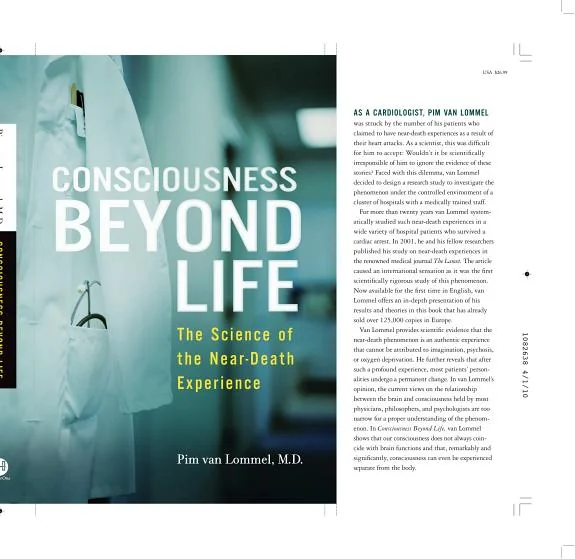
Consciousness Beyond Life
 83
83

Consciousness Beyond Life
Pim van Lommel’s extensive study, Consciousness Beyond Life, offers a rigorously documented exploration of near-death experiences, moving beyond mere anecdote. His meticulous 15-year prospective study of cardiac arrest survivors provides a substantial dataset that challenges conventional materialist explanations for consciousness. The strength of the book lies in its empirical grounding; van Lommel, a cardiologist, applies medical research standards to a topic often dismissed by empirical science. He presents patient accounts alongside physiological data, a crucial step in legitimizing NDE research. A limitation, however, is the inherent difficulty in definitively proving an immaterial consciousness from observable data alone. While the study is compelling, the interpretation of the data remains open to debate within scientific circles. The detailed analysis of specific patient experiences, such as the phenomenon of a "life review" experienced during cardiac arrest, is particularly striking. Van Lommel's work is a significant, evidence-based contribution to the study of consciousness, though it will likely continue to provoke discussion rather than settle it.
📝 Description
83
Pim van Lommel's 2010 book details a 15-year study on near-death experiences.
Consciousness Beyond Life presents the results of a 15-year investigation by Dutch cardiologist Pim van Lommel into near-death experiences (NDEs). The study followed 344 cardiac arrest patients, documenting their subjective accounts and physiological states during these events. Van Lommel's work seeks to connect personal testimonies with scientific investigation, asking if consciousness can exist separate from a functioning brain.
This book is for individuals wanting a scientific look at phenomena often placed in spiritual or philosophical categories. Readers interested in parapsychology, thanatology, and the connections between medicine and consciousness studies will find it relevant. Those familiar with authors like Raymond Moody or Jeffrey Long will notice van Lommel's structured method, which offers a clinical perspective on earlier work.
This study enters the long tradition of exploring states of consciousness beyond ordinary waking awareness. While rooted in empirical medical research, van Lommel's findings engage with themes present in spiritualism and esoteric philosophy for centuries: the nature of the soul, the possibility of an afterlife, and the mind's potential to transcend the physical body. It stands as a modern attempt to reconcile anecdotal accounts of spiritual phenomena with scientific methods, a challenge faced by thinkers examining consciousness outside conventional materialistic frameworks.
💡 Why Read This Book?
• Gain an understanding of the scientific methodology applied to near-death experiences through Pim van Lommel's 15-year prospective study, offering a unique empirical approach to consciousness. • Explore the concept of "borderline experiences" and the "life review" phenomenon as detailed in the book, providing specific case analyses that go beyond general NDE descriptions. • Consider the implications of van Lommel's research for the mind-body problem, challenging established neuroscientific models and opening avenues for exploring consciousness independent of brain function.
⭐ Reader Reviews
Honest opinions from readers who have explored this book.
❓ Frequently Asked Questions
What is the primary research methodology used in Pim van Lommel's "Consciousness Beyond Life"?
The book details a 15-year prospective study of 344 cardiac arrest patients in Dutch hospitals. This method involved systematically observing and documenting patients' subjective experiences and physiological states during and after clinical death.
Does "Consciousness Beyond Life" offer scientific proof of an afterlife?
While the book presents compelling empirical evidence that challenges purely materialistic explanations of consciousness, it does not claim to offer definitive scientific proof of an afterlife. It focuses on the persistence of consciousness independent of brain function.
What are "borderline experiences" as discussed by Pim van Lommel?
Borderline experiences, in the context of the book, refer to the subjective phenomena reported by patients during cardiac arrest. These include out-of-body sensations, seeing a light, meeting deceased relatives, and life reviews, occurring when brain activity is minimal or absent.
How does "Consciousness Beyond Life" compare to other books on near-death experiences?
Unlike many books that rely on anecdotal accounts, van Lommel's work is based on a long-term, systematic scientific study. It offers a cardiologist's perspective and detailed physiological correlations, distinguishing it from earlier works by authors like Raymond Moody.
What is the "life review" phenomenon described in the book?
The "life review" is a common NDE reported by patients where they experience a rapid, comprehensive review of their entire life, often with an assessment of their actions and their impact on others. Van Lommel analyzes these accounts scientifically.
When was Pim van Lommel's "Consciousness Beyond Life" first published?
The book "Consciousness Beyond Life" by Pim van Lommel was first published in Dutch in 2007 and the English translation, which gained international attention, was released on May 21, 2010.
🔮 Key Themes & Symbolism
Empirical Study of NDEs
The core of the book is van Lommel's 15-year prospective study involving 344 cardiac arrest patients. This systematic approach, tracking patients from the moment of cardiac arrest through their recovery, aims to provide objective data on near-death experiences. It moves beyond isolated anecdotes to build a statistically significant body of evidence, examining commonalities in subjective reports and correlating them with physiological states, thereby attempting to establish a scientific basis for exploring consciousness beyond the physical brain.
The Persistence of Consciousness
Van Lommel challenges the prevailing neuroscientific view that consciousness is solely an emergent property of the brain. His research presents instances where patients report complex, coherent experiences during periods of profound physiological shutdown, including minimal or absent brain activity. The book posits that consciousness may have an existence independent of the physical body, suggesting that the brain might act more as a receiver or filter for consciousness rather than its sole generator.
Borderline Experiences & Life Review
The book meticulously details the phenomena patients report during clinical death, categorized as "borderline experiences." Prominent among these is the "life review," a comprehensive, rapid reliving of one's life often accompanied by an ethical or emotional evaluation. Van Lommel analyzes these profound subjective events, exploring their consistency across different individuals and their potential implications for our understanding of life, death, and personal identity.
Critique of Materialism
Consciousness Beyond Life engages directly with the materialist paradigm in science, which asserts that only physical matter is real and that consciousness is a byproduct of brain activity. Van Lommel argues that the data from NDEs cannot be fully explained by current materialistic models. He suggests that the experiences, especially those involving enhanced perception or clear insights, indicate that consciousness may operate in a non-physical dimension.
💬 Memorable Quotes
Direct passages from the work, attributed to the author.
“The border experiences are not hallucinations.”
— This statement from van Lommel emphasizes his scientific stance. He argues that the detailed, consistent, and often transformative accounts of near-death experiences from his study cannot be dismissed as mere hallucinations or products of a dying brain, suggesting a deeper reality to these phenomena.
“The body is not the source of consciousness, but possibly a receiver.”
— This core concept from the book suggests a radical shift in perspective. Instead of consciousness being generated by the brain, van Lommel proposes the brain might filter or tune into a broader field of consciousness, allowing for experiences like out-of-body states.
“The life review provides a profound ethical insight.”
— Van Lommel highlights the common NDE phenomenon of reliving one's life, noting that it often includes an objective, emotional perspective, as if seeing oneself from the outside. This aspect offers a unique ethical dimension to the experience.
“The study followed 344 patients over 15 years.”
— This factual statement underscores the book's scientific rigor. The long-term, large-scale nature of the study provides a robust dataset for analyzing near-death experiences, distinguishing it from anecdotal collections and lending credibility to its findings.
“NDEs are not related to psychological factors or medication.”
— This interpretation addresses a common skeptical argument. Van Lommel asserts that his research controlled for factors like medication, psychological state, or oxygen deprivation, finding that these did not adequately explain the depth and nature of the reported near-death experiences.
🌙 Esoteric Significance
Tradition
While not explicitly tied to a single esoteric lineage like Kabbalah or Theosophy, van Lommel's work speaks to Gnostic and Hermetic ideas concerning the soul's independence from the physical body. It aligns with concepts of a non-local consciousness that predates the body and survives its dissolution. The book offers a modern, scientific lens through which to view ancient metaphysical propositions about the nature of reality and the self, providing empirical support for notions previously confined to esoteric philosophy and mystical experience.
Symbolism
The primary "symbol" explored is consciousness itself, presented not as an epiphenomenon of brain activity but as a fundamental aspect of existence. The "border experiences" – such as the light, the tunnel, and the life review – function as recurring motifs or symbols of transition and revelation. The concept of the "receiver" (brain) versus the "transmitted signal" (consciousness) can be seen as a symbolic representation of the dualistic nature often explored in esoteric thought: the material and the immaterial.
Modern Relevance
Van Lommel's research continues to influence contemporary discussions in consciousness studies, transpersonal psychology, and fields exploring the intersection of science and spirituality. Thinkers and researchers investigating altered states of consciousness, quantum consciousness theories, and the philosophical implications of NDEs frequently cite his work. His findings provide a crucial empirical anchor for modern spiritual inquiry, informing practices and theories that seek to understand consciousness beyond its physical manifestations.
👥 Who Should Read This Book
• Individuals interested in scientific investigations into consciousness and the possibility of survival beyond physical death, seeking evidence beyond anecdotal accounts. • Medical professionals and researchers in fields such as neurology, psychology, and thanatology, who are open to challenging established paradigms regarding the mind-body connection. • Readers familiar with near-death experience literature, such as works by Raymond Moody or Jeffrey Long, who want to engage with a comprehensive, long-term clinical study offering a unique perspective.
📜 Historical Context
Published in English in 2010, Pim van Lommel's "Consciousness Beyond Life" arrived at a time when the scientific study of consciousness was increasingly sophisticated, yet still largely dominated by materialist neuroscience. The book built upon earlier work by figures like Raymond Moody, who popularized the concept of near-death experiences (NDEs) in the 1970s. Van Lommel's contribution was its rigorous, prospective, longitudinal research design, tracking 344 cardiac arrest patients over 15 years. This approach distinguished it from retrospective studies and aimed to provide empirical data that could challenge the prevailing mechanistic views of consciousness. While the field of parapsychology had existed for decades, van Lommel's status as a cardiologist lent significant weight to his findings within medical and scientific circles, provoking debate among researchers who adhered to strict physicalist paradigms.
📔 Journal Prompts
The concept of consciousness as a 'receiver' rather than a generator.
The recurring themes within 'borderline experiences' across different patients.
The implications of the 'life review' for personal ethical understanding.
The challenge van Lommel's findings pose to purely materialist explanations of consciousness.
The potential for the brain to filter consciousness, as proposed by van Lommel.
🗂️ Glossary
Near-Death Experience (NDE)
A profound personal experience associated with being close to death, often including phenomena like out-of-body sensations, seeing a light, and a life review.
Consciousness Beyond Life
The central thesis of van Lommel's work, proposing that consciousness can exist and remain coherent independently of a functioning physical brain, particularly during clinical death.
Borderline Experience
A term used by van Lommel to describe the subjective phenomena reported by patients during cardiac arrest or other critical medical events.
Life Review
A common component of NDEs where individuals experience a rapid, comprehensive recollection and often an evaluation of their entire life.
Prospective Study
A research design where subjects are recruited and followed forward in time, observing outcomes as they occur, as opposed to retrospective studies looking back at past events.
Materialism
A philosophical stance asserting that consciousness is solely a product of physical matter and brain activity, with no independent existence.
Out-of-Body Experience (OBE)
A sensation of floating outside one's physical body and being able to perceive events from a detached perspective, often reported during NDEs.
This book appears in 1 collection
🔮 Readers Also Liked
Browse all →









From the “Out-of-Body Experience” Collection
View all →








More Free Occult Philosophy Books
View all →