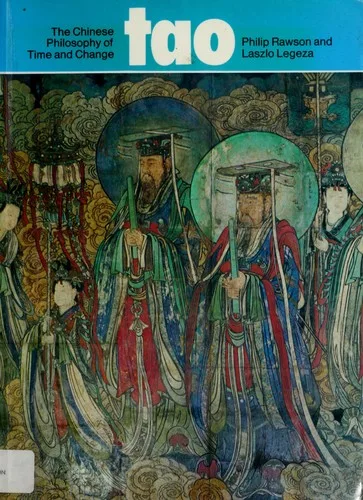
Tao
 72
72

Tao
Rawson and Legeza’s *Tao* offers a scholarly yet accessible examination of a concept central to Eastern thought. The authors succeed in presenting the Tao not as a static dogma, but as a dynamic, pervasive force. Their detailed exposition of the interconnectedness between the Tao and phenomena like Wu Wei is particularly strong, providing a clear framework for understanding non-interference as an active principle. However, the sheer depth of the subject matter, especially when delving into later philosophical interpretations, can occasionally feel dense for the uninitiated. A passage discussing the Tao as the mother of the myriad things, from which all arise and to which all return, effectively encapsulates the work's core argument about cosmic origin and return. This is a valuable resource for those seeking rigorous study of the Tao.
📝 Description
72
Published in 1977, this volume offers a detailed look at the Tao.
This book examines the Tao, a central concept in Chinese philosophy and spirituality. It goes beyond simple explanations to discuss the Tao's role as the fundamental principle and the source of all existence, as well as the natural order of the universe. The authors intend to show how this ancient idea was understood and put into practice in different times and places.
The work is for dedicated students of Eastern philosophy, comparative religion, and esoteric traditions. It will be especially useful for those wanting a deeper understanding of Taoism than introductory books usually provide. Readers interested in the philosophical basis of meditation, ethical frameworks, and worldviews connected to the Tao will find plenty of valuable information. The book considers the Tao's historical development in China, from its early philosophical roots to its place in religious and mystical movements. It looks at the impact of important figures and texts, and how the understanding of the Tao changed over the centuries. The authors recognize the difficulties in translating and grasping such a complex idea across different cultures and languages.
This work engages with the Taoist tradition, a significant stream within esoteric thought that emphasizes naturalness, spontaneity, and alignment with the underlying principles of reality. It connects the philosophical articulation of the Tao with its practical application in spiritual and ethical systems, drawing parallels to how other esoteric traditions seek harmony between the individual and the cosmos. The book's focus on the ineffable source and the natural order resonates with contemplative practices common in various mystical paths.
💡 Why Read This Book?
• Gain a nuanced understanding of Wu Wei, moving beyond 'doing nothing' to grasping its active, harmonious principle as detailed in the text's discussions of Lao Tzu. • Explore the philosophical underpinnings of Yin and Yang as presented in the book, understanding their role not just as opposites but as essential complementary forces in cosmic balance. • Discover the Tao's conception as the primordial 'mother' of all existence, a concept elaborated upon in the text, offering a unique perspective on creation and origin.
⭐ Reader Reviews
Honest opinions from readers who have explored this book.
❓ Frequently Asked Questions
When was Philip S. Rawson and Ireneus L. Legeza's "Tao" first published?
The original publication date for "Tao" by Philip S. Rawson and Ireneus L. Legeza is 1984. This edition provides foundational insights into Taoist philosophy.
What is the core concept of Taoism discussed in this book?
The book centers on the Tao, understood as the fundamental, ineffable principle and natural order of the universe, the source from which all things arise and to which they return.
Does the book cover practical applications of Taoist principles?
Yes, it explores practical applications, particularly through concepts like Wu Wei (non-action) and the principles of living in harmony with the natural flow of the Tao.
Who are the authors and what is their background?
The authors include Philip S. Rawson and Ireneus L. Legeza. Rawson was known for his work on Eastern art and philosophy, while Legeza was a scholar of Oriental studies.
Is this book suitable for beginners in philosophy?
While accessible, the book offers a scholarly depth. Beginners might find it beneficial to approach it with some prior interest in Eastern philosophy or alongside more introductory materials.
What is the significance of Yin and Yang as presented in the book?
The book presents Yin and Yang not merely as opposing forces but as complementary, interdependent elements crucial for the balance and dynamic functioning of the cosmos, as understood within Taoist thought.
🔮 Key Themes & Symbolism
The Ineffable Source
This work examines the Tao not as a deity or a fixed entity, but as the ultimate, ineffable reality that precedes and underlies all existence. It is the 'nameless' that gives rise to names, the formless that shapes forms. The book illustrates how this concept functions as the primordial source from which the 'ten thousand things' emerge, emphasizing its role as the absolute origin and ultimate destination in Taoist cosmology.
Wu Wei: Action in Non-Action
Central to the practical philosophy of the Tao is the concept of Wu Wei. This theme is explored not as passivity or laziness, but as effortless action aligned with the natural flow of the universe. The text demonstrates how understanding and practicing Wu Wei allows one to act with maximum efficacy by minimizing resistance and working in harmony with inherent patterns, a principle elucidated through historical and philosophical analysis.
Cosmic Balance: Yin and Yang
The dynamic interplay of Yin and Yang is presented as a fundamental mechanism through which the Tao manifests. This section details how these complementary, interdependent forces govern all phenomena, from the celestial to the mundane. The book highlights their role in cyclical change, creation, and the maintenance of universal equilibrium, providing a lens through which to perceive the inherent order within apparent chaos.
The Natural Order
The book emphasizes the Tao as the inherent, spontaneous order of nature itself. It argues that true wisdom lies in recognizing and aligning oneself with this natural order, rather than imposing artificial structures or desires. This theme underscores the Taoist ideal of living in accordance with the seasons, the rhythms of life, and the fundamental principles governing the cosmos.
💬 Memorable Quotes
Direct passages from the work, attributed to the author.
“The Tao that can be told is not the eternal Tao.”
— This opening statement from the *Tao Te Ching*, as explored in the book, underscores the ineffable nature of the ultimate principle. It signifies that any attempt to define or articulate the Tao through language or concepts will inherently fall short of its true, boundless reality.
“To be in the world is to be in the midst of the Great Flow.”
— This interpretation emphasizes the pervasive and dynamic nature of the Tao. It implies that all existence is part of a continuous, flowing process, and that understanding this inherent movement is key to navigating life effectively.
“Wu Wei means acting without forcing.”
— This concise definition captures the essence of Wu Wei. It is not about inaction but about acting in accordance with natural principles, avoiding struggle and artificial imposition, thereby achieving results with greater ease and harmony.
💡 Key Ideas
Editorial paraphrase of the work's core concepts — not direct quotes.
The myriad creatures rise from it; it gives them life; it shapes them; it perfects them; it makes them strong.
This passage highlights the Tao's role as the generative source and sustainer of all existence. It suggests a nurturing, formative power that not only brings things into being but also guides their development and empowers them to fulfill their potential.
The sage is a model for the world.
This quote points to the ideal of the enlightened individual within Taoism. The sage embodies the principles of the Tao, living in harmony and serving as an example for others to follow in their own pursuit of balance and wisdom.
🌙 Esoteric Significance
Tradition
This work primarily engages with the philosophical and mystical dimensions of Taoism, a foundational tradition within East Asian spirituality. While not strictly a Hermetic or Kabbalistic text, it explores universal esoteric principles of cosmic order, natural law, and spiritual cultivation that resonate with Western esoteric traditions. It offers a lens into a non-Western esoteric framework, examining concepts like the Tao as the ultimate reality and the practice of Wu Wei as a path to spiritual alignment.
Symbolism
Key symbols explored include the Tao itself, often represented abstractly or through paradoxical language, signifying the unnamable source. The Yin and Yang symbols are central, illustrating the dynamic, complementary forces that govern the universe, representing duality, balance, and cyclical change. The concept of the 'uncarved block' (Pu) is also significant, symbolizing original simplicity, naturalness, and the state of being before the imposition of artificial distinctions and desires.
Modern Relevance
Contemporary practitioners of mindfulness, meditation, and certain martial arts often draw implicitly or explicitly on Taoist principles discussed in works like this. Philosophers and spiritual seekers interested in non-dualistic thinking, ecological harmony, and alternative models of governance and societal organization find value in its exploration of natural order and effortless action. Thinkers in fields like complexity theory and systems thinking may also find parallels in the Tao's depiction of emergent order.
👥 Who Should Read This Book
• Students of comparative religion and philosophy seeking a deep dive into a foundational Eastern tradition, moving beyond introductory concepts. • Seekers of spiritual practices interested in understanding the philosophical underpinnings of mindfulness, balance, and living in harmony with natural rhythms. • Scholars of Chinese history and culture looking for a rigorous examination of the Tao's development and its impact on thought and society.
📜 Historical Context
Published in 1984, *Tao* by Rawson and Legeza emerged during a period of burgeoning Western interest in Eastern philosophies, particularly in the wake of the counterculture movements of the 1960s and 70s. This era saw a surge in translations and scholarly works attempting to bridge the gap between Western and Eastern thought. The book engaged with a rich intellectual landscape where figures like Alan Watts had already popularized Taoist ideas, albeit sometimes superficially. Rawson and Legeza's work, however, offered a more rigorous academic approach, situating the Tao within its historical Chinese context, from the foundational *Tao Te Ching* attributed to Lao Tzu to its influence on later schools. It provided a counterpoint to purely mystical or New Age interpretations, grounding the discussion in textual analysis and historical development, distinguishing it from more syncretic or devotional approaches to Eastern spirituality gaining traction at the time.
📔 Journal Prompts
The Tao as the 'mother' of all things: reflect on its generative power.
Wu Wei in daily actions: where can effortless action be applied?
The interplay of Yin and Yang: identify these forces in a recent experience.
The concept of the 'uncarved block' (Pu): how does it contrast with societal pressures?
The Tao's ineffability: what aspects of yourself resist simple definition?
🗂️ Glossary
Tao (Dao)
The fundamental, ineffable principle underlying all reality; the natural order of the universe; the 'Way'.
Wu Wei
Literally 'non-action' or 'effortless action.' Acting in accordance with the natural flow of things, without forcing or artificiality.
Yin
The feminine, passive, dark, cold, receptive principle in Taoist cosmology.
Yang
The masculine, active, light, hot, assertive principle in Taoist cosmology.
Te (De)
Virtue, power, or integrity that arises from living in accordance with the Tao.
Lao Tzu (Laozi)
The semi-legendary author of the *Tao Te Ching*, traditionally regarded as the founder of Taoism.
Tao Te Ching
The foundational text of Taoism, attributed to Lao Tzu, exploring the nature of the Tao and principles for living.
🔮 Readers Also Liked
Browse all →







More by Philip S. Rawson, Ireneus László Legeza, Philip Rawson and Laszlo Legeza
All books →
More Free Occult Philosophy Books
View all →