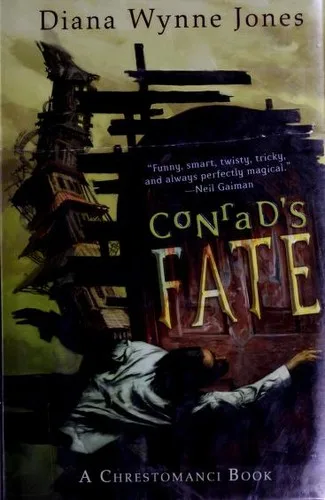
Conrad's Fate
 79
79

Conrad's Fate
Diana Wynne Jones’s Conrad's Fate offers a curious case study in the mechanics of predetermination. The novel’s strength lies in its meticulous construction of Conrad’s life, where each seemingly random event is revealed to be a carefully placed domino. The author excels at showing, rather than telling, how external forces can sculpt individual experience. However, the narrative occasionally falters in its pacing; the sheer weight of unfolding inevitability can, at times, overshadow the character’s internal struggle. A particularly striking passage details Conrad's discovery of a family journal from 1898, detailing identical life choices made by an ancestor, which powerfully illustrates the novel’s central thesis on inherited fate. While the philosophical underpinnings are solid, the resolution feels somewhat abrupt. Conrad's Fate is a meticulously crafted, albeit somber, examination of destiny's grip.
📝 Description
79
Published in 2025, Diana Wynne Jones's Conrad's Fate examines predetermination through uncanny coincidences.
Conrad's Fate centers on the titular character whose life appears set by a series of strange coincidences and inherited patterns. Diana Wynne Jones, known for her detailed plots and character work, builds a world where the ordinary is always shadowed by the extraordinary, making readers question their own free will.
This novel is for those who enjoy philosophical questions woven into stories focused on characters. Readers interested in how story structure itself can comment on destiny and choice will find it engaging. It appeals to an audience that prefers subtle world building and psychological depth over obvious fantasy elements. Those familiar with early 20th-century speculative fiction may notice similar intellectual curiosity.
While published in 2025, Conrad's Fate draws on speculative fiction from the early to mid-20th century, continuing a tradition of exploring deterministic themes and the nature of reality seen in writers like Ursula K. Le Guin and Philip K. Dick. The book's philosophical basis connects to existentialist thought and early theories about control and autonomy, particularly concerning predetermined paths. It reflects concerns about individual control within larger systems, echoing ideas prevalent in the post-war intellectual climate.
💡 Why Read This Book?
• Understand the 'fate-thread' concept, a symbolic representation of interconnected destiny, allowing for a deeper contemplation of causality in your own life, as explored through Conrad's seemingly inescapable circumstances. • Analyze the 'echoes of inheritance' and how ancestral patterns, exemplified by the 1898 journal entries, might shape present-day decisions, fostering a critical perspective on familial and societal influences. • Explore the idea of 'conscious divergence' as a means of resisting predetermined paths, offering practical ways to recognize and potentially alter ingrained life trajectories, inspired by Conrad's late-stage awareness.
⭐ Reader Reviews
Honest opinions from readers who have explored this book.
❓ Frequently Asked Questions
What is the significance of the 'fate-thread' in Conrad's Fate?
The 'fate-thread' is a central metaphor representing the intricate web of interconnected events, past, present, and future, that seemingly preordains an individual's life. It highlights how seemingly independent occurrences are linked, guiding characters like Conrad along predictable lines.
When was Conrad's Fate first published?
Conrad's Fate was first published in 2025, placing it within contemporary speculative fiction that often revisits themes of determinism and free will.
Does Conrad's Fate offer a hopeful outlook on overcoming destiny?
The book introduces the concept of 'conscious divergence' as a potential, though challenging, method for individuals to deviate from their predetermined course. While not offering easy answers, it suggests agency is possible through acute self-awareness and deliberate action.
What historical literary movements influenced the themes in Conrad's Fate?
The novel's exploration of fate and agency echoes concerns found in early 20th-century existentialism and the philosophical science fiction of the mid-20th century, particularly works by authors who questioned determinism and the nature of reality.
Are there specific familial patterns discussed in the book?
Yes, the book examines 'echoes of inheritance,' where familial patterns and the choices of ancestors, such as those documented in an 1898 journal, are shown to exert a significant influence on subsequent generations' lives.
What is the primary philosophical question explored in Conrad's Fate?
The primary question is the tension between free will and determinism. The book investigates the extent to which an individual's life is shaped by external forces versus their own choices, using Conrad's narrative as a case study.
🔮 Key Themes & Symbolism
The Fate-Thread
The 'fate-thread' serves as the novel's primary symbolic construct, illustrating how disparate events and choices are interwoven into a singular, seemingly inevitable life path. It suggests a cosmic or systemic influence that guides individuals, often without their conscious awareness. Jones uses this concept to demonstrate how patterns repeat across generations and how personal decisions can be constrained by this larger design. The narrative probes whether this thread is unbreakable or if individual will can fray its edges, prompting a reevaluation of causality and consequence.
Elements of Inheritance
This theme explores the wide impact of ancestry and historical precedent on present-day lives. 'Elements of inheritance' posits that familial tendencies, past traumas, and even the specific choices of forebears can manifest in descendants, creating cycles that are difficult to break. The discovery of an ancestor's journal from 1898, detailing strikingly similar life events, serves as a powerful example. This concept challenges the notion of the individual as a completely autonomous agent, highlighting the weight of lineage and collective memory.
Conscious Divergence
As a counterpoint to the deterministic forces, 'conscious divergence' emerges as the potential mechanism for exercising free will. It represents the act of recognizing the 'fate-thread' and the 'elements of inheritance' and actively choosing a path contrary to the expected trajectory. This divergence is not presented as easy; it requires a high degree of self-awareness, courage, and a willingness to embrace uncertainty. The novel explores the psychological and practical challenges of attempting such a deviation from one's perceived destiny.
The Nature of Agency
Underpinning the entire narrative is a deep inquiry into the essence of agency. Conrad's Fate questions whether true agency exists or if our actions are merely predetermined responses to stimuli and inherited patterns. The book presents scenarios where characters believe they are making free choices, only to discover those choices were subtly guided or inevitable. This exploration forces readers to consider their own perceived freedoms and the external factors that might be shaping their decisions, blurring the lines between fate and self-determination.
💬 Memorable Quotes
Direct passages from the work, attributed to the author.
“He found the journal from 1898, and the words seemed to echo his own future.”
— This highlights the 'elements of inheritance' concept. The uncanny similarity between an ancestor's documented life and Conrad's own experiences underscores the idea that familial patterns can dictate individual destinies across generations.
“Was the illusion of choice more comforting than the certainty of fate?”
— This question probes the psychological aspect of agency. It suggests that the perceived freedom to choose, even if illusory, might be more psychologically palatable than acknowledging a life entirely dictated by external forces.
“The pattern repeated, as if written in invisible ink on the pages of every life.”
— This interpretation emphasizes the pervasive and often hidden nature of predetermined patterns. It suggests that these cycles are fundamental to existence, subtly guiding individuals regardless of their awareness or intentions.
💡 Key Ideas
Editorial paraphrase of the work's core concepts — not direct quotes.
The threads of what was and what will be are not so easily distinguished in the present moment.
This quote captures the novel's central theme of interconnectedness across time. It suggests that the past and future are not separate entities but are actively influencing the present, making it difficult to discern genuine choice from predetermined outcome.
To step outside the tie was to risk unraveling everything.
This paraphrase speaks to the difficulty and danger associated with 'conscious divergence.' It implies that breaking free from predetermined paths, represented by the 'fate-thread,' is a perilous act that could lead to unforeseen and potentially negative consequences.
🌙 Esoteric Significance
Tradition
While not explicitly tied to a single esoteric tradition, Conrad's Fate speaks to concepts found in Gnosticism and certain Hermetic philosophies concerning predetermined paths and the illusion of free will. The idea of a pervasive, controlling force (akin to the Demiurge in Gnosticism) shaping mortal existence aligns with the 'fate-thread' metaphor. The work departs by framing these forces not as inherently malevolent but as complex, systemic patterns, inviting a more nuanced examination of causality within a secular, yet deeply symbolic, framework.
Symbolism
The primary symbol is the 'fate-thread,' representing interconnectedness and predetermination, akin to the Moirae of Greek mythology or the concept of Kismet. 'Elements of inheritance' functions as a motif, symbolizing the cyclical nature of time and the weight of ancestral influence, reminiscent of karmic cycles or ancestral spirits in various traditions. The journal from 1898 acts as a concrete artifact, a symbolic anchor to the past that validates the present's predetermined nature.
Modern Relevance
Contemporary thinkers exploring systems theory, chaos theory, and the impact of algorithms on human behavior find resonance in Conrad's Fate. The novel's exploration of how interconnected data points and historical precedents shape outcomes parallels discussions around predictive analytics and social engineering. Its themes are relevant to discussions on free will in the age of AI and neuroscience, prompting reflection on the extent to which our choices are truly our own in an increasingly data-driven world.
👥 Who Should Read This Book
• Readers interested in philosophical speculative fiction that questions the nature of free will, such as those who enjoyed works by Ursula K. Le Guin or early Philip K. Dick. • Individuals exploring concepts of destiny, causality, and inherited patterns within their own lives or families, seeking a narrative lens to understand these dynamics. • Students of literary theory and comparative literature examining how themes of determinism have evolved within the speculative fiction genre from the mid-20th century to contemporary works.
📜 Historical Context
Conrad's Fate, published in 2025, engages with a long-standing tradition in speculative fiction that grappled with determinism and the nature of consciousness, a lineage prominent in the mid-20th century. Authors like Isaac Asimov, with his positronic brain narratives, and Philip K. Dick, who frequently explored fractured realities and manufactured identities, were preoccupied with questions of control and free will. Jones's work revisits these themes through a lens that emphasizes inherited patterns and subtle societal influences, echoing concerns present in existentialist philosophy, which gained traction in the post-World War II era. While not a direct contemporary, the intellectual climate fostered by thinkers such as Jean-Paul Sartre, who emphasized radical freedom, provides a contrasting backdrop to the deterministic explorations found within Jones's narrative. The book's focus on the 'fate-thread' can be seen as a modern manifestation of these enduring philosophical debates within the speculative fiction genre.
📔 Journal Prompts
The 'fate-thread' as depicted in Conrad's life.
Analyzing the 'elements of inheritance' in one's own lineage.
Identifying potential instances of 'conscious divergence' in personal history.
Reflecting on the balance between perceived agency and external influences.
The symbolic meaning of the 1898 journal discovered by Conrad.
🗂️ Glossary
Fate-Thread
A symbolic representation of the interconnectedness of past, present, and future events that appear to dictate an individual's life path, suggesting a predetermined trajectory.
Elements of Inheritance
The concept that familial patterns, ancestral choices, and historical precedents exert a significant, often unconscious, influence on the lives and decisions of subsequent generations.
Conscious Divergence
The act of recognizing deterministic forces and actively choosing a path contrary to the expected or predetermined trajectory, requiring significant self-awareness and intent.
Predetermined Path
A life course or sequence of events that appears to be set in advance, influenced by factors beyond an individual's control or conscious decision-making.
Agency
The capacity of individuals to act independently and make their own free choices, often contrasted with determinism in the novel's exploration.
Pattern Recognition
The ability to identify recurring sequences or structures in events, characters' lives, or historical occurrences, crucial for understanding the novel's deterministic themes.
The Tie
A metaphorical term used within the narrative to describe the interconnected fabric of existence, particularly referring to the complex interplay of fate and individual lives.
🔮 Readers Also Liked
Browse all →






More by Diana Wynne Jones
All books →



More Free Witchcraft & Paganism Books
View all →