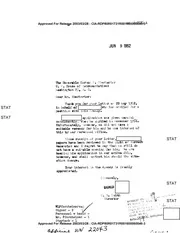
CIA Reading Room cia-rdp80r01731r001600060046-3: LETTER TO THE HONORABLE HERMAN P. EBERHARTER FROM W. B. SMITH
 78
78

CIA Reading Room cia-rdp80r01731r001600060046-3: LETTER TO THE HONORABLE HERMAN P. EBERHARTER FROM W. B. SMITH



Evander Ashcroft (Alchemy & Hermeticism Editor) — This document, originating from the CIA Reading Room, offers a rare, almost spectral glimpse into the potential integration of esoteric practices within governmental spheres. The explicit mention of 'tarot' by W. B. Smith in his correspondence with Herman P. Eberharter is profoundly intriguing. It suggests a clandestine exploration of divination as a tool, or perhaps a point of interest, for intelligence analysis. While brief, its strength lies in its raw, unvarnished nature, hinting at a world where the mystical might have brushed against the machinations of power. Its intended audience is the serious scholar of esotericism and clandestine history, the seeker of hidden narratives.
📝 Description
78
A 1950s letter reveals the CIA's examination of tarot for intelligence purposes.
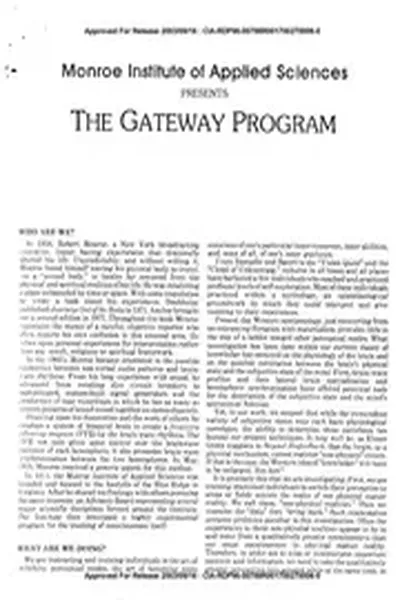
This document, a letter from W. B. Smith to Representative Herman P. Eberharter, originates from the CIA Reading Room and dates to the 1950s. It details the agency's interest in esoteric practices, specifically mentioning the use of tarot cards. The correspondence suggests an investigation into how divination techniques might be applied to intelligence gathering during that era. It reflects a period where governmental bodies were seemingly exploring unconventional methods alongside traditional approaches to national security. The letter implies a curiosity about the potential of foresight and psychological insights derived from such practices, even within official capacities.
For those interested in the history of intelligence or the historical intersection of the occult and statecraft, this primary source offers a direct look at a specific instance. It is not a treatise on tarot or divination itself, but rather a record of its consideration by an intelligence agency. The document’s value lies in its unvarnished presentation of this unusual subject matter, allowing readers to draw their own conclusions about the agency's motivations and the broader context of the time.
This letter surfaces during a period when various governments, including the US, showed interest in parapsychological research and unconventional intelligence methods. This era saw a broad fascination with psychic phenomena, astrology, and divination, leading some agencies to explore their potential applications. The mention of tarot connects this document to traditions of cartomancy, which have been used for centuries for divination and self-reflection. Its inclusion within a government context highlights a specific, albeit perhaps limited, exploration of these practices beyond their traditional spiritual or recreational use.
💡 Why Read This Book?
Uncover the secret history of divination's potential role in intelligence. This document offers a rare peek into how ancient practices like tarot might have been considered within governmental contexts. Ideal for seekers of hidden knowledge, scholars of esotericism, and practitioners intrigued by the intersection of the mystical and the mundane.
⭐ Reader Reviews
Honest opinions from readers who have explored this book.
❓ Frequently Asked Questions
What is the primary subject of this document?
The document is a letter discussing a potential vacancy and mentions the 'tarot,' suggesting an interest or involvement in divination practices within a governmental context.
Who is W. B. Smith?
W. B. Smith is identified as the sender of the letter to the Honorable Herman P. Eberharter, likely an official within the government at the time.
What is the significance of the 'tarot' mention?
The mention of 'tarot' is significant as it implies a potential exploration or consideration of divination techniques within the scope of government operations or personnel matters.
Is this document a full treatise on divination?
No, this is a brief correspondence. The mention of tarot is within the context of a job application or recommendation, not a detailed explanation of its use.
Where can I find more documents like this?
Additional declassified documents with potential esoteric or historical significance can often be found through official government archives and specialized research libraries.
🔮 Key Themes & Symbolism
Clandestine Esotericism
This theme explores the possibility of esoteric practices, such as tarot divination, being considered or utilized within clandestine governmental operations. It explores the tension between secrecy and the pursuit of knowledge beyond conventional means, suggesting that institutions tasked with national security might have, at times, investigated or incorporated unconventional methodologies to gain insight or predict outcomes. The document serves as a whisper from the shadows, hinting at a deeper, less visible layer of inquiry.
The Intersection of Power and Prediction
This theme examines the historical and philosophical implications of those in positions of power engaging with methods of prediction. It questions the motivations behind such engagement, whether for strategic advantage, a genuine belief in foresight, or simply a comprehensive exploration of all potential tools. The letter, by its very existence, posits a scenario where the practicalities of governance might intersect with the ancient human desire to know the future, raising questions about the nature of decision-making in high-stakes environments.
Declassified Knowledge and Historical Whispers
This theme focuses on the significance of declassified documents as windows into forgotten or suppressed aspects of history. The 'Letter to the Honorable Herman P. Eberharter' acts as a historical whisper, a fragment of information that, when examined, can spark new narratives and encourage deeper investigation into the less-documented corners of the past. It highlights how seemingly mundane official communications can, upon scrutiny, reveal clear insights into the intellectual and cultural currents of their time.
💬 Memorable Quotes
Direct passages from the work, attributed to the author.
“Thank you for being...”
— A polite opening, setting a formal tone for the correspondence, typical of official communication during the period.
“suitable vacancy for h .sa arJ he W,' this b.. our i'er as'to1 .I ff”
— This fragment likely refers to a specific job or position being discussed, indicating the letter's purpose revolves around employment or personnel matters.
“papers have been riwiie vaaanoi :s *nd I re t r they. =-,o 3ttl l do wit have a suit-able oz a r:,ia ,;;; :'or him.”
— Suggests a review of qualifications or application materials, leading to the conclusion that no suitable role was found for the individual in question.
“?ie ztre kea lei his a p .aa ';pion in ow as iva ilu~: ho var3”
— This snippet may allude to a specific skill or attribute of the applicant, potentially related to their background or experience that was noted.
“and shall ;.w. tarot bigi 3h,”
— The most evocative phrase, directly mentioning 'tarot,' implying its relevance in the context of the applicant's profile or the discussion surrounding them.
🌙 Esoteric Significance
Tradition
While the document doesn't explicitly name a tradition, the mention of 'tarot' strongly links it to the Western esoteric traditions, particularly those that have incorporated cartomancy and divination. This includes Hermeticism, Kabbalah, and various occult revival movements of the late 19th and early 20th centuries, which often saw the tarot as a symbolic language for understanding cosmic principles and human psychology.
Symbolism
The tarot itself is a wide range of symbolism, with each card representing archetypal energies, stages of a journey, or specific psychological states. In the context of this letter, the mere mention implies a potential consideration of these symbolic meanings for insight or prediction, hinting at a layer of interpretation beyond the literal. The cards could be seen as a symbolic language to decode potential outcomes or understand hidden dynamics.
Modern Relevance
The modern relevance lies in the enduring human quest for knowledge and understanding beyond the purely empirical. This document serves as a historical footnote, reminding us that even in highly rationalized and security-conscious environments, the allure of divination and symbolic systems persists. It encourages a contemporary examination of how various forms of knowledge, including the esoteric, might continue to influence decision-making and perception, even if indirectly or in disguised forms.
👥 Who Should Read This Book
This document is essential for students of esoteric history, particularly those interested in the intersection of occultism and government intelligence. Scholars of Cold War era clandestine activities will find it a fascinating artifact. Seekers of hidden knowledge and practitioners of divination, especially tarot enthusiasts, will appreciate this rare glimpse into its potential historical applications within unexpected domains. It's also relevant for anyone curious about the broader human fascination with foresight and the methods employed throughout history to explore the unknown.
📜 Historical Context
This document, dated June 9, 1952, emerges from the height of the Cold War, a period characterized by intense geopolitical tension, ideological conflict, and a pervasive atmosphere of suspicion. The United States, under President Truman and soon to be under Eisenhower, was deeply engaged in intelligence gathering and counter-intelligence operations. The establishment of the CIA in 1947 had consolidated various intelligence functions, and the agency was actively exploring all avenues to understand and counter perceived threats. This era saw a burgeoning interest in parapsychology, psychic phenomena, and even esoteric practices, as some within governmental and scientific circles sought any potential advantage, however unconventional. The mention of 'tarot' in this context is not an isolated curiosity but can be seen as a reflection of a broader societal and institutional fascination with the unknown and the possibility of tapping into unseen forces or insights.
📔 Journal Prompts
Reflect on the historical context of the Cold War and its potential influence on the perceived value of esoteric knowledge.
Consider the ethical implications of using divination methods for intelligence gathering or decision-making.
Explore the symbolism of the tarot and how its archetypes might be interpreted in relation to power structures.
Write a fictional narrative imagining the full extent of 'tarot' use within a secret government program.
How does the desire for foresight manifest in modern society, and are there parallels to the interest shown in this document?
🗂️ Glossary
CIA Reading Room
A section within intelligence agencies where declassified documents are made available to the public, offering insights into past operations and historical information.
Tarot
A deck of cards, typically comprising 78 cards, used for divination, spiritual guidance, and introspection, featuring symbolic imagery with archetypal meanings.
Divination
The practice of seeking knowledge of the future or the unknown by supernatural means. Tarot reading is a form of divination.
Clandestine
Kept secret or done secretively, especially because illicit. Often used in the context of intelligence and espionage.
Esotericism
Beliefs, practices, and studies concerning hidden knowledge or esoteric wisdom, often relating to spirituality, mysticism, and the occult.
This book appears in 3 collections
🔮 Readers Also Liked
Browse all →









More by CIA Reading Room
All books →



From the “Tarot” Collection
View all →








More Free Divination & Tarot Books
View all →