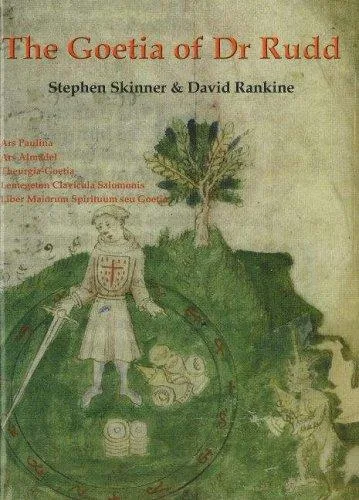
Goetia of Dr Rudd
 62
62

Goetia of Dr Rudd


Stephen Skinner's 'Goetia of Dr Rudd' is a monumental contribution to the field of grimoire studies. Skinner masterfully reconstructs and illuminates a crucial, yet previously obscure, text, offering practitioners and scholars an unparalleled glimpse into a sophisticated system of ceremonial magic. The clarity of the translation and the depth of the annotations are exceptional, demystifying complex rituals and the intricate angelology and demonology presented. This work is essential for anyone serious about understanding the practical applications and historical evolution of Goetic magic. It stands as a testament to Skinner's erudition and commitment to preserving and disseminating vital esoteric knowledge, making it an indispensable addition to any serious occult library.
📝 Description
62
Stephen Skinner's 2007 'Goetia of Dr Rudd' presents Dr. John Rudd's lost grimoire.
This volume makes available the contents of a grimoire attributed to Dr. John Rudd, a manuscript that predates some versions of the Lesser Key of Solomon. Stephen Skinner provides a translation of the text along with his own extensive commentary. The grimoire details angelic and daemonic hierarchies, including their sigils, and outlines rituals for summoning and commanding them. Skinner's work aims to clarify the practical methods and theoretical framework of this specific magical system.
The book is aimed at those with a serious interest in Western esotericism. It covers aspects of magical practice and belief from the pre-Victorian era. The text includes discussions on the cosmology underpinning these practices and the philosophical ideas associated with them. Skinner's annotations help to situate Rudd's grimoire within the broader history of ceremonial magic.
Dr. John Rudd's grimoire belongs to the tradition of Solomonic magic, which draws upon the legendary King Solomon's supposed command over spirits. This lineage includes texts like the Greater Key and the Lesser Key of Solomon, though Rudd's work appears to be an independent or related development rather than a direct derivative. The focus on detailed hierarchies and specific ritual procedures for spirit evocation is characteristic of grimoires from the late medieval period through the early modern era. Skinner's edition places this text within that historical and practical context.
💡 Why Read This Book?
Uncover a lost grimoire of immense historical and practical significance. Explore a unique system of ceremonial magic with detailed instructions and powerful sigils. Deepen your understanding of Goetic traditions and their historical context. Ideal for practitioners seeking to expand their repertoire and scholars of Western esotericism.
⭐ Reader Reviews
Honest opinions from readers who have explored this book.
❓ Frequently Asked Questions
What is the primary focus of the 'Goetia of Dr Rudd'?
The book primarily focuses on the reconstruction and interpretation of Dr. John Rudd's lost grimoire, detailing specific rituals, angelic and daemonic correspondences, and the practical application of Goetic magic.
Who was Dr. John Rudd?
Dr. John Rudd was a lesser-known but significant figure in the history of magical texts, whose personal grimoire, now meticulously reconstructed by Stephen Skinner, offers a unique perspective on Goetic practices.
Is this book suitable for beginners in magic?
While it offers historical context, the 'Goetia of Dr Rudd' is best suited for intermediate to advanced practitioners and serious scholars due to the complexity and specific nature of the rituals described.
What makes this translation unique?
Stephen Skinner's translation is distinguished by its scholarly rigor, comprehensive annotations, and the successful reconstruction of a previously fragmented and lost text, providing unparalleled clarity and context.
Does this book contain practical instructions for summoning spirits?
Yes, the book provides detailed instructions and sigils for ceremonial operations, intended for practitioners who understand the necessary precautions and ethical considerations involved in such work.
🔮 Key Themes & Symbolism
The Reconstruction of Lost Esoteric Knowledge
This volume represents a significant achievement in the recovery of lost magical traditions. Skinner's meticulous research and scholarly approach resurrect Dr. Rudd's grimoire from obscurity, offering a tangible link to a forgotten era of occult practice. The process of reconstruction itself is a evidence of the enduring power of these texts and the dedication required to preserve and transmit such arcane wisdom across centuries. Readers gain insight into the challenges and triumphs of historical textual analysis within the area of the esoteric, understanding how fragments of knowledge are pieced together to form a coherent and potent magical system.
Ceremonial Goetic Operations
Fundamentally, the 'Goetia of Dr Rudd' is a practical guide to ceremonial magic. It explores the specific methodologies, tools, and invocations necessary for engaging with the angelic and daemonic hierarchies described. The book elucidates the intricate steps involved in preparing the magician, the ritual space, and the various components of the operation. It emphasizes the precise nature of these rituals, highlighting the importance of correct symbolism, pronunciation, and intent for successful engagement with spiritual entities, offering a window into the operational grimoire tradition.
The Angelic and Daemonic Hierarchy
Central to the 'Goetia of Dr Rudd' is its detailed exploration of the complex hierarchies of spiritual beings. The text maps out the relationships, attributes, and powers of numerous angels and demons, providing practitioners with a framework for understanding these forces. Skinner’s annotations shed light on the historical development and esoteric significance of these classifications, linking them to broader traditions of angelic and daemonic lore. This comprehensive charting of the spiritual cosmos offers a profound understanding of the forces that govern existence and their potential for interaction with the human realm.
💬 Memorable Quotes
Direct passages from the work, attributed to the author.
“Each sigil is a key, a divine fingerprint etched upon the fabric of reality.”
— This highlights the symbolic and energetic nature of sigils, positing them as direct conduits to divine power and manifestations of universal laws.
“The magician becomes the crucible, transforming intent into manifest form.”
— This emphasizes the active, transformative role of the practitioner in the magical process, where their will and focus shape the outcome.
“Beyond the veil, intelligences await those who possess the knowledge and the courage to call.”
— This speaks to the existence of hidden spiritual realms and the requirement of both esoteric knowledge and personal fortitude for engaging with their inhabitants.
“Ritual is the language through which the mundane communes with the sublime.”
— This defines ritual as a sacred form of communication, bridging the gap between the earthly and the divine, the material and the spiritual.
💡 Key Ideas
Editorial paraphrase of the work's core concepts — not direct quotes.
The power lies not in the name, but in the true understanding of the divine architecture.
This quote suggests that true magical efficacy stems from comprehension of cosmic principles and divine order, rather than mere recitation of incantations.
🌙 Esoteric Significance
Tradition
This work is deeply rooted in the Western Ceremonial Magic tradition, specifically the lineage of the Solomonic grimoires. It draws heavily from Kabbalistic cosmology, angelic hierarchies, and the practice of evocation. The 'Goetia of Dr Rudd' represents a practical, operational interpretation of these ancient systems, aiming to provide practitioners with the tools and knowledge necessary to interact with spiritual entities for specific purposes. Its significance lies in its contribution to understanding this specific branch of operative magic and its combination of theoretical framework and practical application.
Symbolism
The symbolism within the 'Goetia of Dr Rudd' is complex, encompassing the geometric precision of magical circles, the potent imagery of angelic and daemonic sigils, and the symbolic language of ritual implements. Sigils act as condensed representations of spiritual essences, designed to facilitate invocation and connection. The arrangement of the ritual space, the colors, the incantations—all are imbued with symbolic meaning, intended to create a sacred microcosm that mirrors the macrocosm and allows for effective communication with higher or other-dimensional intelligences.
Modern Relevance
Despite its historical origins, the 'Goetia of Dr Rudd' retains significant relevance for contemporary practitioners and scholars of esoteric studies. It offers a detailed blueprint for a system of magic that, while demanding, can yield clear insights into consciousness, spirituality, and the nature of reality. The text encourages a disciplined approach to magical work, emphasizing the importance of study, intent, and ethical conduct. For modern seekers, it provides a tangible connection to the ancestral currents of Western magic, offering pathways for personal development and spiritual exploration.
👥 Who Should Read This Book
This volume is an essential acquisition for serious students of Western Esotericism, particularly those with an interest in grimoire magic and the Solomonic tradition. Practitioners of ceremonial magic will find its detailed instructions and unique insights useful for expanding their operational repertoire. Scholars of occult history and religious studies will appreciate its contribution to understanding the development and practice of magical systems in historical contexts. Seekers of hidden knowledge and esoteric wisdom will be drawn to its profound exploration of spiritual hierarchies and the possibilities of direct engagement with the unseen.
📜 Historical Context
The 'Goetia of Dr Rudd' emerges from a collection of Western esotericism, likely taking shape during a period of intense magical and philosophical inquiry, possibly the late 17th or early 18th century. This era witnessed a resurgence of interest in grimoires, alchemy, and Kabbalah, influenced by figures like Agrippa and Dee. Dr. John Rudd's grimoire, as reconstructed by Skinner, represents a specific branch of this tradition, demonstrating a practical, operational approach to the complex hierarchies and operations found in the Solomonic magical corpus. The text reflects a society where the boundaries between the spiritual and material realms were perceived as more permeable, and where systematic engagement with supernatural forces was a recognized, albeit clandestine, pursuit. Its preservation and study offer invaluable insights into the evolution of magical thought and practice during an important transitional period.
📔 Journal Prompts
Reflect on the concept of 'divine architecture' as presented in the text. How does understanding this structure influence your perception of magical operations?
Analyze a specific sigil from the grimoire. What immediate impressions or intuitive meanings does it evoke, beyond its intended purpose?
Consider the ethics of invoking spiritual entities. What personal guidelines or principles would you establish before undertaking such a ritual?
How does the idea of the 'magician as crucible' resonate with your own experiences of transformation or manifestation?
Explore the notion of 'ritual as language.' How can you apply this understanding to enhance the effectiveness and meaning of your personal spiritual practices?
🗂️ Glossary
Goetia
A term derived from the Greek 'goēteia,' referring to sorcery or witchcraft, often specifically associated with the evocation of demons as described in grimoires like the Lesser Key of Solomon.
Sigil
A magical symbol or diagram, often created by combining letters or geometrical shapes, believed to represent and invoke a specific spiritual entity or power.
Evocation
The magical practice of calling forth spirits or entities into a visible or perceptible form within a designated ritual space, typically for communication or instruction.
Grimoire
A textbook of magic, typically containing instructions on how to create magical objects, perform rituals, and invoke spirits, often compiled from earlier magical texts.
Ceremonial Magic
A systematized form of magic that employs elaborate rituals, specific gestures, incantations, and symbolic tools to achieve its aims, often involving the invocation of divine or spiritual forces.
This book appears in 3 collections
🔮 Readers Also Liked
Browse all →






More by Stephen Skinner
All books →




From the “Ritual Magic” Collection
View all →






More Free Magic & Ritual Books
View all →