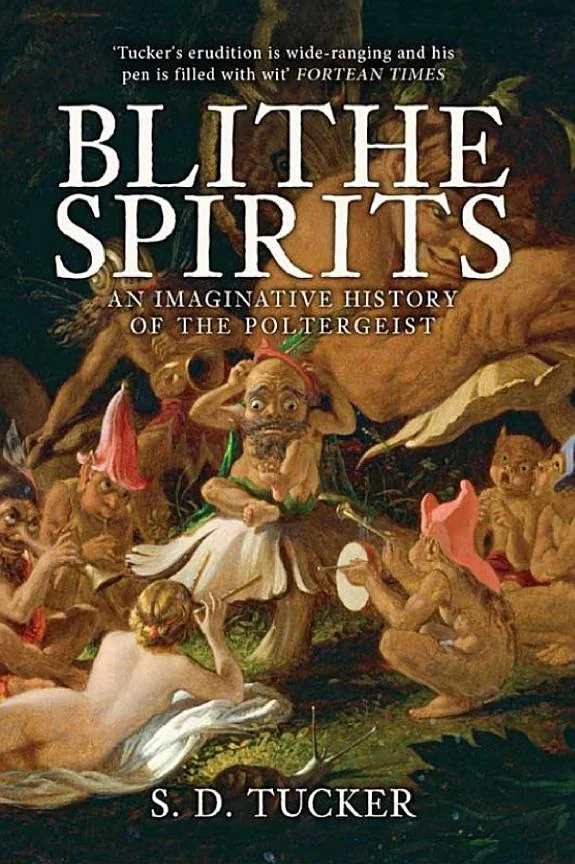
Blithe Spirits
 71
71

Blithe Spirits
S. D. Tucker’s *Blithe Spirits* offers a rigorously cataloged survey of poltergeist reports, a welcome antidote to the often sensationalized discourse surrounding these phenomena. The strength of the work lies in its systematic approach, meticulously dissecting cases from various eras and geographical locations, such as the "Drummer of Tedworth" incident from 17th-century England. Tucker effectively positions these events within their historical and cultural contexts, demonstrating how societal frameworks influence interpretation. However, the book occasionally leans towards a dry, academic tone that might alienate readers seeking more visceral engagement with the subject. The detailed case analyses, while thorough, sometimes lack a synthesis of the emotional or psychological impact these events have had on those involved. Despite this, *Blithe Spirits* stands as a valuable, fact-driven resource for anyone serious about understanding the history and nature of poltergeist activity.
📝 Description
71
S. D. Tucker's *Blithe Spirits* (2017) examines poltergeist phenomena across cultures and history.
S. D. Tucker's *Blithe Spirits* analyzes reported poltergeist phenomena from various global cultures and historical periods. The book moves past sensationalism to study these events through historical, literary, and sociological perspectives. It provides a structured method for understanding a persistent aspect of paranormal investigation, using documented cases and academic interpretations.
The work places the study of poltergeists within a larger history of paranormal investigation. While the term "poltergeist" became common in the late 19th century, particularly in German spiritualist groups, such phenomena have been recorded for centuries. Tucker's book likely discusses earlier reports, such as those from the medieval era, and contrasts them with modern scientific methods that developed after figures like J.W. Dunne and later parapsychological research at places like Duke University.
This book engages with the historical study of apparitions and unexplained physical disturbances, a tradition that runs through many cultures. While modern parapsychology seeks empirical evidence, the book acknowledges the long-standing human interest in phenomena attributed to spirits or unseen forces. It touches on how these beliefs intersect with psychological theories, particularly concerning the role of individuals in generating such events, a concept that resonates with ideas found in some occult traditions concerning psychic energy.
💡 Why Read This Book?
• Gain an understanding of the historical trajectory of poltergeist phenomena, from the 1660s "Drummer of Tedworth" cases to modern investigations, providing context unavailable in generalized paranormal literature. • Learn about the "psychokinetic" (PK) theory of poltergeist activity and the concept of the "agent," offering specific theoretical frameworks for understanding disturbances that differ from standard ghost lore. • Analyze how cultural and societal interpretations have shaped the reporting and understanding of poltergeists across different centuries, equipping you with a critical lens beyond simple belief or disbelief.
⭐ Reader Reviews
Honest opinions from readers who have explored this book.
❓ Frequently Asked Questions
What historical periods does Blithe Spirits cover regarding poltergeist activity?
*Blithe Spirits* examines poltergeist phenomena across a wide historical spectrum, referencing documented cases from as early as the 17th century, such as the "Drummer of Tedworth," through to more contemporary reports.
Does the book focus on specific geographic regions for poltergeist reports?
Yes, the book analyzes a global selection of reported poltergeist phenomena, indicating that it covers cases from various cultures and geographical locations, not limited to a single region.
What is the main theoretical approach used to analyze poltergeists in this book?
The book analyzes poltergeist phenomena through historical, literary, and sociological lenses, exploring concepts like the psychokinetic theory and the role of a potential "agent" in generating disturbances.
Is S. D. Tucker's "Blithe Spirits" suitable for beginners in paranormal studies?
While comprehensive, the book's analytical and scholarly approach makes it particularly suitable for researchers and serious students of parapsychology rather than absolute beginners seeking introductory material.
How does "Blithe Spirits" differentiate itself from other books on ghosts and hauntings?
It differentiates itself by focusing specifically on poltergeist activity and employing a rigorous, evidence-based analysis across history, literature, and society, rather than general hauntings or sensationalized accounts.
What is the significance of the "agent" concept in the book's analysis?
The concept of the "agent," often an individual believed to be unconsciously causing disturbances, is central to the book's exploration of psychokinetic theories and understanding the source of poltergeist events.
🔮 Key Themes & Symbolism
The Poltergeist Agent
A central focus of *Blithe Spirits* is the concept of the "agent," an individual often at the nexus of reported poltergeist activity. Tucker explores theories suggesting this agent, frequently an adolescent, may unconsciously generate the physical disturbances. This contrasts with traditional hauntings attributed to discarnate spirits, shifting the locus of paranormal causation to a living human subject and their psychological state.
Historical Case Studies
The book meticulously examines historical reports, providing context for the evolution of understanding poltergeist phenomena. Cases like the "Drummer of Tedworth" from 1660s England are analyzed, allowing readers to trace how societal beliefs, available scientific explanations, and reporting biases have influenced the interpretation of disturbances over centuries.
Societal and Literary Framing
*Blithe Spirits* investigates how poltergeist events are not only reported but also framed by the societies and literature of their time. The work analyzes how cultural narratives shape perceptions, influencing whether phenomena are explained through religious, psychological, or paranormal frameworks, thereby revealing much about the eras in which they occurred.
Psychokinesis (PK) Theory
Tucker examines the psychokinetic (PK) theory as a primary explanation for poltergeist activity. This perspective posits that mental energy, potentially from an unconscious agent, can directly influence the physical environment, causing objects to move or other anomalous occurrences. The book evaluates the evidence and theoretical underpinnings of this controversial concept.
💬 Memorable Quotes
Direct passages from the work, attributed to the author.
“Distinguishing between physical and intelligent hauntings is key.”
— This highlights the analytical approach of differentiating poltergeist activity, characterized by physical manifestations, from hauntings typically associated with intelligent communication or residual energy.
“Cultural context shapes the interpretation of anomalous events.”
— This emphasizes that how poltergeist phenomena are understood and reported is heavily influenced by the prevailing beliefs, scientific understanding, and societal norms of the specific time and place.
“The Drummer of Tedworth case provides an early example.”
— This refers to a specific historical incident (circa 1660s) that serves as an early, well-documented case study within the book, illustrating the long history of phenomena now categorized as poltergeist activity.
“Psychokinetic theories offer an alternative to spiritual explanations.”
— This points to the book's exploration of scientific or quasi-scientific hypotheses, such as psychokinesis, as potential explanations for poltergeist events, contrasting them with more traditional supernatural interpretations.
💡 Key Ideas
Editorial paraphrase of the work's core concepts — not direct quotes.
The "agent" is frequently identified as the focal point of disturbance.
This paraphrased concept highlights a core thesis: that a living individual, often unknowingly, plays a central role in the manifestation of poltergeist events, redirecting focus from external spirits to internal human dynamics.
🌙 Esoteric Significance
Tradition
While not strictly adhering to a single esoteric lineage, *Blithe Spirits* engages with themes relevant to Western Esotericism, particularly concerning subtle energies and the mind-matter interface. Its exploration of psychokinesis touches upon concepts found in Theosophy and later New Age thought, which often posit conscious or unconscious mental powers influencing the physical world. The work departs from traditional Hermeticism or Kabbalah by focusing on specific, observable (though debated) phenomena rather than broader cosmological or magical systems.
Symbolism
The primary "symbol" explored is the "agent," representing the human psyche as a potential source of external manifestation. The disturbances themselves – moving objects, unexplained noises – function as symbols of underlying psychological tension or unrecognized forces. The book implicitly treats these events as symbolic expressions of the boundary between the internal world of consciousness and the external physical reality.
Modern Relevance
Contemporary thinkers and practitioners in fields like consciousness studies, parapsychology, and even certain branches of depth psychology find value in *Blithe Spirits*. Its rigorous analysis of the agent phenomenon and psychokinesis provides a foundation for modern research into mind-matter interaction and the potential for the human mind to influence physical systems, echoing interests found in contemporary quantum mysticism and transpersonal psychology.
👥 Who Should Read This Book
• Researchers of parapsychology and anomalous phenomena seeking a structured overview of poltergeist case studies and theoretical frameworks. • Historians of belief systems interested in how societies have interpreted and documented unexplained physical disturbances across different eras. • Skeptical investigators and critical thinkers wanting to engage with a detailed, evidence-based analysis of poltergeist activity beyond sensationalized media portrayals.
📜 Historical Context
Published in 2020, *Blithe Spirits* arrives at a time of renewed, albeit often fringe, interest in paranormal phenomena, building upon decades of parapsychological research. The book engages with a history of inquiry that gained significant momentum in the late 19th and early 20th centuries, particularly within spiritualist movements and later academic pursuits at institutions like the Society for Psychical Research. Tucker's work implicitly contrasts with the more spiritually-focused or purely anecdotal accounts prevalent in earlier eras. It navigates a landscape where Freudian psychology and later Jungian archetypes had already begun to offer alternative frameworks for understanding anomalous experiences, challenging purely supernatural explanations. While not a direct contemporary, the work stands in dialogue with researchers like Nandor Fodor, who extensively studied poltergeist cases in the mid-20th century, and later figures in psychokinesis research.
📔 Journal Prompts
The "agent" as a focal point of disturbance.
Societal framing of phenomena like the Drummer of Tedworth.
Psychokinetic (PK) theories versus spiritual explanations.
Distinguishing physical disturbances from intelligent hauntings.
The role of adolescence in poltergeist reports.
🗂️ Glossary
Poltergeist
From the German for "noisy ghost," referring to a type of paranormal disturbance characterized by physical phenomena like moving objects, unexplained noises, and destruction, often without apparent intelligent agency.
Agent
In the context of poltergeist studies, the "agent" is typically an individual, often unconsciously, believed to be the source or focus of the disturbances.
Psychokinesis (PK)
The purported ability to influence a physical system by thought alone, without the use of conventional means. A key theory in explaining poltergeist activity.
Intelligent Haunting
A type of paranormal manifestation typically involving communication or interaction with a perceived discarnate entity, distinct from the physical disturbances of a poltergeist.
Residual Haunting
The theory that paranormal activity is a replaying of past events, like an energetic imprint, rather than an interactive consciousness.
Parapsychology
The study of alleged psychic phenomena and other paranormal claims, including ESP (extrasensory perception) and PK (psychokinesis).
Drummer of Tedworth
A famous 17th-century English poltergeist case involving a drummer accused of theft, whose alleged subsequent disturbances provided an early, influential example for the phenomenon.
This book appears in 1 collection
🔮 Readers Also Liked
Browse all →








From the “Poltergeist” Collection
View all →








More Free Occult Philosophy Books
View all →