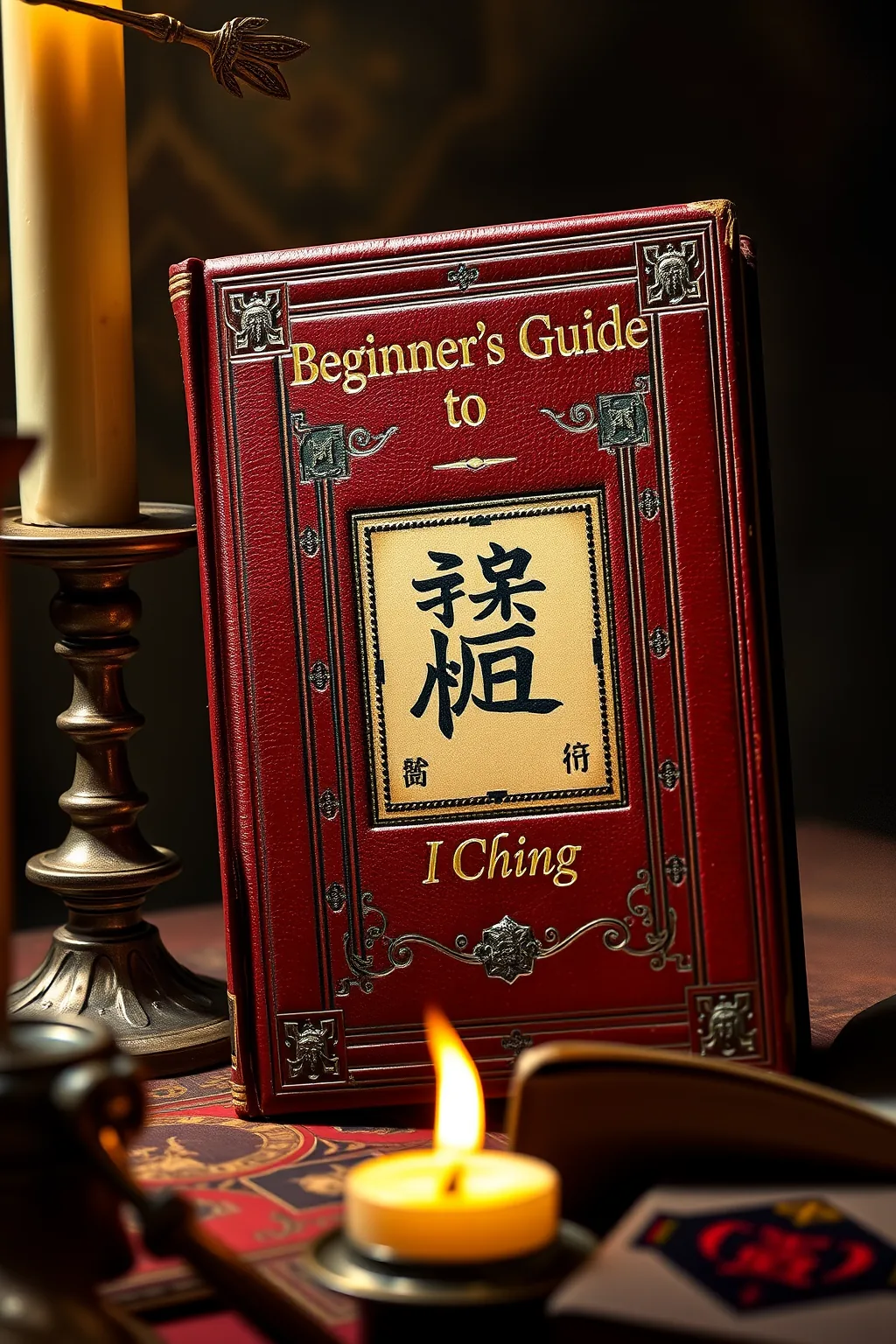
Beginner's Guide to I Ching
 61
61

Beginner's Guide to I Ching



Alaric Kestrel, Metaphysical Studies Reviewer – 'The Beginner's Guide to I Ching' serves as a vital conduit for accessing the profound depths of this ancient Chinese oracle. Eschewing arcane jargon, it thoughtfully unpacks the core principles, hexagrams, and their nuanced interpretations, making this venerable system approachable for the contemporary student. Its strength lies in its clarity and its ability to foster an intuitive understanding of the I Ching's symbolic language. This guide is an invaluable companion for anyone seeking to cultivate self-awareness, gain insight into complex situations, or simply connect with a timeless source of wisdom that resonates with enduring truth. A most welcome addition to any seeker's library.
📝 Description
61
This 1970s guide explains the I Ching's hexagrams for newcomers.
This book introduces the I Ching, also known as the 'Book of Changes,' to readers unfamiliar with its principles. It presents the core concepts of the text, including the cyclical nature of existence and the interplay of Yin and Yang. The guide breaks down the 64 hexagrams, explaining their symbolic meanings and how they relate to transformation and balance.
The text aims to assist those beginning their study of this philosophical system. It seeks to illuminate intuitive understanding and connect the reader with what it calls universal patterns. The author intends for readers to perceive the world through the symbolism of the I Ching and its underlying structure.
The I Ching originates from ancient China, with roots stretching back over 3,000 years. It is considered one of the oldest Chinese classic texts. Traditionally used for divination, it also functions as a philosophical work exploring change and balance in the universe. Its system of hexagrams, derived from combinations of broken (Yin) and unbroken (Yang) lines, offers a framework for understanding dynamic processes. The text has influenced various schools of thought, including Taoism and Confucianism, and has been interpreted across different esoteric traditions worldwide.
💡 Why Read This Book?
This book is your key to unlocking the ancient Chinese oracle of the I Ching, offering profound insights into life's challenges and opportunities. Ideal for spiritual seekers, students of divination, and practitioners seeking to deepen their intuitive connection to universal patterns. It provides a clear, step-by-step approach to understanding the hexagrams, empowering you to consult this timeless wisdom for guidance and self-discovery.
⭐ Reader Reviews
Honest opinions from readers who have explored this book.
❓ Frequently Asked Questions
What is the I Ching?
The I Ching, or 'Book of Changes,' is an ancient Chinese divination text and philosophical classic, revered for its comprehensive system of symbols representing natural processes and human experience.
How do I use the I Ching for guidance?
Typically, one formulates a question, casts coins or yarrow stalks to generate hexagrams, and then consults the text for interpretations relevant to the situation.
Is prior knowledge of Chinese philosophy required?
No, this guide is specifically designed for beginners and introduces foundational concepts clearly, making it accessible without prior philosophical background.
What are hexagrams?
Hexagrams are sixty-four symbols, each composed of six stacked lines (broken or solid), representing fundamental archetypes and situations in life.
Can the I Ching predict the future?
The I Ching doesn't predict a fixed future but rather offers insight into the current dynamics and potential outcomes, empowering informed decision-making.
🔮 Key Themes & Symbolism
The Philosophy of Change
Fundamentally, the I Ching is a profound exploration of the ceaseless nature of transformation. It posits that change is the only constant, and understanding its patterns allows for harmonious navigation of life's currents. This section studies the dynamic interplay of Yin and Yang, the fundamental forces driving all phenomena, and how their balance and imbalance manifest in the sixty-four hexagrams, each representing a unique phase or situation in the cosmic dance.
Divination as Self-Discovery
This guide reframes divination not as fortune-telling, but as a sophisticated tool for introspection and gaining clarity. The process of consulting the I Ching, whether through coin casting or other methods, is presented as a meditative practice that helps to illuminate subconscious thoughts, reveal hidden influences, and offer perspectives on dilemmas. It emphasizes the I Ching as a mirror reflecting one's inner state and the surrounding energies, guiding the user toward more conscious and aligned choices.
Symbolism and Archetypes
The sixty-four hexagrams are rich tapestries of visual and conceptual symbolism, each drawing from natural phenomena, human relationships, and cosmic principles. This theme unravels the intricate language of these archetypal images, from the receptive Earth (Kun) to the creative Heaven (Qian). Understanding these symbols provides a framework for interpreting life's events, recognizing universal patterns, and developing a deeper appreciation for the interconnectedness of all things within the grand design.
💬 Memorable Quotes
Direct passages from the work, attributed to the author.
“The Book of Changes reveals the patterns of the cosmos.”
— This highlights the I Ching's function as a cosmic map, offering insights into universal laws and cycles.
“Through change, we find our true path.”
— Emphasizes the transformative power of embracing flux and using it for personal growth and alignment.
“The hexagrams are whispers from the Tao.”
— Suggests the oracle provides subtle, intuitive guidance from the fundamental principle of the universe.
“Balance is the key to harmony.”
— Underscores the importance of equilibrium, particularly between Yin and Yang, for well-being.
“Seek wisdom within the unfolding lines.”
— Encourages a deep, contemplative engagement with the I Ching's symbolic language for profound understanding.
🌙 Esoteric Significance
Tradition
The I Ching is a central to Chinese esoteric traditions, deeply intertwined with Taoism and Confucianism, but extending into broader metaphysical philosophies. It represents a sophisticated system of sympathetic magic and cosmology, offering a framework for understanding the subtle energies (Qi) that permeate the universe and human life. Its cyclical view of time and transformation aligns with Hermetic principles of "As Above, So Below," making it a vital tool for alchemical self-transformation and spiritual attainment.
Symbolism
The core symbolism lies in the eight trigrams (Bagua) and the sixty-four hexagrams, each a unique configuration of Yin (broken) and Yang (solid) lines. These lines represent fundamental forces, elements, and archetypal situations. The I Ching's symbolism acts as a universal language, encoding principles of balance, movement, stillness, and interaction. Understanding these symbols allows practitioners to decode the energetic blueprint of any given moment, guiding them towards alignment with natural cosmic rhythms.
Modern Relevance
In contemporary times, the I Ching transcends its ancient origins to offer profound psychological and philosophical insights. It serves as a powerful tool for mindfulness, decision-making, and working through the complexities of modern life. Its emphasis on adaptability, understanding cyclical patterns, and finding balance resonates deeply with individuals seeking meaning and stability in a rapidly changing world. The I Ching continues to inspire artists, thinkers, and spiritual seekers, providing a timeless source of wisdom for self-awareness and personal evolution.
👥 Who Should Read This Book
This guide is essential for the spiritual seeker beginning their esoteric journey, offering a clear entry point into one of the world's most ancient and revered wisdom systems. It is equally valuable for students of divination and comparative mythology seeking to understand the foundational principles of Chinese cosmology. Practicing occultists and practitioners of Tarot will find the I Ching's symbolic language and cyclical philosophy to be a profound complement to their existing disciplines. Scholars of ancient philosophy and Eastern religions will appreciate its accessible yet insightful exploration of its core concepts, making it a foundational text for deeper study.
📜 Historical Context
The I Ching, or 'Book of Changes,' emerged from ancient Chinese shamanistic practices and philosophical inquiries dating back to the Shang Dynasty (c. 1600–1046 BCE). Its philosophical development solidified during the Spring and Autumn period (771–476 BCE) and the Warring States period (475–221 BCE), notably influenced by Confucian scholars who incorporated it into the canonical Five Classics. Throughout imperial China, it served not only as a divination manual but also as a profound text on cosmology, ethics, and governance. Its influence spread across East Asia, impacting Korean, Japanese, and Vietnamese thought. In the 20th century, translations by figures like Richard Wilhelm brought its esoteric wisdom to the Western world, sparking renewed interest in its mystical and psychological dimensions, cementing its status as a foundational text in global esoteric traditions.
📔 Journal Prompts
Reflect on a recent significant change in your life. How might a specific hexagram from the I Ching describe this transformation?
Consider the interplay of Yin and Yang in your daily interactions. Where do you find balance, and where is there tension?
If you were to consult the I Ching for guidance on a current challenge, what question would you ask, and what hexagram do you anticipate receiving?
How does the concept of 'change' as presented in the I Ching challenge or affirm your current worldview?
Explore the archetypal imagery of one of the trigrams. How does its essence manifest in your personal life or the world around you?
🗂️ Glossary
Yin
The feminine, passive, receptive, dark, and yielding principle in Chinese philosophy, often represented by broken lines in the I Ching.
Yang
The masculine, active, creative, light, and assertive principle, often represented by solid lines in the I Ching.
Hexagram
A symbol composed of six stacked lines (broken or solid), representing a specific situation, archetype, or stage of cosmic development in the I Ching.
Trigram (Bagua)
A symbol composed of three stacked lines, forming eight fundamental archetypes that are the building blocks of the hexagrams.
Tao
The fundamental, ineffable principle of the universe in Taoist philosophy, representing the natural order and flow of all things.
This book appears in 2 collections
🔮 Readers Also Liked
Browse all →








From the “Tarot” Collection
View all →







More Free Divination & Tarot Books
View all →