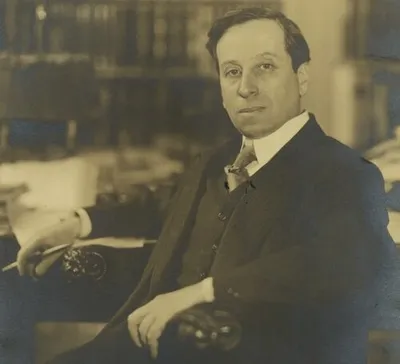
Robert Eisler
Robert Eisler was a polymath whose work spanned diverse fields, including mythology, religion, and economics.
Robert Eisler (1882–1949) was an Austrian intellectual with an exceptionally broad range of interests, contributing to fields such as mythology, comparative religion, art history, economics, and psychoanalysis. He held academic positions and lectured at prestigious institutions like the Sorbonne and Oxford. His life was marked by significant events, including military service in World War I and imprisonment in Nazi concentration camps, where his health suffered. Eisler's intellectual legacy includes theories on the historical Jesus based on his interpretation of the Slavonic Josephus manuscript, proposals for a dual currency system to combat inflation, and anthropological studies on human violence.
His extensive network included prominent figures of his time, such as Sigmund Freud, Carl Jung, Aby Warburg, and Walter Benjamin. Eisler's career involved diplomatic work in Paris with the International Institute of Intellectual Cooperation, where he presented his controversial views on Jesus. He also engaged with the Warburg Circle, presenting papers on symbolism and mythology, though his interactions with Aby Warburg were complex. Eisler's economic theories, particularly his dual currency plan, were presented to international committees, though they were not adopted.
Early Life and Intellectual Development
Born in Vienna in 1882, Robert Eisler pursued a rigorous academic path, earning doctorates in both economics and art history from the University of Vienna. His early economic work was associated with the "Second Austrian School of Value Theory," influenced by his teachers Christian von Ehrenfels and Alexius Meinong. His travels through the Mediterranean fueled his interest in art and archaeology. Eisler's conversion to Roman Catholicism in 1908 was for the purpose of marriage to Rosalia "Lili" von Pausinger, an Austrian baroness. His academic pursuits were interrupted by a significant personal crisis in 1907, involving an attempted theft of a codex in Udine, Italy, and subsequent self-harm attempts, leading to his confinement in a sanitarium.
Scholarly Contributions and Esoteric Interests
Eisler's research delved into areas touching upon esoteric and comparative religious studies. He lectured on "Orphic and Early Christian Cult Symbolism" and explored "Orphic-Dionysian Mystery Thought in Early Christianity," connecting ancient mystery traditions with Christian antiquity. A significant part of his work focused on reinterpreting the historical Jesus. By analyzing the Slavonic Josephus manuscript, which he believed offered a less censored account, Eisler proposed that Jesus led a revolutionary movement against Roman occupation. This interpretation formed the basis of his multi-volume work, ΙΗΣΟϒΣ ΒΑΣΙΛΕϒΣ Οϒ ΒΑΣΙΛΕϒΣΑΣ, and its English abridgment, The Messiah Jesus and John the Baptist.
Economic Theories and Political Engagement
Beyond religious and historical scholarship, Eisler was deeply engaged with economic theory, particularly concerning monetary policy and inflation. During the Great Depression, he proposed a "dual currency system," drawing inspiration from Renaissance "banco-money." This system aimed to establish a negative interest rate to stimulate the economy. He presented his ideas, known as the "Eisler Plan," to the British Parliamentary Finance Committee Review in 1932 and the U.S. Congress’s Committee on Banking and Currency in 1934, asserting its potential to revolutionize global prosperity. However, his proposals were not implemented by either government. Eisler also served briefly on the International Committee on Intellectual Cooperation in Paris after World War I.
Later Life and Legacy
Eisler's later life was marked by political turmoil and personal hardship. He spent fifteen months imprisoned in Dachau and Buchenwald concentration camps, an experience that severely impacted his health, leading to heart disease. Despite these adversies, his intellectual work continued. His anthropological study, "Man into Wolf: An Anthropological Interpretation of Sadism, Masochism, and Lycanthropy," explored the origins of human violence. Eisler's life and work intersected with many influential thinkers of the 20th century, including Sigmund Freud, Carl Jung, Aby Warburg, and Walter Benjamin. Upon his death in 1949, his widow contributed a significant portion of his papers to the Warburg Institute's archive.
Key Ideas
- Reinterpretation of the historical Jesus based on the Slavonic Josephus manuscript, viewing him as a leader of a political revolt.
- Proposal for a dual currency system to control inflation and stabilize economies.
- Anthropological theory on the prehistoric origins of human violence, sadism, masochism, and lycanthropy.
Notable Quotes
“There is no doubt now that the triumphal entry of Jesus into Jerusalem and the "cleansing" of the Temple were considered by Jews, as well as by Romans, as a revolutionary rising against the Roman government… Yet it is very important to see that even this hostile and prejudiced statement does not imply an accusation that Jesus started this rising against the Roman army of occupation, but admits that He was urged by His zelotic followers upon the path which led to the conscious self-sacrifice on the Cross.”
Books by Robert Eisler
2 free public domain books · Read online or download