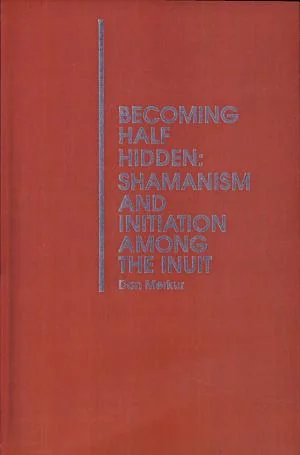
Becoming Half Hidden
 77
77

Becoming Half Hidden
Daniel Merkur's *Becoming Half Hidden* offers a refreshing perspective on shamanism by diligently attempting to re-center the shaman's own voice and lived experience. The book excels in its analytical approach to understanding the internal landscape of initiatory states, moving beyond mere cataloging of external behaviors. Merkur’s effort to penetrate the symbolic language of shamans is commendable, particularly in his analysis of trance states and the psychological transformations they entail. A notable strength lies in his detailed engagement with specific ethnographic accounts, allowing for a granular understanding of the concepts at play. However, the academic tone, while rigorous, can occasionally make the text dense for readers less familiar with anthropological theory. The discussion around the concept of the 'shaman's voice' itself, and the inherent difficulties in translating such profound subjective experience, is a particularly strong and revealing section. Merkur’s work provides a valuable, albeit challenging, contribution to the study of ecstatic traditions.
📝 Description
77
Daniel Merkur's 1993 book examines shamanism through the practitioner's subjective experience.
Daniel Merkur's "Becoming Half Hidden" offers a scholarly look at shamanism and initiation rites. The book prioritizes understanding the internal world and language of shamans to decode their transformative processes. Merkur moves beyond simple ethnographic accounts to address the psychological and spiritual dimensions of these practices. This work is suited for serious students of comparative religion, anthropology, and depth psychology. It appeals to those interested in altered states of consciousness and ritual, seeking rigorous analysis of spiritual traditions. Readers will engage with the core experiences of initiatory figures and find relevance in understanding the roots of altered states in shamanism.
Published in 1993, "Becoming Half Hidden" appeared during a period of renewed academic interest in shamanism. Merkur's work countered earlier, externally focused analyses by centering the shaman's internal voice. The book engages with late 20th-century anthropological debates about interpreting indigenous spiritual practices. It analyzes how shamanic experiences, while framed in specific cosmologies, share commonalities across societies, suggesting universal patterns in human spiritual development.
💡 Why Read This Book?
• Gain a deeper understanding of shamanic initiation by analyzing the practitioner's subjective experience, as explored through Merkur's focus on their unique language and internal states, which is a core element of the book's methodology. • Explore the psychological and spiritual dimensions of altered states of consciousness beyond simple ethnographic descriptions, as detailed in Merkur's examination of trance phenomena and their symbolic articulation. • Understand the academic context of shamanic studies prior to 1993 by engaging with Merkur's counterpoint to earlier dominant theories, offering a specific historical framing for his research.
⭐ Reader Reviews
Honest opinions from readers who have explored this book.
❓ Frequently Asked Questions
What is the primary goal of Daniel Merkur's *Becoming Half Hidden*?
The primary goal is to analyze shamanism and initiation from the perspective of the shamans themselves, seeking to understand their experiences by examining their language and internal states, rather than relying solely on external observation.
When was *Becoming Half Hidden* first published and what was the academic climate like?
The book was first published in 1993. It emerged during a period of active study in shamanism, offering a distinct perspective that contrasted with earlier dominant theories by prioritizing the practitioner's subjective experience.
How does Merkur approach the 'language' of shamans?
Merkur attempts to get 'behind' the shamans' language to understand the underlying experiences. This involves analyzing their symbolic expressions and narratives to decode the meaning of their trance states and initiatory journeys.
Who would benefit most from reading *Becoming Half Hidden*?
Students of comparative religion, anthropology, depth psychology, and those interested in altered states of consciousness and esoteric traditions would find this book valuable for its rigorous, insider-focused analysis.
Does the book offer practical shamanic techniques?
No, *Becoming Half Hidden* is a scholarly analysis and does not provide practical instructions for shamanic practices. Its focus is on understanding the phenomenon from the perspective of those who experience it.
What distinguishes Merkur's work from earlier studies on shamanism?
Merkur's work distinguishes itself by centering the shaman's subjective experience and internal language, a departure from earlier studies that often focused more on external observations and anthropological frameworks.
🔮 Key Themes & Symbolism
The Shaman's Subjective Reality
Merkur's central thesis is the necessity of understanding shamanism through the lens of the shaman's own consciousness. He argues against interpretations that reduce these profound experiences to mere social functions or psychological pathologies. By examining the symbolic narratives and linguistic structures employed by shamans, the work seeks to reveal the internal logic and felt reality of their initiatory journeys. This focus allows for an appreciation of shamanism as a distinct mode of knowing and being, deeply rooted in altered states of consciousness.
Initiation as Psychological Passage
The book posits that initiation rites, as experienced and described by shamans, represent a profound psychological transformation. Merkur analyzes the common stages and symbolic encounters within these rites, interpreting them as a structured passage through archetypal states of the psyche. This perspective frames initiation not just as a cultural milestone, but as an internal crucible that reshapes the individual's identity and perception of reality, often involving encounters with death and rebirth motifs.
The Language of Ecstasy
A significant aspect of *Becoming Half Hidden* is its exploration of the unique language shamans use to communicate their ecstatic experiences. Merkur studies the metaphorical, symbolic, and often paradoxical nature of this language, arguing it is not a distortion of ordinary speech but a necessary mode for conveying altered states. Understanding this 'language of ecstasy' is presented as key to unlocking the shaman's worldview and the efficacy of their practices within their cultural context.
Comparative Shamanic Structures
While emphasizing individual experience, Merkur also identifies recurring structural elements and themes across diverse shamanic traditions. The work compares various accounts of visionary journeys, spirit encounters, and transformative ordeals, suggesting underlying universal patterns in human consciousness when pushed to its limits. This comparative approach allows for a broader understanding of shamanism's place within the spectrum of human spiritual and psychological expression.
💬 Memorable Quotes
Direct passages from the work, attributed to the author.
“The aim has been to get behind the shamans' language in order to understand their experiences.”
— This statement captures Merkur's core methodological commitment: to move beyond surface-level descriptions of shamanic practices and study the subjective, experiential reality of the shaman, using their own linguistic and symbolic expressions as the primary data.
“Initiation is understood as a death and rebirth.”
— This concept underscores the transformative power attributed to initiation rites within shamanic traditions. It suggests that the process involves a symbolic dissolution of the old self and the emergence of a new, often spiritually empowered, identity.
“The shaman's experience is often one of confronting and integrating primal forces.”
— This interpretation points to the intense psychological nature of shamanic journeys, where practitioners are depicted as engaging with fundamental aspects of existence, often personified as spirits or energies, and integrating them into their being.
“The language used by shamans is a crucial key to their worldview.”
— This emphasizes Merkur's focus on semiotics and symbolic analysis within shamanism. The specific vocabulary, metaphors, and narrative structures employed by shamans are seen as direct windows into their unique understanding of reality and the cosmos.
💡 Key Ideas
Editorial paraphrase of the work's core concepts — not direct quotes.
Shamanism is not a religion but a set of techniques for entering into ecstasy.
This paraphrase highlights Merkur's functionalist view of shamanism, emphasizing the practical, skill-based nature of achieving altered states of consciousness, rather than viewing it solely through the lens of established dogma or belief systems.
🌙 Esoteric Significance
Tradition
While not strictly adhering to a single Western esoteric lineage like Hermeticism or Kabbalah, *Becoming Half Hidden* deeply informs the esoteric study of shamanism and ecstatic practices. It aligns with traditions that explore altered states of consciousness, visionary experiences, and the direct apprehension of spiritual realities. The work provides a scholarly framework for understanding the experiential core that underpins many esoteric disciplines, validating the profound nature of these inner journeys.
Symbolism
The book frequently touches upon universal shamanic symbols such as the 'axis mundi' (world tree or pillar) connecting realms, the 'spirit helper' or animal guide, and motifs of death and rebirth during initiation. These symbols, central to many esoteric cosmologies, are analyzed by Merkur not just as cultural markers but as expressions of deep psychological and spiritual archetypes encountered in altered states of consciousness.
Modern Relevance
Contemporary practitioners of Neo-shamanism, psychological researchers exploring consciousness, and scholars of comparative mysticism find Merkur's work highly relevant. Thinkers interested in the phenomenology of religious experience, the psychology of transformation, and the cross-cultural study of altered states frequently cite or draw upon his rigorous analysis of the shaman's perspective.
👥 Who Should Read This Book
• Students of comparative religion and anthropology seeking a rigorous, non-reductive analysis of shamanic traditions, particularly those interested in understanding the subjective dimensions of religious experience. • Psychologists and psychotherapists interested in altered states of consciousness, trance phenomena, and the psychological underpinnings of spiritual or initiatory journeys. • Esoteric practitioners and scholars of mysticism who wish to ground their understanding of ecstatic states and visionary practices within a scholarly framework derived from the direct experiences of shamans.
📜 Historical Context
Published in 1993, *Becoming Half Hidden* arrived as the academic study of shamanism was grappling with the legacy of scholars like Mircea Eliade, whose influential work had previously framed much of the discourse. Merkur's approach, prioritizing the shaman's internal perspective and linguistic framework, offered a critical counterpoint to more externally focused ethnographic or comparative analyses prevalent at the time. The late 20th century saw a burgeoning interest in altered states of consciousness and cross-cultural psychology, providing fertile ground for Merkur's detailed examination. While not directly engaging in public debate, Merkur’s work contributed to a broader scholarly shift towards valuing indigenous epistemologies and subjective experience within the study of religion and anthropology, moving away from purely structuralist or functionalist interpretations that dominated earlier decades.
📔 Journal Prompts
The shaman's language as a key to understanding their experiences.
Comparing the concept of initiation as death and rebirth across different traditions.
Reflecting on the distinction between shamanic techniques and religious dogma.
Analyzing the role of spirit helpers in shamanic narratives.
The internal logic of altered states of consciousness.
🗂️ Glossary
Shamanism
A religious or spiritual practice originating in indigenous cultures, characterized by a practitioner's ability to contact the spirit world and use this connection to heal, divine, or mediate between the human and spirit realms.
Initiation
A ritual or process through which an individual is formally admitted into a new status, order, or society, often involving symbolic death and rebirth, and leading to a transformation of consciousness or identity.
Altered States of Consciousness (ASC)
Any mental state significantly different from a normal waking state, often induced by specific techniques like meditation, trance, or the use of psychoactive substances, characterized by changes in perception, cognition, and emotion.
Ecstasy
A state of being or feeling beyond one's usual self, characterized by intense emotion, rapture, or profound spiritual or emotional excitement, often associated with trance and visionary experiences.
Phenomenology
A philosophical approach that focuses on the structure of consciousness as experienced from the first-person point of view, seeking to understand the essence of experiences without imposing external theories.
Ethnography
The scientific description of the customs and behaviors of individual peoples and cultures, typically involving immersive fieldwork and detailed observation of a specific group.
Symbolic Language
A system of communication that uses symbols (images, gestures, words) to represent ideas, concepts, or feelings, often employed in spiritual or psychological contexts to convey meanings not easily expressed through literal language.