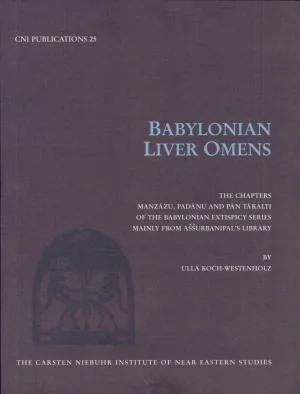
Babylonian Liver Omens
 71
71

Babylonian Liver Omens
Ulla Susanne Koch's "Babylonian Liver Omens" is a rigorous academic undertaking that sheds vital light on the mechanics of Mesopotamian divination. The meticulous editing of previously unpublished cuneiform texts concerning the front of the liver is its principal strength. Koch's detailed analysis of Akkadian terms, such as those related to the liver's anatomical features and their divinatory significance, is invaluable for specialists. However, the sheer density of philological detail and technical analysis might present a significant barrier for the non-specialist reader seeking a broader overview of Babylonian cosmology. The section detailing the interpretation of specific liver formations offers a window into the precise, almost scientific, methodology the Babylonians applied to their divinatory arts. While its academic rigor is undeniable, its accessibility could have been enhanced with more contextualization for those outside the immediate field of Assyriology. It is a crucial resource for understanding the intellectual foundations of divination.
📝 Description
71
Ulla Susanne Koch's 2007 book examines Babylonian liver omens through three unpublished texts.
This study provides a scholarly analysis of Mesopotamian divination, specifically extispicy, the interpretation of sacrificed animal entrails. Koch meticulously edits and discusses three previously unpublished sections of the canonical omen series, focusing on divinations derived from the front of the liver.
The work traces the textual traditions behind one of the earliest systematic attempts to understand and predict phenomena through observation and pattern recognition. It is intended for scholars of the ancient Near East, Assyriologists, and specialists in divination and proto-science. Advanced students and practitioners of esoteric traditions interested in the historical roots of divinatory practices will also find value. The book contributes to the understanding of intellectual history, the development of early scientific thought, and comparative religious studies through its detailed examination of primary source material.
Babylonian omen series, dating from the second millennium BCE, were integral to Babylonian statecraft and religious life. These texts reflect a sophisticated approach to pattern recognition and a desire to find order in cosmic signals. Koch's work makes newly accessible primary sources concerning the front of the liver, a significant area within extispicy.
Babylonian liver omens represent a foundational practice within ancient Mesopotamian divination, a tradition that sought to understand divine will and predict future events through the observation of natural phenomena. Extispicy, the specific method detailed in Koch's work, involved the meticulous examination of animal entrails, particularly the liver. This practice was deeply interwoven with religious belief and statecraft, reflecting a worldview where cosmic order and human affairs were interconnected. Understanding these omens offers insight into early attempts at systematic observation and pattern recognition, precursors to later forms of divination and scientific inquiry.
💡 Why Read This Book?
• Gain direct access to three newly edited chapters of the canonical Babylonian omen series, offering primary source material on extispicy that is otherwise unavailable. • Understand the precise Akkadian terminology used in Babylonian divination, providing a scholarly foundation for interpreting ancient Mesopotamian religious and intellectual practices. • Appreciate the development of early systematic inquiry by examining how Babylonian priests used liver omens as a form of proto-scientific observation and analysis.
⭐ Reader Reviews
Honest opinions from readers who have explored this book.
❓ Frequently Asked Questions
What is extispicy and how was it practiced in Babylonia?
Extispicy, or *barutu*, was a divinatory practice in ancient Babylonia involving the examination of the entrails of sacrificed animals, particularly sheep. Priests meticulously observed the shape, size, and markings of organs like the liver to interpret divine will and predict future events.
What is the significance of the liver in Babylonian divination?
The liver was considered a central organ for divination due to its perceived connection to the life force and its complex vascular system. Its various features and formations were believed to directly reflect divine messages or celestial influences.
What new material does Ulla Susanne Koch's book present?
The book presents the first-time publication and analysis of three chapters from the canonical Babylonian omen series that specifically focus on the front of the liver. This adds to our understanding of a key area within extispicy.
Who were the primary scholars or figures involved in the study of Babylonian omens?
While the original texts date back millennia, modern scholarship on Babylonian omens involves figures like Jean-Jacques Glassner and, through this work, Ulla Susanne Koch. The Babylonian priests themselves were the original compilers and interpreters.
How does Babylonian Liver Omens relate to the development of science?
The book frames Babylonian omen series, including liver omens, as among the earliest intellectual adventures of humankind into the realm of science. They represent a systematic attempt to observe, categorize, and predict phenomena.
What is the Akkadian language's role in this study?
Akkadian is the language in which the Babylonian omens were written. Koch provides a complete analysis of the Akkadian terms used in divination, offering crucial linguistic tools for understanding the texts.
🔮 Key Themes & Symbolism
Extispicy as Proto-Science
The work positions Babylonian divination, specifically extispicy from the liver, as a foundational step in humanity's intellectual journey towards scientific inquiry. It highlights the meticulous observation, cataloging of phenomena, and the search for predictable patterns that characterized these ancient practices, viewing them not as mere superstition but as early attempts to systematize knowledge and understand causality in the cosmos.
Akkadian Divinatory Lexicon
A central focus is the comprehensive analysis of Akkadian terms essential for understanding Babylonian divination. This includes the specific vocabulary used to describe the anatomy of the sheep's liver, the observed anomalies, and the resulting divinatory interpretations. Koch's work provides scholars with a precise linguistic key to unlock the nuances of these complex texts.
Canonical Omen Series
The book studies the structure and content of the canonical Babylonian omen series, particularly the ten chapters dedicated to extispicy. By editing and analyzing previously unpublished sections concerning the front of the liver, it offers new insights into the standardization and transmission of this vital divinatory knowledge across Mesopotamia.
The Front of the Liver
A specific emphasis is placed on the interpretation of omens derived from the anterior (front) section of the sheep's liver. This detailed focus allows for an examination of how particular anatomical regions and their variations were systematically correlated with specific divine messages and future outcomes.
💬 Memorable Quotes
Direct passages from the work, attributed to the author.
“The canonical version of the Babylonian omen series concerned with barutu: extispicy (divination from entrails of sheep), consisted of ten chapters or sub-series...”
— This statement frames the omen series as a structured, codified system of knowledge transmission, akin to later scientific disciplines, and identifies extispicy as its core divinatory method.
“...and are among the first intellectual adventures of Ancient Man into the field of science.”
— This interpretation elevates Babylonian omen compilation from simple religious practice to an early form of scientific exploration, emphasizing systematic observation and the quest for understanding natural phenomena.
“Three of these chapters, all concerned with the front of the liver, are edited here for the first time.”
— This highlights the book's contribution to scholarship by revealing new primary source material, specifically focusing on a crucial yet previously underexplored aspect of extispicy.
“Also, the book contains a complete analysis of the Akkadian terms used in divination...”
— This points to the essential linguistic and lexicographical contribution of the work, providing scholars with the necessary tools to accurately interpret the original cuneiform texts.
“...a complete index of texts and words, copies of the new-fo”
— This indicates the book's value as a comprehensive scholarly resource, offering extensive indices and textual reproductions that facilitate further research and study of Babylonian divination.
🌙 Esoteric Significance
Tradition
While not strictly aligned with a single Western esoteric lineage like Hermeticism or Kabbalah, Babylonian liver omens represent a foundational element in the broader history of divination and occult philosophy. This work connects to ancient Mesopotamian magical and religious systems, which often informed later esoteric traditions through Hellenistic and Arabic intermediaries. It provides a crucial historical antecedent to the divinatory arts practiced within many esoteric schools, offering a glimpse into one of humanity's earliest systematic attempts to commune with or interpret supernatural forces.
Symbolism
The liver itself, in Babylonian cosmology, was a potent symbol of life, fate, and the divine connection. Its surface, divided into sections representing celestial bodies or divine domains, and its vascular network, symbolizing the flow of life or cosmic energies, were rich grounds for symbolic interpretation. Specific markings, such as the 'gall bladder' or the 'right side' of the liver, carried distinct symbolic meanings tied to auspiciousness, divine favor, or impending doom.
Modern Relevance
Contemporary practitioners of Western esotericism, particularly those interested in comparative divination or the historical roots of magical practices, draw upon the study of Babylonian omens. Scholars and occultists researching the evolution of divination, the relationship between religion and early science, or Mesopotamian influences on later traditions find Koch's meticulous work indispensable for understanding these ancient methodologies.
👥 Who Should Read This Book
• Scholars of Ancient Near Eastern Studies: Gain access to critically edited primary source material and detailed linguistic analysis of Mesopotamian divination practices. • Students of Comparative Religion: Understand the role of divination in ancient societies and its impact on early religious thought and practice. • Esoteric Practitioners interested in historical divination: Explore the origins of divinatory systems and the intellectual framework behind one of the oldest documented forms of seeking divine knowledge.
📜 Historical Context
The compilation and study of Babylonian omen series, including extispicy, flourished primarily from the second millennium BCE through the Neo-Babylonian period (626-539 BCE). These texts emerged within a culture deeply invested in understanding divine will through meticulous observation of natural phenomena. This intellectual current stood in contrast to purely mythological explanations, seeking instead to establish empirical correlations, however interpreted. Scholars like A. Leo Oppenheim extensively documented Mesopotamian divination. The work by Koch builds upon this foundation, offering critical editions of specific liver omen texts previously unavailable to the wider scholarly community. These texts represent a sophisticated, textually transmitted tradition that was integral to Babylonian statecraft and religious practice, demonstrating an early form of intellectual systematization.
📔 Journal Prompts
The systematic cataloging of liver formations.
The function of Akkadian terms in divinatory interpretation.
The concept of omens as 'intellectual adventures'.
The significance of the front of the liver in extispicy.
Comparing Babylonian extispicy to modern scientific observation methods.
🗂️ Glossary
Extispicy
A form of divination involving the examination of the entrails of sacrificed animals, particularly the liver, to discern divine will or predict future events.
Barutu
The Akkadian term for extispicy, the practice of divination through the inspection of sacrificial animal entrails.
Akkadian
An ancient Semitic language spoken in Mesopotamia from the 3rd millennium BCE, used for administrative, literary, and religious texts, including omen series.
Omen Series
Collections of divinatory texts, often organized systematically, in ancient Mesopotamia that recorded observations and their purported interpretations.
Canonical
In this context, refers to the established, authoritative versions of the Babylonian omen series that were widely recognized and studied.
Liver Omens
A specific category of Babylonian omens derived from the observation and interpretation of the various parts and markings of a sacrificed sheep's liver.
Cuneiform
The wedge-shaped writing system used in ancient Mesopotamia for various languages, including Akkadian, on clay tablets.
This book appears in 1 collection
🔮 Readers Also Liked
Browse all →









From the “Divination” Collection
View all →









More Free Occult Philosophy Books
View all →