Aristotelische Naturphilosophie und christliche Kabbalah im Werk des Paulus Ritius
 72
72

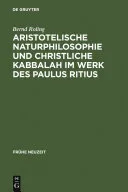
Aristotelische Naturphilosophie und christliche Kabbalah im Werk des Paulus Ritius
Bernd Roling’s study on Paulus Ritius is a rigorous scholarly endeavor that sheds light on a fascinating nexus of Aristotelianism and Kabbalah. The book excels in its detailed exposition of Ritius's philosophical architecture, particularly his attempts to harmonize seemingly disparate intellectual traditions. Roling’s meticulous research into Ritius's life and work, including his role as physician to the Habsburg court and his interactions with Erasmus and Reuchlin, provides crucial context for understanding his intellectual output. A particular strength lies in the analysis of Ritius's concept of the *Mundus Imaginalis*, which Roling explains as a bridge between the sensible and intelligible worlds, filtered through a Kabbalistic lens. However, the dense academic prose, while accurate, might present a barrier for readers not deeply immersed in Renaissance intellectual history. The work could have benefited from a more explicit discussion of how Ritius's medical theories directly informed his philosophical speculations. Despite this, Roling offers a compelling re-evaluation of a significant, yet often overlooked, Renaissance thinker.
📝 Description
72
Bernd Roling's 2009 study examines Paulus Ritius's synthesis of Aristotelianism and Christian Kabbalah.
Bernd Roling's "Aristotelische Naturphilosophie und christliche Kabbalah im Werk des Paulus Ritius" analyzes the intellectual world surrounding Paulus Ritius (Paolo Ricci). Ritius was a significant figure in Renaissance thought who combined Aristotelian natural philosophy with Christian Kabbalah. This fusion influenced German intellectual circles in the 16th century.
Roling details Ritius's engagement with Hebrew texts and his attempts to reconcile them with Christian beliefs. The book offers a thorough analysis of Ritius's philosophical system. It is particularly relevant for scholars of Renaissance philosophy, especially those interested in the intersection of Jewish mysticism and Christian ideas.
Historians of science and medicine will also find value here, given Ritius's position as a physician to Habsburg emperors. Students of esoteric traditions, comparative religion, and intellectual history will gain insight into how Kabbalistic concepts were received in early modern Europe. A basic understanding of both Aristotelianism and Kabbalah is recommended for readers.
The book situates Paulus Ritius's work within the early 16th-century intellectual environment. This era saw a growing interest in Humanism and ancient texts. Ritius, born Jewish and later converting to Christianity, occupied a unique position. His connections to figures like Erasmus and Reuchlin highlight his importance. Following Reuchlin's *De arte cabalistica* (1517), Christian scholars in Germany began to study and adapt the Kabbalah, often through theological reinterpretation. Roling places Ritius's philosophical project within this context of intellectual exchange.
💡 Why Read This Book?
• Understand the unique synthesis of Aristotelian natural philosophy and Christian Kabbalah as developed by Paulus Ritius, a key figure who mediated Italian Renaissance thought to Germany. • Grasp Ritius's innovative concept of the *Mundus Imaginalis*, exploring its role in connecting the divine, intellectual, and material realms within his philosophical system. • Appreciate the historical context of 16th-century German intellectual life, examining how figures like Ritius engaged with Hebrew sources and integrated Kabbalistic ideas into Christian frameworks, particularly following Reuchlin's influence.
⭐ Reader Reviews
Honest opinions from readers who have explored this book.
❓ Frequently Asked Questions
Who was Paulus Ritius and why is he important?
Paulus Ritius (Paolo Ricci, c. 1480–1541) was a physician to Habsburg emperors and a significant mediator of Italian Renaissance philosophy in Germany. His importance lies in his unique synthesis of Aristotelian natural philosophy with Christian Kabbalah, influencing intellectual discourse in the 16th century.
What is the relationship between Aristotelian philosophy and Kabbalah in Ritius's work?
Ritius sought to harmonize Aristotelian physics and metaphysics with the symbolic and theological systems of Kabbalah. He used Kabbalistic frameworks to reinterpret Aristotelian concepts and vice versa, creating a distinctive philosophical synthesis.
What was the significance of the *Mundus Imaginalis* for Ritius?
The *Mundus Imaginalis*, or 'imaginary world,' was central to Ritius's thought as a conceptual space that bridged the gap between the divine intellect and the physical world. It allowed him to integrate mystical insights with philosophical reasoning.
Who were some key contemporaries of Paulus Ritius mentioned in the book?
The book highlights Ritius's connections with prominent Renaissance figures such as Erasmus of Rotterdam and Johannes Reuchlin. His role as physician to Habsburg emperors also places him within the imperial court's intellectual circles.
What intellectual tradition does Bernd Roling's analysis engage with?
Bernd Roling's analysis engages deeply with the history of Renaissance philosophy, particularly the reception of Kabbalah, Aristotelianism, and the development of esoteric thought in early modern Europe.
What does 'Christian Kabbalah' refer to in this context?
Christian Kabbalah refers to the Renaissance Christian interpretation and adaptation of Jewish Kabbalistic texts and concepts. Scholars like Ritius sought to find Christian theological truths or allegorical meanings within these Hebrew mystical traditions.
🔮 Key Themes & Symbolism
Aristotelianism and Kabbalah
This theme explores the core of Ritius's philosophical project: the intricate synthesis of Aristotelian natural philosophy with the esoteric doctrines of Jewish Kabbalah. Roling demonstrates how Ritius didn't merely juxtapose these traditions but actively sought points of convergence, reinterpreting Aristotelian concepts through a Kabbalistic lens and vice versa. This integration aimed to create a comprehensive worldview that addressed both the rational and the mystical dimensions of existence, reflecting a broader Renaissance interest in reconciling diverse ancient wisdom traditions.
The Mundus Imaginalis
Central to Ritius's system is the concept of the *Mundus Imaginalis*, the 'imaginary world.' This realm functions as an intermediary between the divine intellect and the sensible, material world. Within Ritius's framework, it is a space where abstract ideas and divine intelligences can manifest in symbolic forms accessible to the human mind. Roling analyzes how this concept allowed Ritius to bridge the gap between philosophical speculation and mystical experience, providing a structure for understanding divine emanation and human cognition.
Christianized Kabbalah
The work investigates Ritius's efforts to develop a 'Christian Kabbalah.' As a convert from Judaism, Ritius engaged deeply with Hebrew mystical texts, seeking to uncover Christian theological truths within them. This involved allegorical interpretations and the adaptation of Kabbalistic symbolism to fit Christian doctrines. Roling contextualizes this within the broader trend of Christian Kabbalah in the Renaissance, highlighting Ritius's distinctive contributions and his role in mediating these ideas in Germany.
Renaissance Intellectual Mediation
Paulus Ritius (Paolo Ricci) emerges as a crucial intermediary figure, translating Italian Renaissance philosophical currents, particularly those concerning Kabbalah and Neoplatonism, into the German intellectual landscape. His position as physician to Habsburg emperors and his connections with figures like Erasmus and Reuchlin placed him at the heart of significant intellectual exchanges. Roling's study underscores Ritius's role in this transmission, showing how his unique philosophical synthesis contributed to the intellectual ferment of the 16th century.
💬 Memorable Quotes
Direct passages from the work, attributed to the author.
“Ritius united Aristotelian natural philosophy with Christian Kabbalah.”
— This highlights the central thesis of Roling's work, focusing on Ritius's groundbreaking attempt to create a cohesive philosophical system by merging two seemingly disparate intellectual traditions prevalent in the Renaissance.
“Paulus Ritius was a physician to Habsburg emperors.”
— This factual statement grounds Ritius's intellectual activities in his historical and social context, indicating his influence and access within the highest echelons of 16th-century European power.
“Ritius's work engaged with Hebrew texts for Christian theological insights.”
— This points to the practice of Christian Kabbalah, illustrating Ritius's specific methodology in extracting and reinterpreting Jewish mystical traditions to support Christian doctrines.
“He was a friend of Erasmus of Rotterdam and Johannes Reuchlin.”
— This contextualizes Ritius within the prominent intellectual network of the Renaissance, showing his connections to leading humanist scholars and early Kabbalah enthusiasts.
💡 Key Ideas
Editorial paraphrase of the work's core concepts — not direct quotes.
The *Mundus Imaginalis* served as a bridge between the sensible and intelligible worlds.
This paraphrased concept explains a key element of Ritius's philosophy, emphasizing the function of the 'imaginary world' as a mediator in his metaphysical and epistemological framework.
🌙 Esoteric Significance
Tradition
This work sits squarely within the Western Esoteric Tradition, specifically focusing on the Renaissance Hermetic and Kabbalistic revival. It exemplifies the Christian Kabbalah movement, where Jewish mystical concepts were adopted and reinterpreted within a Christian theological framework. Ritius’s synthesis departs from purely Jewish Kabbalah by infusing it with Aristotelian metaphysics and Christian doctrine, creating a unique syncretic philosophy that aimed to reveal universal divine truths through multiple traditions.
Symbolism
A key symbol explored is the *Mundus Imaginalis*, representing the intermediary area of imagination and symbolic forms through which divine ideas descend and are apprehended. Another motif is the Tree of Life (Sefirot), which Ritius likely employed not just as a cosmological map but as a symbolic structure for understanding both divine emanation and the organization of knowledge, potentially linking its stages to Aristotelian categories or medical principles.
Modern Relevance
Contemporary esoteric scholars and practitioners interested in the history of syncretism and the development of Western magical and philosophical traditions find Ritius’s work highly relevant. His methods of integrating diverse cosmological systems inform modern attempts to synthesize occult philosophies. Thinkers exploring the relationship between consciousness, imagination, and reality, particularly within Hermetic and Kabbalistic studies, draw upon the intellectual groundwork laid by figures like Ritius.
👥 Who Should Read This Book
• Scholars of Renaissance intellectual history: Gain a nuanced understanding of the cross-cultural exchange of ideas, particularly the reception of Kabbalah in Christian Europe. • Students of esoteric traditions: Explore the historical development of Christian Kabbalah and syncretic philosophies, focusing on a key 16th-century practitioner. • Researchers in comparative religion and philosophy: Analyze how Ritius attempted to reconcile Aristotelianism, a core part of Western philosophy, with the mystical framework of Kabbalah.
📜 Historical Context
The early 16th century in Germany was a fertile ground for intellectual synthesis, particularly concerning religious and philosophical traditions. Following Johannes Reuchlin's pioneering work on Kabbalah, such as his *De arte cabalistica* (1517), Christian scholars increasingly explored Hebrew mystical texts, seeking esoteric wisdom and theological validation. Paulus Ritius (Paolo Ricci), a physician of Jewish origin who converted to Christianity, embodied this intellectual trend. His work emerged within the context of Renaissance Humanism, which encouraged the study of ancient languages and texts, including Hebrew. Ritius's unique contribution lay in his sophisticated integration of Aristotelian natural philosophy with these Kabbalistic elements, creating a distinctive philosophical system. His close association with figures like Erasmus of Rotterdam placed him at the center of humanist discourse, while his position as physician to Habsburg emperors gave his ideas significant reach. This era also saw ongoing debates about the interpretation of scripture and the nature of divine knowledge, making Ritius's attempts to bridge different traditions particularly relevant.
📔 Journal Prompts
The synthesis of Aristotelian natural philosophy and Christian Kabbalah in Ritius's work.
Paulus Ritius's conception of the *Mundus Imaginalis* as a bridge between worlds.
The challenges and opportunities of integrating Hebrew mystical concepts into a Christian theological framework.
Johannes Reuchlin's influence on the Christian understanding of Kabbalah in the 16th century.
The role of physicians like Ritius in shaping Renaissance philosophical discourse.
🗂️ Glossary
Aristotelian Natural Philosophy
The study of the natural world based on the principles and writings of Aristotle, focusing on concepts like substance, form, matter, causality, and teleology, prevalent in medieval and Renaissance European thought.
Christian Kabbalah
A Renaissance movement where Christian scholars studied and reinterpreted Jewish Kabbalistic texts, seeking to find Christian theological truths, allegorical meanings, and esoteric wisdom within them.
Paulus Ritius (Paolo Ricci)
A 16th-century physician and philosopher, known for his conversion from Judaism to Christianity and his significant role in mediating Italian Renaissance philosophy, particularly Christian Kabbalah, in Germany.
Mundus Imaginalis
Latin for 'imaginary world'; a concept representing an intermediary area of imagination and symbolic forms, crucial in Ritius's philosophy for connecting the divine intellect with the material world.
Beweistheorie
German for 'theory of proof'; refers to Ritius's work on epistemological methods and how knowledge, particularly esoteric knowledge, can be established or demonstrated.
Renaissance Humanism
An intellectual movement of the Renaissance focused on classical antiquity, emphasizing human potential, reason, and the study of the humanities (grammar, rhetoric, history, poetry, moral philosophy).
Johannes Reuchlin
A key German humanist and scholar of the Renaissance, considered one of the 'fathers of humanism.' His work on Hebrew and Kabbalah, particularly *De arte cabalistica*, was highly influential.