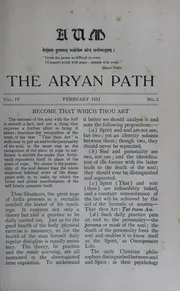
Annie Besant
 77
77

Annie Besant
Annie Besant's 1920 text is less a narrative and more a systematic presentation of her Theosophical worldview. The strength lies in its directness; Besant articulates complex ideas with a clarity born of deep conviction and extensive study. Her discussion on the law of karma, for instance, is presented not as abstract theory but as a fundamental principle of cosmic justice and evolution, offering a glimpse into how such concepts were integrated into a practical spiritual philosophy. A notable limitation, however, is the inherent reliance on Theosophical jargon, which can present a barrier to those unfamiliar with the specific terminology. Without prior context, certain sections discussing planes of existence or specific spiritual hierarchies may feel dense. Nevertheless, the work is valuable for its unfiltered exposition of a pivotal figure's thought.
📝 Description
77
Published in 1920, Annie Besant's book articulates the esoteric principles that guided her significant work.
This volume is not a standard biography but an exposition of the philosophies that shaped Annie Besant's extensive involvement in spiritual and intellectual circles. It grants readers direct access to her views on subjects that influenced early 20th-century occultism. The book is aimed at students of esoteric traditions, particularly those interested in Theosophy and its main figures. It will appeal to readers researching the development of spiritual philosophies in the late Victorian and Edwardian eras, and those who value primary source material from influential thinkers. The work originates from a time of considerable spiritual and philosophical change in Europe and America. The late 19th and early 20th centuries saw renewed interest in Eastern religions, mysticism, and occult sciences, often channeled through organizations like the Theosophical Society. Besant, a prolific writer, became a central figure in this movement after joining in 1889. This period also involved reconciling scientific progress with spiritual ideas, a tension present in many works of the time.
Annie Besant's book emerges from the Theosophical movement, which experienced a surge in the late 19th and early 20th centuries. This spiritual philosophy, co-founded by Helena Blavatsky, sought to synthesize Eastern and Western esoteric traditions. Besant, a key figure and later president of the Theosophical Society, articulated its core tenets. Her writings often engaged with contemporary scientific and philosophical discourse, attempting to bridge perceived divides between materialism and spirituality. The book reflects this milieu, addressing concepts central to Theosophical thought.
💡 Why Read This Book?
• Understand Annie Besant's core philosophical tenets regarding karma and reincarnation, gaining insight into how these concepts were foundational to early 20th-century Theosophy. • Explore the Theosophical cosmology presented in the book, including its hierarchical structures and evolutionary pathways, which offers a unique perspective on spiritual development. • Grasp Besant's articulation of universal laws governing existence, providing a framework for understanding the interconnectedness of consciousness and matter as presented in her era.
⭐ Reader Reviews
Honest opinions from readers who have explored this book.
❓ Frequently Asked Questions
When was Annie Besant first published?
The work "Annie Besant" was first published in 1920, positioning it within the early 20th-century landscape of esoteric thought and Theosophy.
What is the primary esoteric tradition discussed in Annie Besant's book?
The primary esoteric tradition explored is Theosophy, a movement Annie Besant was deeply involved in, particularly after joining Helena Blavatsky's society.
Does the book offer biographical details about Annie Besant?
While it reflects Besant's personal philosophical stance, the book primarily serves as an exposition of her esoteric and Theosophical views rather than a detailed personal biography.
What are some key concepts covered in Annie Besant's work?
Key concepts include karma, reincarnation, the nature of consciousness, universal laws, and the evolutionary path of humanity and the cosmos, all viewed through a Theosophical lens.
Who was Helena Blavatsky in relation to Annie Besant?
Helena Blavatsky was the co-founder of the Theosophical Society. Annie Besant joined the society in 1889 and became a leading figure, eventually succeeding Blavatsky as its president.
Is this book suitable for beginners in esoteric studies?
It can be challenging for absolute beginners due to its specific terminology, but it is highly valuable for those interested in the history and core teachings of Theosophy.
🔮 Key Themes & Symbolism
The Law of Karma
Besant's work extensively elaborates on the principle of karma, presenting it not merely as retribution but as a fundamental law of cause and effect that governs the moral and spiritual universe. The text explores how actions create consequences that shape individual destinies across multiple lifetimes, emphasizing its role in spiritual evolution and the unfolding of cosmic justice. This concept is central to understanding the Theosophical perspective on suffering and progress.
Reincarnation and Evolution
Central to Besant's philosophy is the doctrine of reincarnation, viewed as the mechanism through which individual souls progress through successive physical existences. The book details this process as an integral part of a grand evolutionary scheme, not just for humanity but for the cosmos itself. It posits that each incarnation offers opportunities for learning, purification, and the development of higher consciousness, driving the soul towards its ultimate spiritual realization.
Universal Laws and Consciousness
The text posits that existence is governed by immutable universal laws, which Besant seeks to illuminate. These laws apply to the material world as well as the subtler planes of consciousness. The book discusses the nature of consciousness itself, suggesting it is fundamental and pervasive, and that human awareness is but one manifestation within a vast, interconnected spiritual hierarchy. Understanding these laws is presented as key to aligning oneself with the cosmic order.
Theosophical Cosmology
Besant outlines a comprehensive cosmological framework inherited from Theosophy, describing various planes of existence, elemental beings, and spiritual hierarchies that populate the universe. This intricate structure serves to explain the diverse phenomena of life and consciousness, providing a map for spiritual aspirants. The work details the processes of cosmic evolution and involution, illustrating the cyclical nature of creation and the ordered progression of all forms of life.
💬 Memorable Quotes
Direct passages from the work, attributed to the author.
“The universe is a manifestation of Spirit, and matter is its vehicle.”
— This statement captures the monistic underpinnings of Besant's Theosophy, asserting that all phenomena, from the densest material object to the most subtle thought, originate from a single, divine spiritual essence.
“Each plane of existence has its own laws and inhabitants.”
— This captures the hierarchical view of reality common in Theosophy, where the universe is structured into distinct levels or dimensions, each with its unique characteristics and forms of life.
“The ultimate goal is the realization of the divine within the human.”
— This points to the soteriological aim of Besant's teachings – the process of spiritual awakening and self-realization, where the individual consciousness recognizes its inherent unity with the divine source.
“Humanity's path is one of progressive spiritual unfoldment.”
— This interpretation emphasizes Besant's optimistic view of human destiny, framing existence as a journey of continuous development towards higher states of awareness and spiritual perfection.
💡 Key Ideas
Editorial paraphrase of the work's core concepts — not direct quotes.
Karma is the engine of evolution, driving souls through cycles of experience.
This paraphrased concept highlights Besant's view of karma as a dynamic force, essential for spiritual growth. It suggests that karmic consequences are not punitive but educational, facilitating the soul's journey through repeated lives.
🌙 Esoteric Significance
Tradition
This work is firmly rooted in the Theosophical tradition, which itself draws heavily from Neoplatonism, Hinduism (particularly Vedanta and Yoga), Buddhism, and Hermeticism. Besant's exposition presents a systematized version of Theosophy, emphasizing universal laws, reincarnation, and karma as central tenets. It fits within the tradition by offering a comprehensive philosophical framework intended to explain the cosmos and humanity's place within it, departing primarily through its specific articulation and organizational leadership.
Symbolism
The concept of the 'Monad' is a key symbolic motif, representing the divine spark within each being, the ultimate spiritual essence that undergoes the evolutionary journey. Another significant symbolic element is the 'planes of existence' – often visualized as nested spheres or dimensions, representing different levels of consciousness and reality, from the densest physical to the most rarefied spiritual.
Modern Relevance
Contemporary New Age spirituality and various forms of modern occultism continue to draw upon the foundational concepts laid out by Theosophists like Besant. Her articulation of karma, reincarnation, and subtle energy systems informs many modern spiritual practices and belief systems. Thinkers and practitioners interested in comparative religion, consciousness studies, and alternative spiritual histories frequently reference Besant's contributions to the esoteric landscape.
👥 Who Should Read This Book
• Students of Theosophy: Those seeking to understand the foundational teachings and philosophical underpinnings of the Theosophical movement directly from a key leader. • Researchers of Esoteric History: Scholars interested in the intellectual currents of the late 19th and early 20th centuries and the development of Western occultism. • Aspiring Spiritual Philosophers: Individuals looking for a comprehensive, though dense, system of thought that attempts to explain existence, consciousness, and the human spiritual journey.
📜 Historical Context
Published in 1920, Annie Besant's work emerged during a period of significant spiritual and intellectual exploration, following the widespread influence of Helena Blavatsky's Theosophical Society. The late 19th and early 20th centuries witnessed a reaction against prevailing materialism and scientific rationalism, leading many to seek alternative explanations in mysticism, Eastern religions, and occultism. Besant herself was a formidable orator and writer who, after joining the Theosophical Society in 1889, rose to become its president, propagating its doctrines globally. This era also saw the rise of other spiritual movements, such as Spiritualism and Anthroposophy, founded by Rudolf Steiner, who had himself been a prominent member of the Theosophical Society before his departure in 1913. Besant's writings aimed to synthesize esoteric traditions and present a coherent spiritual philosophy, engaging with scientific discoveries of the time and seeking to offer a universalist perspective.
📔 Journal Prompts
Reflect on the principle of karma as presented in Besant's work and its implications for personal responsibility.
Consider the concept of reincarnation and its role in the evolutionary path described.
Analyze the hierarchy of spiritual beings and planes of existence as outlined by Besant.
How does Besant's view of universal laws contrast with scientific principles?
Explore the idea of the Monad as the divine spark within human consciousness.
🗂️ Glossary
Theosophy
A mystical-philosophical system founded in the late 19th century, seeking to understand divine wisdom. It emphasizes universal brotherhood, comparative religion, and the study of ancient traditions and unexplained laws of nature.
Karma
In Theosophy, the universal law of cause and effect that governs all existence. It dictates that every action has a consequence, shaping an individual's destiny across multiple lifetimes.
Reincarnation
The doctrine that the soul, after death, is reborn into a new physical body. This process is seen as a means of spiritual evolution and learning through successive lives.
Monad
The ultimate spiritual principle or divine spark within an individual, considered to be eternal and unchanging, which journeys through the cycle of reincarnation and evolution.
Planes of Existence
Different levels or dimensions of reality, ranging from the physical to the purely spiritual, each with its own laws, forms, and inhabitants, as described in Theosophical cosmology.
Universal Laws
Fundamental principles believed to govern the entire cosmos, encompassing moral, spiritual, and physical aspects of existence, as expounded in esoteric philosophies like Theosophy.
Evolution
In the Theosophical context, a broad process of unfolding and development that applies not only to physical forms but also to consciousness, spirit, and the cosmos itself over vast cycles of time.
🔮 Readers Also Liked
Browse all →



More by Annie Wood Besant
All books →




More Free Theosophy & Anthroposophy Books
View all →