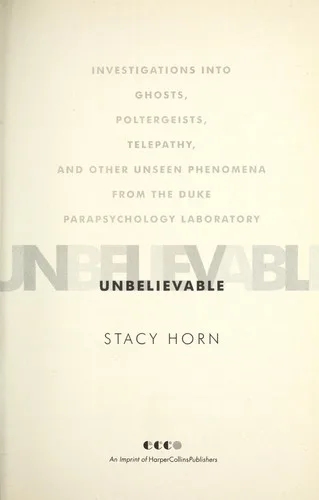
Unbelievable
 76
76

Unbelievable
Stacy Horn’s "Unbelievable" offers a compelling, if sometimes disquieting, exploration of those who live with experiences others deem impossible. Horn’s strength lies in her almost anthropological detachment, presenting the detailed accounts of individuals who claim contact with the supernatural, alien abduction, or psychic phenomena without immediate judgment. The work truly shines when it dissects the psychological underpinnings of these beliefs, particularly the narrative construction that allows these experiences to cohere within a person’s life. A notable passage describes the intense social isolation reported by abductees, highlighting how their extraordinary claims often alienate them from everyday society. However, the book occasionally feels like it’s circling a definitive conclusion without fully landing, leaving the reader with a lingering sense of incompletion regarding the ultimate nature of the phenomena discussed. It is a valuable text for understanding belief, though less so for understanding the unbelievable itself.
📝 Description
76
Stacy Horn's 2009 book examines individuals claiming paranormal experiences.
Published in 2009, Stacy Horn's "Unbelievable" meticulously examines individuals who report extraordinary experiences, particularly those involving the paranormal. The book moves beyond simple anecdote, analyzing the psychological, social, and cultural factors that shape belief in the unbelievable. Horn probes the boundaries between delusion, perception, and genuine phenomena, treating her subjects with a serious, analytical gaze. This work is suited for readers fascinated by the intersection of psychology and the supernatural, skeptics interested in the mechanics of belief, and those who appreciate a non-sensationalist approach to paranormal claims. It will appeal to individuals who enjoy deep dives into case studies and understanding the human element behind extraordinary accounts.
"Unbelievable" emerged during a period of renewed popular interest in paranormal investigation and skepticism, following the boom of reality television shows dedicated to ghost hunting and UFO sightings. Horn's approach distinguished itself by focusing on the internal experiences of believers rather than validating or debunking external claims. This era saw continued academic debate, a backdrop against which Horn’s work contributes to public discourse on belief.
While not strictly esoteric in the occult sense, "Unbelievable" engages with phenomena often relegated to the fringes of mainstream understanding. It sits within a broader tradition of examining subjective realities and altered states of consciousness that have long interested spiritualists and parapsychologists. Horn's work analyzes the psychological architecture that supports beliefs in the paranormal, a topic that echoes historical investigations into spiritualism and mediumship, albeit through a modern psychological lens. The book addresses how individuals construct meaning from experiences that defy conventional explanation, a core concern for those who explore the nature of consciousness beyond ordinary perception.
💡 Why Read This Book?
• Gain insight into the psychological frameworks that support belief in extraordinary claims, as illustrated by the detailed case studies of individuals Horn profiles. • Understand the social dynamics surrounding unusual experiences, examining how societal acceptance or rejection can shape an individual's narrative, referencing the 2009 publication context. • Learn about the concept of confabulation as explored in the book, providing a lens through which to view personal testimonies that challenge conventional reality.
⭐ Reader Reviews
Honest opinions from readers who have explored this book.
❓ Frequently Asked Questions
What is the primary focus of Stacy Horn's "Unbelievable"?
"Unbelievable" centers on individuals who report paranormal or supernatural experiences. It meticulously examines the psychological, social, and cultural factors that shape their beliefs, rather than solely focusing on validating or debunking the experiences themselves.
When was Stacy Horn's "Unbelievable" first published?
Stacy Horn's "Unbelievable" was first published in 2009, placing it within a period of significant public engagement with paranormal themes.
Does "Unbelievable" offer proof of paranormal phenomena?
No, the book does not aim to provide definitive proof of paranormal phenomena. Instead, it explores the subjective reality of those who believe they have experienced such events and the mechanisms behind these beliefs.
Who would benefit from reading "Unbelievable"?
Readers interested in psychology, sociology, the nature of belief, and skeptical inquiry into extraordinary claims will find "Unbelievable" particularly rewarding.
What distinguishes Horn's approach in "Unbelievable"?
Horn's approach is analytical and non-sensationalist. She treats the subjects' narratives seriously, exploring the internal logic and personal significance of their experiences with empathy.
Are there specific case studies discussed in the book?
Yes, "Unbelievable" features detailed examination of various individuals and their extraordinary claims, serving as the foundation for Horn's analysis of belief formation and experience.
🔮 Key Themes & Symbolism
The Architecture of Belief
Horn meticulously dissects how individuals construct and maintain belief in experiences that defy conventional understanding. This involves exploring the narrative coherence individuals impose on disparate events, often drawing from cultural archetypes or personal trauma. The work examines how, for the believer, these extraordinary occurrences form a logical, albeit unconventional, framework for their reality. It’s less about the external validity of the claim and more about the internal psychological necessity it fulfills for the experiencer, particularly in the context of the early 21st century's media landscape.
Subjectivity vs. Objectivity
A central theme is the tension between subjective experience and objective reality. Horn illustrates how powerfully personal perception can shape an individual's world, even when those perceptions are at odds with empirical evidence. The book probes the limitations of external validation when dealing with deeply personal, transformative events. It highlights how societal skepticism can isolate individuals, reinforcing the subjective reality of their experiences as the only space where they are understood or validated, a dynamic often intensified by the internet's rise.
The Social Dimension of the Unbelievable
The book explores how social context influences the reporting and reception of extraordinary claims. Horn considers how cultural narratives, peer groups, and even therapeutic practices can shape the language and understanding of unusual experiences. She examines the isolation felt by those whose experiences are dismissed and the potential formation of subcultures or communities where such claims are accepted. This social framing is crucial to understanding why certain beliefs gain traction and how they are sustained against widespread disbelief.
Psychological Mechanisms of Extraordinary Experience
Horn explores various psychological phenomena that might contribute to or explain reported extraordinary experiences. Concepts like confabulation, suggestibility, and the impact of trauma are discussed not as dismissals, but as potential frameworks for understanding the subjective reality of the experiencer. The book posits that these internal mechanisms are potent forces in shaping one's perception of reality, offering a psychological lens through which to view claims of the paranormal, alien contact, or psychic abilities.
💬 Memorable Quotes
Direct passages from the work, attributed to the author.
“The line between delusion and reality is often drawn by social consensus.”
— This interpretation suggests that what is deemed 'real' or 'unreal' is frequently determined not by inherent truth, but by collective agreement within a society. Horn's work explores how this consensus can marginalize individuals with experiences outside the norm.
“Belief in the impossible can provide a structure for the chaotic.”
— This highlights how embracing extraordinary narratives can serve a psychological function, offering order and meaning to individuals experiencing profound personal upheaval or inexplicable events. It speaks to the human need for coherence.
“The experiencer's narrative holds its own undeniable truth.”
— This interpretation suggests that regardless of external validation, the subjective reality and personal meaning derived from an extraordinary experience are profoundly real for the individual who underwent it.
“We often see what we are prepared to believe.”
— This aphorism captures the essence of confirmation bias and the power of expectation in perception. Horn uses this idea to explore how pre-existing beliefs can influence the interpretation of ambiguous or unusual events.
💡 Key Ideas
Editorial paraphrase of the work's core concepts — not direct quotes.
Anecdotes, however strange, shape the range of human understanding.
This paraphrased concept emphasizes the power of personal stories, even those considered unbelievable, in influencing how we perceive the world and what we consider possible. It underscores the importance of individual testimony.
🌙 Esoteric Significance
Tradition
While not strictly tied to a single esoteric lineage, "Unbelievable" engages with themes often explored in Gnostic and Hermetic thought concerning altered states of consciousness and the nature of perceived reality. It examines the subjective experience of the 'numinous' or the 'otherworldly' from a psychological perspective, which indirectly touches upon how individuals interpret encounters with what might be considered non-ordinary intelligence or dimensions within esoteric traditions. Horn's work offers a secular lens on phenomena that esotericists might interpret through spiritual or metaphysical frameworks.
Symbolism
The book implicitly engages with the symbolism of the 'stranger' or the 'other' – whether alien, ghost, or divine messenger – as a projection of the psyche or an external force. The recurring motif of abduction or visitation can symbolize a profound rupture in an individual's reality, forcing a re-evaluation of self and world. The 'unbelievable' itself functions as a symbol for that which lies beyond rational comprehension, challenging the boundaries of accepted knowledge and personal identity.
Modern Relevance
Contemporary discussions on consciousness, psychedelics, and the philosophical implications of simulated reality echo the questions raised in "Unbelievable." Thinkers exploring altered states, the neuroscience of belief, and the impact of digital culture on perception find Horn's analysis relevant. Practices like mindfulness and certain therapeutic approaches that focus on accepting subjective experience also align with the book's exploration of internal reality, making it a touchstone for understanding the human interface with the inexplicable in the 21st century.
👥 Who Should Read This Book
• Individuals fascinated by the psychology of belief and the formation of extraordinary narratives, seeking to understand the 'why' behind claims of the paranormal. • Skeptics and critical thinkers interested in dissecting the mechanisms of perception, suggestibility, and confabulation in real-world case studies. • Researchers in sociology and comparative religion who study how unusual experiences are framed, shared, and integrated (or rejected) within societal structures.
📜 Historical Context
When "Unbelievable" was released in 2009, the cultural landscape was saturated with paranormal content, fueled by reality television and internet forums. Skeptical inquiry, championed by figures like Carl Sagan in earlier decades, continued to grapple with the widespread public fascination for UFOs, ghosts, and psychic phenomena. Horn's work emerged as a counterpoint to sensationalist approaches, offering a grounded, psychological analysis of belief. Unlike the more credulous portrayals prevalent in popular media, Horn focused on the internal lives of experiencers. Her approach can be seen as engaging with the intellectual currents of cognitive psychology and sociology of belief, which sought to understand the mechanics of conviction rather than the veracity of the claims themselves. The book’s reception likely positioned it within a broader academic and public discourse about the nature of evidence and the psychology of conviction.
📔 Journal Prompts
The social consensus surrounding extraordinary claims: when does it become a barrier?
Confabulation as a narrative tool: how might personal histories resemble unbelievable accounts?
The experiencer's narrative: what internal truths might it reveal, even if externally unverifiable?
Belief in the impossible: what psychological needs might it fulfill, as explored in the book?
The subjective reality of the 'other': how does the book challenge objective interpretations of experience?
🗂️ Glossary
Confabulation
The production of fabricated or misinterpreted memories about oneself or the world, without the conscious intention to deceive. In "Unbelievable," it's explored as a mechanism for creating coherent narratives from fragmented or unusual experiences.
Suggestibility
The quality of being inclined to accept or believe what is suggested. Horn examines how suggestibility can influence the interpretation and reporting of experiences, particularly in contexts where external pressures or leading questions are present.
Subjective Reality
An individual's personal perception and interpretation of the world, shaped by their unique experiences, beliefs, and psychological state. The book emphasizes the lasting impact of subjective reality on an individual's life.
Narrative Coherence
The logical consistency and comprehensibility of a story or account. Horn analyzes how individuals construct narrative coherence around extraordinary events to make sense of them within their own framework.
Social Consensus
The collective agreement or shared belief within a group or society regarding a particular issue or phenomenon. The book discusses how social consensus defines the boundaries of what is considered 'believable'.
Phenomenology
The philosophical study of the structures of experience and consciousness from the first-person point of view. Horn's approach, while psychological, touches on phenomenological aspects by focusing on the lived experience of believers.
Esoteric
Intended for or likely to be understood by only a small number of people with a specialized knowledge or interest. While the book is not strictly esoteric, it explores phenomena often relegated to esoteric discourse.
🔮 Readers Also Liked
Browse all →







More Free Theosophy & Anthroposophy Books
View all →