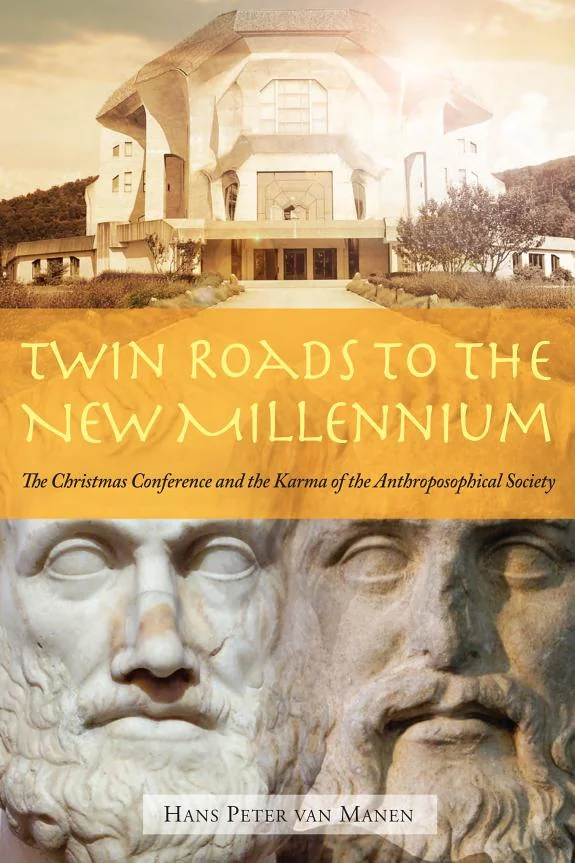
TWIN ROADS TO THE NEW MILLENIUM
 78
78

TWIN ROADS TO THE NEW MILLENIUM
Van Manen's study of the Anthroposophical Movement's spiritual and karmic underpinnings is a rigorous, if demanding, piece of scholarship. He avoids easy answers, instead constructing a dense argument that connects the movement's origins to ancient philosophical streams, specifically the Aristotelian and Platonic traditions as interpreted by Rudolf Steiner. The book's strength lies in its detailed tracing of these karmic connections, offering a perspective rarely found in more general introductions to Anthroposophy. However, the dense prose and reliance on specific Anthroposophical terminology can present a significant barrier to entry for those not already familiar with the subject matter. A particularly illuminating section discusses the "streams of destiny" influencing the movement's development. Ultimately, "Twin Roads to the New Millennium" serves as an essential, though specialized, text for understanding the esoteric architecture of a major 20th-century spiritual impulse.
📝 Description
78
Hans Peter van Manen's 2014 book examines the spiritual currents of the Anthroposophical Movement.
Hans Peter van Manen's "Twin Roads to the New Millennium" analyzes the spiritual and karmic forces within the Anthroposophical Movement. The book traces historical and esoteric links between older philosophical ideas and modern spiritual science that Rudolf Steiner inspired. It moves past simple explanations to show spiritual evolution as a process of karma and destiny.
This study is for researchers of Western esotericism, especially those interested in Anthroposophy and Rudolf Steiner's work. It helps readers understand the karmic patterns and historical factors that shaped spiritual movements of the 20th century. Those who appreciate detailed historical analysis based on esoteric principles will find value here.
The book was published before the turn of the millennium and discusses the spiritual and societal changes expected then. It places Anthroposophy within a larger historical and philosophical context, referencing Aristotelian and Platonic traditions Steiner discussed in 1924 lectures. Van Manen also considers the early 21st century's intellectual climate, showing how past spiritual movements influence today's.
The book engages with the Theosophical and Anthroposophical traditions, particularly the spiritual-scientific work of Rudolf Steiner. It situates Steiner's movement within a lineage of Western esotericism, connecting it to earlier philosophical streams like Platonism and Aristotelianism as interpreted by Steiner. Van Manen uses concepts central to these traditions, such as karma and reincarnation, to explain the development and trajectory of spiritual movements in the 20th and early 21st centuries.
💡 Why Read This Book?
• Gain a nuanced understanding of the karmic lineage of the Anthroposophical Movement, specifically how it draws from Aristotelian and Platonic traditions as discussed in Steiner's 1924 lectures. • Explore the concept of "streams of destiny" and how van Manen interprets their influence on the formation and trajectory of spiritual societies. • Understand the spiritual-scientific context of the early 21st century through the lens of karma and reincarnation, as presented in the book's analysis.
⭐ Reader Reviews
Honest opinions from readers who have explored this book.
❓ Frequently Asked Questions
What is the primary focus of "Twin Roads to the New Millennium"?
The book's primary focus is the spiritual and karmic background of the Anthroposophical Movement, tracing its roots in ancient philosophical traditions and the work of Rudolf Steiner.
When was "Twin Roads to the New Millennium" first published?
The book was first published on June 3, 2014.
Who is the author of "Twin Roads to the New Millennium"?
The author is Hans Peter van Manen.
What specific lectures by Rudolf Steiner are referenced?
The book references Rudolf Steiner's lectures on karma given in 1924, which discussed the Aristotelian and Platonic traditions.
What esoteric concepts does the book explore?
It explores concepts such as karma, reincarnation, spiritual evolution, and the destiny of spiritual movements.
Is this book suitable for beginners in esotericism?
While offering valuable insights, the book's dense academic style and specific terminology make it more suitable for those with prior knowledge of Anthroposophy and Western esotericism.
🔮 Key Themes & Symbolism
Karmic Threads
Van Manen meticulously investigates the concept of karma as a driving force behind the formation and evolution of spiritual movements. The book posits that individual and collective karmic patterns, stretching back through historical epochs, actively shape the spiritual impulses that emerge in human history. This is particularly applied to understanding the specific destiny that befell the Anthroposophical Society and its related movements, connecting it to earlier spiritual-scientific endeavors and the foundational work of Rudolf Steiner.
Ancient Streams of Destiny
The work highlights how historical spiritual traditions, specifically the Aristotelian and Platonic streams as discussed by Steiner in his 1924 lectures, continue to exert influence. Van Manen analyzes these as "streams of destiny" that carry specific karmic potentials into new eras. The book seeks to demonstrate how these ancient currents are not merely historical footnotes but active forces that manifest in the spiritual range of the 20th and 21st centuries, impacting how spiritual movements develop.
Spiritual-Scientific Movements
Central to the book is an examination of the Anthroposophical Movement as a modern manifestation of spiritual science. Van Manen explores the unique spiritual-scientific approach initiated by Rudolf Steiner, analyzing its karmic prerequisites and the challenges it faced. The book examines the spiritual background and the karmic implications for those involved, positioning it as a crucial case study in the history of esoteric movements.
The New Millennium Context
Published in anticipation of the new millennium, the book engages with the spiritual questions and expectations surrounding this transitional period. It frames the Anthroposophical Movement's trajectory within a broader eschatological context, considering how past karmic patterns might inform the future spiritual development of humanity. The "twin roads" metaphor suggests potential paths forward, influenced by these deep historical and karmic roots.
💬 Memorable Quotes
Direct passages from the work, attributed to the author.
“Steiner spoke of the principal Aristotelian and Platonic traditions – and the movements based on their thinking.”
— This highlights the book's core argument: that major spiritual movements, like Anthroposophy, are not isolated phenomena but are deeply rooted in and influenced by ancient philosophical and spiritual lineages.
“The spiritual and karmic background to the Anthroposophical Movement and Society.”
— This phrase expresses the book's central objective: to uncover the hidden karmic and spiritual forces that underpinned the founding and trajectory of Rudolf Steiner's movement.
“First published in the run-up to the new millennium.”
— This contextualizes the book's initial release, suggesting it was written during a period of anticipation and reflection on the future, linking contemporary spiritual movements to millennial shifts.
“A unique and important source for understanding...”
— This indicates the book's value as a primary resource for scholars and practitioners seeking in-depth knowledge about the esoteric underpinnings of Anthroposophy.
💡 Key Ideas
Editorial paraphrase of the work's core concepts — not direct quotes.
Van Manen studies the streams of destiny co-mingling and diverging.
This paraphrased concept refers to the author's analysis of how different karmic influences and historical forces interact, sometimes merging and other times separating, to shape the development of spiritual endeavors.
🌙 Esoteric Significance
Tradition
This work is firmly situated within the tradition of Western Esotericism, particularly drawing from the spiritual-scientific lineage initiated by Rudolf Steiner and Anthroposophy. It departs from more purely philosophical or historical analyses by focusing intensely on karmic causality and spiritual evolution as understood within this specific esoteric framework. It engages with concepts of reincarnation and destiny, viewing them not as abstract beliefs but as operative forces shaping human history and spiritual movements.
Symbolism
The "twin roads" themselves serve as a potent symbol, representing the dualistic yet interconnected paths of spiritual development or historical trajectories. The book likely also explores symbols inherent in Steiner's work, such as the duality of Christ as a cosmic being, or the symbolic representations of spiritual hierarchies and their influence on human evolution. The concept of "streams of destiny" also functions symbolically, illustrating the flow and confluence of karmic forces through time.
Modern Relevance
Contemporary thinkers and practitioners within Anthroposophy and related spiritual movements continue to draw upon detailed historical and karmic analyses like van Manen's. Researchers exploring the evolution of esoteric thought in the 20th and 21st centuries find his work valuable for understanding the underlying principles of spiritual-scientific initiatives. It remains relevant for anyone seeking to grasp the esoteric architecture of movements that aim to integrate spiritual insights with scientific understanding.
👥 Who Should Read This Book
• Students of Anthroposophy seeking a deeper, karmically-informed understanding of the movement's origins and development, moving beyond introductory texts. • Researchers of Western Esotericism interested in the specific spiritual-scientific lineage of Rudolf Steiner and its historical context. • Individuals exploring the intersection of philosophy, karma, and spiritual movements, particularly those who appreciate detailed historical and esoteric scholarship.
📜 Historical Context
Hans Peter van Manen's "Twin Roads to the New Millennium" emerged in 2014, a period marked by continued interest in spiritual movements of the 20th century and a growing academic engagement with esotericism. The book situates itself within the intellectual currents flowing from the legacy of Rudolf Steiner and Anthroposophy, a movement that had already been studied extensively by figures like Wouter Hanegraaff and Antoine Faivre. Van Manen's work specifically addresses the spiritual and karmic dimensions, building upon Steiner's own lectures from 1924 concerning Platonic and Aristotelian traditions. While not necessarily a direct engagement with a specific competing school of thought in its reception, the book implicitly contrasts its detailed karmic analysis with more secular or purely historical interpretations of Anthroposophy. The reception of such works often lies within specialized academic circles and esoteric communities, where detailed textual analysis is highly valued.
📔 Journal Prompts
The Aristotelian and Platonic traditions as streams of destiny.
Karmic background of the Anthroposophical Movement.
Reflecting on the "twin roads" metaphor in spiritual development.
Rudolf Steiner's 1924 lectures on karma and their modern relevance.
The spiritual-scientific impulse and its karmic unfolding.
🗂️ Glossary
Anthroposophical Movement
A spiritual movement founded by Rudolf Steiner, aiming to develop a path of knowledge and activity based on the principle that there are spiritual forces and beings that influence the material world and human evolution.
Karma
In this context, karma refers to the law of cause and effect governing spiritual, ethical, and physical realms, influencing reincarnation and the unfolding destiny of individuals and humanity.
Spiritual Science
A term used by Rudolf Steiner to describe a method of inquiry and knowledge acquisition focused on the spiritual dimensions of reality, distinct from materialism.
Streams of Destiny
A concept referring to the specific karmic influences and historical predispositions that shape the development and trajectory of individuals, movements, or entire epochs.
Rudolf Steiner
The Austrian philosopher, scientist, and esotericist who founded Anthroposophy and was a prolific author and lecturer on topics ranging from spiritual science to social renewal.
New Millennium
Refers to the period around the year 2000, often viewed as a significant transitional phase in human consciousness and societal development, a theme explored in the book's context.
Platonic Traditions
Philosophical and spiritual ideas derived from Plato and his followers, focusing on the world of Forms, the immortality of the soul, and the pursuit of wisdom.
This book appears in 1 collection
🔮 Readers Also Liked
Browse all →







From the “Anthroposophy” Collection
View all →


More Free Theosophy & Anthroposophy Books
View all →