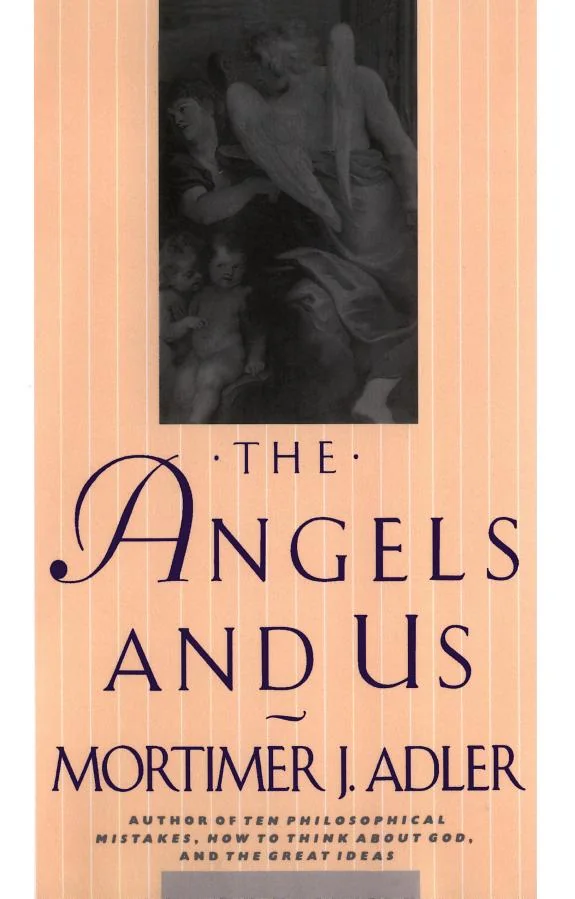
Angels and Us
 73
73

Angels and Us
Mortimer J. Adler’s "Angels and Us" presents a commendably sober approach to a subject often swathed in sentimentality or overt credulity. Adler, a philosopher by training, meticulously unpacks the historical and theological arguments surrounding angelic existence. His strength lies in his disciplined analysis, dissecting the philosophical implications of belief in incorporeal beings. For instance, his exploration of how the concept of angels served as a bridge between the divine and the human in medieval thought is particularly sharp. However, the book occasionally feels like an academic exercise, lacking the visceral engagement that some readers might seek when contemplating such ethereal subjects. Adler’s focus remains squarely on the *idea* of angels, sometimes at the expense of their perceived influence on human experience. Ultimately, "Angels and Us" serves as a valuable, if somewhat detached, philosophical primer on a perennially fascinating topic.
📝 Description
73
Mortimer J. Adler's 1993 book, Angels and Us, philosophically examines angelic beings.
Published in 1993, Mortimer J. Adler's Angels and Us offers a philosophical and theological analysis of angelic beings. The book carefully examines historical and religious ideas about angels, including their structured orders and their function as divine communicators. Adler does not assert doctrine but instead conducts a careful investigation into how people have understood these non-physical entities across various belief systems.
This work is for readers interested in the philosophical foundations of religious belief and the history of theological ideas. It speaks to those who ponder existence beyond the material world and seek to grasp the lasting influence of angels in Western culture and thought. Students of philosophy, theology, and comparative religion will find it particularly useful. Adler situates the discussion of angels within a wide scope of intellectual history, referencing figures and traditions that shaped our views of the celestial.
This work engages with the perennial philosophical questions surrounding beings traditionally understood as intermediaries between the divine and the human. It traces concepts that have informed Neoplatonic, Gnostic, and later Christian mystical traditions, examining how these ideas have been integrated into metaphysical frameworks. Adler's approach is to analyze the intellectual history of these concepts, rather than to promote specific occult beliefs. The book thus serves as a study of the philosophical underpinnings of beliefs often found in esoteric thought.
💡 Why Read This Book?
• Gain a structured understanding of angelic hierarchies and their philosophical underpinnings, as explored in Adler's systematic breakdown of medieval and classical thought. • Grasp the historical evolution of angelology, tracing its development from ancient traditions to the philosophical inquiries of the 20th century, as detailed throughout the text. • Examine the logical and metaphysical arguments concerning the existence and nature of incorporeal beings, providing a critical framework for your own contemplation of these concepts.
⭐ Reader Reviews
Honest opinions from readers who have explored this book.
❓ Frequently Asked Questions
When was Mortimer J. Adler's "Angels and Us" first published?
Mortimer J. Adler's "Angels and Us" was first published on September 15, 1993, making it a relatively modern philosophical treatment of an ancient subject.
What is the main focus of Mortimer J. Adler's "Angels and Us"?
The book focuses on the philosophical and theological examination of angels, exploring their historical interpretations, conceptual hierarchies, and the implications of belief in such incorporeal beings.
Does Adler present definitive proof of angelic existence in "Angels and Us"?
No, Adler’s approach is one of philosophical inquiry rather than theological assertion. He examines how angels have been viewed and debated, rather than offering definitive proof of their existence.
Who is Mortimer J. Adler and what is his background?
Mortimer J. Adler (1902-2001) was an American philosopher, educator, and popular author, known for his extensive work in synthesising philosophical thought and making it accessible. His background is in rigorous philosophical analysis.
What kind of reader would benefit most from "Angels and Us"?
Readers interested in philosophy of religion, comparative theology, intellectual history, and the conceptual frameworks behind spiritual beliefs will find "Angels and Us" particularly valuable.
Does the book discuss guardian angels specifically?
Yes, the book specifically discusses the concept of guardian angels among other types and hierarchies of angels that have been part of religious and philosophical discourse.
🔮 Key Themes & Symbolism
The Philosophical Nature of Angels
Adler approaches angels not as objects of faith alone, but as subjects for philosophical scrutiny. The work interrogates the very possibility and conceptual coherence of incorporeal beings. It examines how philosophers and theologians throughout history have grappled with the idea of entities that exist apart from the physical world, exploring the logical implications and the role such beings play in metaphysical systems. This includes discussions on their potential attributes, their relationship to God, and their function as intermediaries or agents.
Hierarchies and Categorizations
A significant portion of "Angels and Us" is dedicated to exploring the various hierarchical structures proposed for angels across different traditions. From the pseudo-Dionysian nine orders to later theological elaborations, Adler analyzes how these categorizations have served to organize understanding of the celestial realm. The book discusses how these hierarchies reflect human attempts to impose order on the divine and the unknown, and how different levels of angelic beings were conceived to possess distinct roles and capacities.
Angels as Objects of Belief
The book studies the historical and psychological reasons behind humanity's persistent belief in angels. Adler examines how these beings have been integrated into religious doctrines, cultural narratives, and personal spiritual experiences. He considers the function of angelic figures in providing comfort, guidance, and a sense of divine presence, exploring the ways in which belief in angels shapes individual worldviews and communal religious practices. The work critically assesses the phenomenon of angelic devotion and its theological justification.
The Concept of Guardian Angels
Adler specifically addresses the popular and enduring concept of guardian angels. The work scrutinizes the theological basis for believing that individual humans are assigned protective celestial beings. It explores the philosophical implications of such a concept, including notions of divine providence, personal spiritual guidance, and the nature of intercession. The book aims to clarify the historical development and theological reasoning behind this particular aspect of angelology.
💬 Memorable Quotes
Direct passages from the work, attributed to the author.
“The question of the existence of angels is inseparable from our understanding of the nature of reality itself.”
— This statement highlights Adler's philosophical approach, suggesting that the debate over angels is not merely a theological curiosity but a fundamental inquiry into metaphysics and the boundaries of what can be known.
“Humanity has consistently sought intermediaries between the material world and the divine.”
— This interpretation points to the recurrent theme in "Angels and Us" that angels serve a crucial function in bridging the perceived gap between human existence and the transcendent, acting as conceptual tools for understanding the divine.
“Belief in incorporeal beings challenges our empirical assumptions about existence.”
— This interpretation underscores Adler's focus on the epistemological and ontological questions raised by angelology, showing how such beliefs push the limits of human knowledge and our definition of what it means 'to be'.
💡 Key Ideas
Editorial paraphrase of the work's core concepts — not direct quotes.
The classification of angels reflects a desire to map the unseen.
This paraphrased concept emphasizes how the historical development of angelic hierarchies can be seen as an intellectual project to categorize and comprehend spiritual realities, imposing structure on the ineffable.
Guardian angels represent a specific manifestation of divine care.
This paraphrased concept focuses on the theological role of guardian angels as depicted in the book, illustrating them as a particular expression of God's protective and guiding influence over individuals.
🌙 Esoteric Significance
Tradition
While Mortimer J. Adler was not primarily an esotericist, "Angels and Us" engages with a subject central to many esoteric traditions, particularly those rooted in Neoplatonism and Hermeticism, which heavily influenced medieval Christian angelology. His work provides a philosophical critique and historical overview of concepts like angelic hierarchies, intermediaries, and celestial intelligences, which are foundational in systems like Kabbalah, Theosophy, and various forms of Western magic. The book, by dissecting these concepts philosophically, offers a bridge for esoteric practitioners to understand the intellectual lineage of their beliefs.
Symbolism
Within the context of angelology, symbols like wings often represent speed, transcendence, and the ability to traverse different realms – from the material to the spiritual. Adler’s work touches upon the symbolic function of angels as messengers, bridging the divine and human, much like the Caduceus or Hermes’ winged sandals symbolize communication and transit. The very concept of a celestial hierarchy can be seen as a symbolic map of spiritual attainment and cosmic order, a common motif in esoteric cosmology.
Modern Relevance
Contemporary interest in angels, often seen in popular culture, self-help spirituality, and certain New Age practices, owes a debt to the historical traditions that Adler examines. While his approach is philosophical, modern practitioners seeking to understand the roots of angelic invocations, correspondences, or the concept of spirit guides often find value in his systematic analysis of historical angelology. Thinkers and groups exploring comparative religion or the philosophical underpinnings of spiritual phenomena continue to draw upon the historical frameworks he elucidates.
👥 Who Should Read This Book
• Students of Philosophy of Religion: Gain a rigorous, historically grounded analysis of core arguments concerning the existence and nature of angels. • Comparative Theology Scholars: Understand the development and categorization of angelic concepts across major Western religious traditions. • Individuals Questioning Metaphysical Beliefs: Explore the logical and philosophical frameworks that have supported belief in incorporeal beings for centuries.
📜 Historical Context
Published in 1993, "Angels and Us" emerged during a period of renewed interest in spirituality and metaphysics, often alongside a critical philosophical lens. While the late 20th century saw various New Age movements exploring angelic phenomena, Adler’s work stands apart by grounding its inquiry in classical and medieval philosophical traditions, rather than contemporary spiritualist trends. He engaged with the intellectual currents shaped by thinkers like Thomas Aquinas, whose extensive writings on angels provided a foundational framework for much of Western angelology. This context is crucial; Adler was participating in a long-standing philosophical debate, referencing figures and concepts that had been central to scholasticism for centuries, and implicitly contrasting his rigorous analysis with more speculative or uncritical approaches to the subject that might have been prevalent.
📔 Journal Prompts
The concept of angelic hierarchies as a map of spiritual attainment.
The philosophical implications of believing in guardian angels.
Adler's examination of incorporeal beings and empirical reality.
The historical function of angels as intermediaries.
How the idea of celestial intelligences shapes metaphysical systems.
🗂️ Glossary
Incorporeal Beings
Entities that exist without a physical body or material form. In philosophical and theological discourse, this term is often applied to angels, spirits, or God.
Angelology
The study of angels, their nature, ranks, and functions, as understood within religious and philosophical traditions.
Hierarchy
In the context of angels, a system of ranks or orders, typically arranged in ascending or descending levels of spiritual or divine proximity and power.
Metaphysics
The branch of philosophy that deals with the fundamental nature of reality, including the relationship between mind and matter, substance and attribute, and potential and actuality.
Theology
The study of the nature of God and religious belief. It often involves systematic reasoning about divine matters and religious doctrines.
Intermediaries
In a religious or philosophical context, beings or entities that act as a link or go-between between two distinct realms, such as the divine and the human.
Providence
The protective care of God or of nature as a spiritual power; divine guidance or foreseeing care.
This book appears in 1 collection
🔮 Readers Also Liked
Browse all →









From the “Angels” Collection
View all →





More Free Occult Philosophy Books
View all →