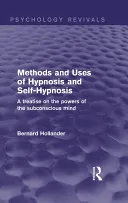
Methods and Uses of Hypnosis and Self-Hypnosis (Psychology Revivals)
 76
76

Methods and Uses of Hypnosis and Self-Hypnosis (Psychology Revivals)
Bernard Hollander's 1928 treatise, Methods and Uses of Hypnosis and Self-Hypnosis, offers a surprisingly accessible manual on a subject often shrouded in mystique. Hollander’s decades of personal experience lend a grounded, empirical tone to his examination of hypnotic phenomena. He effectively catalogues various methods and applications, moving beyond mere speculation. A notable strength lies in his detailed descriptions of case studies, which illustrate the practical utility of hypnosis in his era. However, the work’s limitations stem from its historical context; some of the theoretical underpinnings and diagnostic categories reflect 1928's understanding of psychology, which has since evolved considerably. For instance, Hollander's discussion of 'nervous affections' and their treatment via hypnosis, while historically significant, may seem dated to contemporary readers. Despite this, the author’s earnest attempt to legitimize hypnosis as a serious field of study, as seen in his detailed protocols for induction, remains a valuable contribution. The book serves as a crucial window into the early professional discourse on hypnosis, predating many modern psychotherapeutic frameworks.
📝 Description
76
Bernard Hollander's 1928 book details his decades of practice and study in hypnotism.
Originally published in 1928, Bernard Hollander's "Methods and Uses of Hypnosis and Self-Hypnosis" chronicles his extensive experience with hypnotism over thirty years. Hollander aimed to clarify a subject then perceived as mysterious and inadequately researched. He sought to shed light on hypnotic phenomena, encouraging further study among medical and psychological practitioners, as well as the public.
The text is particularly relevant for those studying early 20th-century psychology and parapsychology. It offers insights into the history of therapeutic methods and how altered states of consciousness were understood. Historians of medicine and psychology will find Hollander's detailed observations useful for grasping the early discussions surrounding hypnosis.
Published during a time of growing interest in the subconscious and psychical research, Hollander's work emerged when figures like Freud and Janet were active. Hypnosis, often mixed with spiritualism and stage acts, was being examined for scientific validity. Hollander positioned hypnosis as a topic deserving serious investigation, separate from its sensationalized public image.
Published in 1928, this book emerges from an era where the boundaries between scientific inquiry and esoteric exploration were less rigidly defined. While Hollander sought scientific validation for hypnosis, his work coincided with a broader cultural fascination with altered states, psychical research, and the hidden potentials of the human mind. This interest was fueled by movements like spiritualism and early psychoanalysis, both of which touched upon themes of subconscious influence and non-ordinary consciousness. Hollander's systematic approach to hypnosis, including its therapeutic and self-development applications, resonated with a tradition that viewed such practices as keys to understanding deeper psychological realities.
💡 Why Read This Book?
• Gain an understanding of early 20th-century hypnotic techniques and their perceived medical applications, as detailed in Hollander's extensive case studies from the 1920s. • Explore the foundational concepts of suggestion and altered states of consciousness as presented by a practitioner with thirty years of experience, offering a historical perspective on mind-body practices. • Discover the historical discourse surrounding hypnosis, situating it within the intellectual currents of its time, distinct from sensationalized accounts and paving the way for later psychotherapeutic developments.
⭐ Reader Reviews
Honest opinions from readers who have explored this book.
❓ Frequently Asked Questions
What is the original publication year of Methods and Uses of Hypnosis and Self-Hypnosis?
The original publication year for Bernard Hollander's Methods and Uses of Hypnosis and Self-Hypnosis was 1928. This edition is part of the Psychology Revivals series, indicating its historical significance.
Who was Bernard Hollander and what was his expertise in hypnosis?
Bernard Hollander was a practitioner who studied hypnotism for nearly his entire life and actively practiced it for thirty years. His extensive experience formed the basis for the observations and methods presented in his 1928 book.
What was the primary objective of Hollander's book when it was first published?
The main objective of the book, upon its original publication in 1928, was to highlight the significance of hypnotism and its associated phenomena. Hollander aimed to stimulate greater inquiry into what was then considered a mysterious and unexplored subject.
Does the book cover self-hypnosis, or only hypnosis performed by an operator?
Yes, the book explicitly covers both hypnosis performed by an operator and self-hypnosis. Hollander discusses the potential and practical uses of self-hypnosis as a method for personal development and therapeutic intervention.
What kind of reader is this book intended for, according to the original blurb?
According to the original blurb, the book was intended for both medical and psychological experts, as well as the general reader. Hollander aimed to make the subject accessible and interesting to a broad audience interested in hypnotism.
How does this book relate to early 20th-century psychological thought?
Published in 1928, the book engages with the early 20th-century fascination with the subconscious and altered states of consciousness. It reflects a period of scientific investigation into phenomena previously relegated to the mystical or sensational.
🔮 Key Themes & Symbolism
The Art of Suggestion
Hollander meticulously details the mechanics of suggestion within hypnotic states, viewing it as the core mechanism for therapeutic intervention. He explores how carefully crafted verbal cues can influence a subject's perceptions, memories, and even physiological responses. This focus on suggestion positions hypnosis not as a magical manipulation, but as a psychological technique rooted in the power of focused intent and communication, a concept that bridges early psychological theory with esoteric practices of mental influence.
Hypnosis as a Therapeutic Modality
The work champions hypnosis as a legitimate tool for treating a range of ailments, particularly 'nervous affections' prevalent in the early 20th century. Hollander provides extensive examples of its application in alleviating pain, managing anxieties, and addressing behavioral issues. This perspective aligns with esoteric traditions that view the mind as a potent force for healing, suggesting that by altering mental states, one can directly impact physical well-being, a precursor to modern psychosomatic medicine.
The Dual Nature of Hypnotism
Hollander addresses both the potential dangers and the profound benefits of hypnotism. He cautions against its misuse while advocating for its ethical application in controlled environments. This balanced approach acknowledges the power inherent in altered states of consciousness, a theme common in esoteric literature where mastery over the self and one's psychic faculties is paramount, differentiating between uncontrolled psychic phenomena and disciplined mental application.
Self-Hypnosis for Personal Cultivation
A significant portion of the book is dedicated to the practice of self-hypnosis, presenting it as a means of self-improvement and empowerment. Hollander outlines methods by which individuals can induce hypnotic states in themselves to foster willpower, enhance concentration, and cultivate desired mental states. This appeals to esoteric ideals of self-mastery and the pursuit of inner development through focused mental discipline.
💬 Memorable Quotes
Direct passages from the work, attributed to the author.
“The main object of this book was to draw attention to the importance of hypnotism and its phenomena, in order to stimulate inquiry into what was at the time a ‘mysterious and unexplored subject’.”
— This statement highlights Hollander's mission to legitimize hypnosis, positioning it as a subject deserving serious scientific and public attention, moving it from the field of the occult to that of empirical study.
“I have studied hypnotism nearly all my life and practised it for thirty years.”
— This declaration emphasizes the author's extensive practical experience, lending credibility to his observations and methods. It suggests a deep, lifelong engagement with the subject matter.
“The investigations, experiences, and views presented in this title would prove of interest and value both to the medical and psychological expert and the general reader.”
— This indicates Hollander's intention to bridge the gap between academic/professional understanding and public curiosity, making complex psychological phenomena accessible and relevant to a wide audience.
“The phenomena of hypnotism are of varied character and are capable of producing the most remarkable results.”
— This interpretation reflects Hollander's acknowledgment of the diverse and potent effects achievable through hypnotic states, suggesting a wide scope of application and influence.
💡 Key Ideas
Editorial paraphrase of the work's core concepts — not direct quotes.
Hypnotism is a subject of the greatest importance, and one which is not yet sufficiently understood.
This paraphrase captures Hollander's view that hypnosis holds significant, yet under-appreciated, potential. It underscores his belief in its scientific and practical value, urging for greater exploration.
🌙 Esoteric Significance
Tradition
While not explicitly aligned with a single esoteric lineage, Hollander's work touches upon themes resonant with Hermeticism and general occult psychology. The focus on mental discipline, the power of suggestion, and the potential for self-mastery through altered states of consciousness reflects the Hermetic principle of 'As Above, So Below,' applying inner mental states to manifest external change. It departs from purely mystical traditions by seeking empirical validation and practical application within a medical-psychological framework.
Symbolism
The primary 'symbol' Hollander engages with is the hypnotic state itself – a liminal space between consciousness and unconsciousness. This state can be seen as a symbolic representation of the threshold between the mundane and the hidden aspects of the psyche. The operator's 'suggestion' acts as a symbolic key, unlocking potentials within the subject's mind, akin to how esoteric rituals use symbolic actions to induce specific spiritual or psychological states.
Modern Relevance
Hollander's work finds echoes in contemporary fields like hypnotherapy, cognitive behavioral therapy (CBT), and even mindfulness practices. His emphasis on self-hypnosis as a tool for personal development foreshadows modern self-help movements and neuro-linguistic programming (NLP). Thinkers and practitioners exploring the mind-body connection, the placebo effect, and the power of suggestion continue to engage with the foundational principles Hollander explored, albeit with updated theoretical frameworks.
👥 Who Should Read This Book
• Aspiring hypnotherapists and practitioners of early 20th-century psychological methods seeking historical context for their craft. • Researchers in the history of medicine and psychology interested in primary source material on the development of therapeutic techniques for nervous disorders. • Students of esoteric psychology and mind sciences looking to understand the scientific and practical investigations into altered states of consciousness from a bygone era.
📜 Historical Context
Bernard Hollander's Methods and Uses of Hypnosis and Self-Hypnosis emerged in 1928, a vibrant period for psychological inquiry. This era saw the rise of psychoanalysis under Sigmund Freud and the work of Pierre Janet on dissociation, alongside burgeoning interest in psychical research. Hypnosis, often a subject of public fascination and skepticism, was being explored by figures like Morton Prince. Hollander's book contributed to the effort to understand and apply hypnosis scientifically, distinguishing it from parlor tricks and spiritualist claims. While Freud famously moved away from using hypnosis extensively in his later work, preferring free association, figures like Emil Coué had popularized auto-suggestion, showing a public appetite for self-improvement through mental techniques. Hollander's work positioned itself within this complex landscape, aiming for empirical rigor while acknowledging the profound potential of the hypnotic state.
📔 Journal Prompts
The role of suggestion in achieving desired outcomes.
Self-hypnosis as a method for cultivating willpower.
The relationship between mental states and physical well-being.
Understanding the historical perception of 'nervous affections'.
The ethical considerations of influencing another's mind.
🗂️ Glossary
Hypnotism
A state of human consciousness involving focused attention and reduced peripheral awareness characterized by an enhanced capacity for response to suggestion. Hollander examines its induction, phenomena, and uses.
Suggestion
The process by which an idea, feeling, or impulse is introduced into the mind, often during a hypnotic state, influencing the subject's thoughts, emotions, or actions without their conscious, critical judgment.
Self-Hypnosis
The practice of inducing a hypnotic state in oneself, typically for therapeutic purposes, self-improvement, or personal exploration, as detailed by Hollander's methods.
Nervous Affections
A broad term used in early 20th-century medical contexts to describe a range of psychological and psychosomatic disorders, including anxiety, hysteria, and various forms of neurasthenia, which Hollander discusses treating with hypnosis.
Phenomena
Observable facts or events related to hypnotism, such as catalepsy, amnesia, hallucinations, or heightened suggestibility, which Hollander sought to systematically document and explain.
Operator
The individual who induces and guides the hypnotic state in a subject, responsible for the suggestions given and the overall management of the session.
Subject
The individual who enters the hypnotic state under the guidance of an operator or through self-induction, characterized by increased receptivity to suggestion.