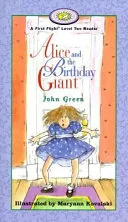
Alice and the Birthday Giant
 80
80

Alice and the Birthday Giant
John Frederick Green’s Alice and the Birthday Giant offers a charmingly peculiar premise: a birthday wish materializes as a bewildered giant. The narrative is propelled by Alice’s quick thinking as she attempts to manage the chaos this colossal visitor brings to her party. Green effectively captures the child's perspective, portraying the giant not as a monster, but as an entity out of its element, craving simple pleasures. A particularly strong moment is Alice’s practical approach to appeasing the giant, focusing on earthly delights like hot dogs and ice cream, which grounds the fantastical element in relatable desires. However, the reliance on the librarian, Ms. McKracken, as the sole source of magical aid feels somewhat convenient, potentially limiting Alice’s agency in the resolution. Despite this, the book provides a lighthearted exploration of managing the unexpected. It’s a diverting tale for younger readers.
📝 Description
80
John Frederick Green's 2000 novel Alice and the Birthday Giant begins with a girl's birthday wish creating a colossal visitor.
Alice and the Birthday Giant follows a young girl whose birthday wish for a visitor results in a giant appearing. This colossal being, despite his immense size, wants nothing more than to go home and enjoy simple pleasures like hot dogs and ice cream. Alice must figure out how to manage her unexpected guest, leading to a story about problem-solving and diplomacy between worlds. The narrative balances humor with the challenge of dealing with extraordinary circumstances.
The book is suited for young readers who enjoy imaginative and slightly unusual stories. It appeals to children who like tales with magic, talking animals, or fantastical creatures. The story offers a gentle lesson on handling unexpected situations. Parents looking for lighthearted fiction with a sense of wonder for their children will find this book a good fit.
Published in 2000, Alice and the Birthday Giant taps into the late 20th century's fascination with magical realism and portal fantasies. While not explicitly aligned with a specific esoteric tradition, its publication reflects a broader interest in bridging ordinary life with extraordinary possibilities. The story's premise of a mundane event, a birthday party, leading to contact with beings from other realms echoes themes found in certain strains of occult fiction that explore the permeability of reality and the manifestation of the unseen.
💡 Why Read This Book?
• Gain an appreciation for literal interpretations of wishes, as seen when Alice's 'something big' manifests as a literal giant, prompting unique problem-solving scenarios. • Experience the blend of the mundane and the magical, particularly how everyday desires like 'hot dogs and ice cream' become crucial for interdimensional diplomacy with the giant. • Discover the role of the librarian, Ms. McKracken, as a source of practical guidance in extraordinary circumstances, demonstrating how knowledge can help manage overwhelming situations.
⭐ Reader Reviews
Honest opinions from readers who have explored this book.
❓ Frequently Asked Questions
What is the central conflict in Alice and the Birthday Giant?
The central conflict arises when Alice's birthday wish for 'something big' results in a giant appearing in her bedroom, disrupting her party and needing to return home.
Who helps Alice deal with the giant?
Alice seeks magical help from Ms. McKracken, the librarian, to manage the situation and assist the giant in returning to its home.
When was Alice and the Birthday Giant first published?
The book was first published in the year 2000.
What are the giant's simple desires?
Despite its size and the chaos it causes, the giant's primary desires are to return home and to enjoy earthly treats like hot dogs and ice cream.
What is the overall tone of the book?
The tone is whimsical, humorous, and slightly surreal, focusing on a child's imaginative response to an extraordinary event.
What does Ms. McKracken represent in the story?
Ms. McKracken represents a source of knowledge and magical assistance, guiding Alice in handling the unexpected arrival of the giant.
🔮 Key Themes & Symbolism
Wishes and Manifestation
The narrative explores the potent, and sometimes overwhelming, nature of wishes. Alice's desire for 'something big' is granted literally, illustrating how intentions can manifest in unexpected and challenging ways. This theme highlights the idea that desires, once unleashed, require careful management and understanding, moving beyond simple wish fulfillment to the practicalities of dealing with what has been brought into being. The giant's presence serves as a physical embodiment of an uncontained wish.
The Ordinary Meets The Extraordinary
A core element is the juxtaposition of Alice's normal birthday party setting with the sudden appearance of a giant. This contrast emphasizes how the extraordinary can intrude upon the mundane, requiring adaptation and resourcefulness. The story suggests that even in the most ordinary circumstances, magic and the unusual are possible, and that navigating these intrusions often involves applying logic and empathy to fantastical situations.
Hospitality and Understanding
Despite the chaos, the story subtly addresses themes of hospitality and empathy towards the 'other.' The giant is not depicted as inherently malevolent but as a displaced being with simple needs. Alice's eventual goal is not to banish the giant but to help it return home, showing a progression from fear or confusion to compassionate aid. The giant's desire for hot dogs and ice cream humanizes it, making its plight relatable.
Knowledge as a Tool
The character of Ms. McKracken, the librarian, introduces the concept of knowledge and potentially magical lore as a means to resolve extraordinary problems. Her role suggests that wisdom, often found in books and study, is a crucial resource when faced with the inexplicable. This positions the library not just as a place of information, but as a center for practical magical assistance.
💬 Memorable Quotes
Direct passages from the work, attributed to the author.
“All the giant really wants is to return home (and have some hot dogs and ice cream before he goes)!”
— This highlights the giant's surprisingly simple and relatable desires, contrasting its imposing size with basic needs, and framing the conflict as one of aiding a displaced entity rather than fighting a monster.
“Alice must quickly get some magical help from the librarian Ms. McKracken before everything gets out of control!”
— This points to the narrative's reliance on a knowledgeable figure, Ms. McKracken, to provide the solution, positioning wisdom and possibly arcane knowledge as the key to resolving extraordinary, chaotic situations.
“Alice is hoping to have an extraordinary day. It is her birthday and she has wished for something really big.”
— This sets up the central premise: the literal fulfillment of a wish, emphasizing the theme of desires manifesting in tangible, albeit unexpected and overwhelming, ways.
“But the 'something big' turns out to be a giant who suddenly appears in her bedroom and causes chaos at her birthday party.”
— This directly introduces the conflict and the blend of the mundane (birthday party) with the fantastical (giant), illustrating the unexpected consequences of Alice's wish.
“Alice must quickly get some magical help...”
— This phrase underscores the urgency of the situation and the need for external, possibly supernatural, intervention to manage the chaos introduced by the giant.
🌙 Esoteric Significance
Tradition
While not explicitly adhering to a specific esoteric tradition like Hermeticism or Kabbalah, the book taps into a broader theme of manifested desire and the liminal spaces between worlds, reminiscent of folk magic and fairy tales. The idea that a wish can literally conjure a being from 'elsewhere' echoes concepts found in many magical systems where focused intent can draw forth entities or alter reality. The librarian, Ms. McKracken, serves as a conduit to 'magical help,' suggesting a hidden layer of reality accessible through specific knowledge or intervention.
Symbolism
The 'Giant' itself can be interpreted as a symbol of an overwhelming, uncontained force—perhaps representing an unmanaged aspect of the psyche, an uncontrolled desire, or a disruption from an unknown realm. Alice's birthday, a marker of time and personal growth, becomes the catalyst for this disruption. The 'hot dogs and ice cream' represent a grounding in simple, earthly pleasures, suggesting that even the most extraordinary beings, or manifestations, can be appeased or understood through basic, relatable needs.
Modern Relevance
In contemporary discourse on manifestation and the power of thought, Alice and the Birthday Giant offers a whimsical, cautionary tale. It speaks to the idea that what we wish for can indeed come to pass, but not always in the desired form, requiring practical engagement rather than passive reception. For practitioners interested in the psychology of desire and the creative power of imagination, the book provides a simple, accessible allegory for the consequences of poorly defined or unmanaged intentions.
👥 Who Should Read This Book
• Young readers aged 6-10 who enjoy imaginative stories featuring fantastical creatures and slightly chaotic situations. • Parents and educators seeking lighthearted fiction that can spark conversations about wishes, consequences, and problem-solving. • Enthusiasts of gentle portal fantasy who appreciate narratives where the extraordinary intrudes upon the ordinary in a humorous and manageable way.
📜 Historical Context
Published in 2000, John Frederick Green’s Alice and the Birthday Giant arrived in a literary landscape still vibrant with children’s fantasy and magical realism. The late 20th and early 21st centuries saw a continued embrace of the whimsical and the surreal in children's literature, building on traditions established by authors like Roald Dahl and Lewis Carroll. While not directly affiliated with a specific esoteric school, the book’s theme of wishes manifesting concretely and the need for magical intervention aligns with broader interests in the power of the mind and the permeable boundaries between realities, which have roots in Hermetic philosophy and occult traditions. The work emerged in a period where authors like Philip Pullman were also exploring complex moral and metaphysical themes within children’s fiction, though Green’s approach remains lighter and more focused on immediate, fantastical problem-solving rather than grand theological debates. The book's reception was primarily within the children's market, without significant commentary from esoteric circles.
📔 Journal Prompts
The giant's desire for hot dogs and ice cream, and Alice's need to provide them.
Ms. McKracken's role as a source of magical help.
The literal manifestation of Alice's wish for 'something big'.
Managing chaos at a birthday party with an unexpected colossal guest.
Alice's journey from surprise to problem-solving with the giant.
🗂️ Glossary
Giant
A colossal, mythical being, often depicted as large and imposing. In this narrative, the giant is a literal manifestation of a wish, appearing unexpectedly and causing disruption while seeking to return home.
Birthday Wish
A desire or hope expressed, typically on one's birthday, for something to happen or to be given. Here, the wish for 'something big' has tangible and disruptive consequences.
Magical Help
Assistance provided through supernatural or mystical means. In the story, this is sought from Ms. McKracken, the librarian, to resolve the extraordinary situation with the giant.
Librarian
A professional who manages a library. Ms. McKracken, the librarian, possesses knowledge or abilities beyond the ordinary, serving as a key figure in resolving the plot's magical elements.
Extraordinary Day
A day that is exceptional or unusual, deviating from the norm. Alice anticipates such a day, which is delivered through the unexpected arrival of the giant.
Return Home
The act of going back to one's place of origin or residence. This is the primary goal of the giant, driving much of the narrative's resolution.
Chaos
A state of complete disorder and confusion. The giant's appearance and presence at the birthday party create significant chaos that Alice must manage.
This book appears in 1 collection
🔮 Readers Also Liked
Browse all →








From the “Incantations” Collection
View all →




More Free Occult Philosophy Books
View all →