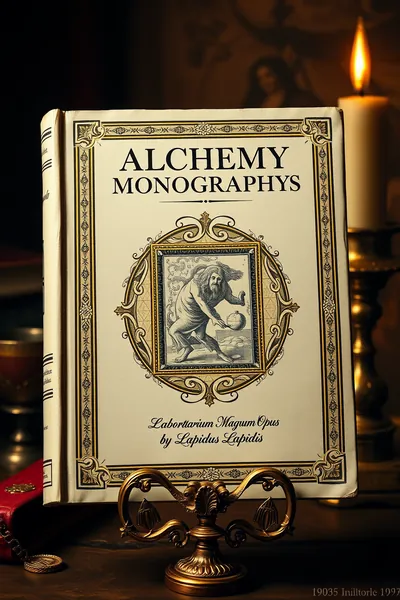
Alchemy

 82
82

Alchemy
Margaret Mahy's "Alchemy" presents a dense, yet rewarding, exploration of the subject, eschewing broad generalizations for a focus on specific symbolic interpretations. The strength lies in its meticulous attention to the visual and conceptual language of alchemical texts, particularly how the "Prima Materia" is depicted as both a physical and spiritual starting point. A notable limitation, however, is the occasional density of the prose, which can make certain sections demanding for readers less familiar with Hermetic terminology. The discussion surrounding the "coniunctio", or sacred union, offers a particularly insightful look into the psychological parallels of alchemical processes. The work is a serious academic treatment, offering substantial material for dedicated study.
📝 Description
82
Margaret Mahy's 1988 book demystifies alchemy beyond mere gold-making.
Alchemy, as presented by Margaret Mahy, is more than the pursuit of turning base metals into gold. It is a complex philosophical system, a spiritual discipline, and an early scientific endeavor. The book examines the layered meanings within alchemical symbolism, moving past simple interpretations to uncover its deeper esoteric dimensions. Mahy addresses those seriously interested in esoteric traditions, historical occultism, and the philosophical basis of early modern science. This work is suitable for students of comparative religion, scholars of mystical thought, and anyone seeking to understand the symbolic language that shaped Western spiritual and intellectual history.
The practice of alchemy has ancient roots, originating in Hellenistic Egypt, Persia, and India. Arabic scholars significantly influenced its Western development by preserving and expanding classical texts. By the Renaissance, alchemy was a recognized field, merging laboratory work with Neoplatonic and Hermetic philosophies. Figures like Paracelsus in the 16th century applied alchemical principles to medicine, showing its broad impact. Key alchemical concepts include the Prima Materia, the fundamental substance; the Philosopher's Stone, the agent of change; and the Magnum Opus, the process of perfection. The symbolic language, using metals, planets, colors, and myths, encoded spiritual and psychological truths.
Alchemy stands as a significant current within Western esotericism, blending practical experimentation with Gnostic, Hermetic, and Neoplatonic philosophical frameworks. It is not solely a proto-science for material gain but a symbolic path toward inner transformation and spiritual perfection, often termed the Great Work. Mahy's work places these practices within a historical context, tracing their lineage from ancient traditions through medieval Islamic scholarship and into the Renaissance, where they intersected with early medical and philosophical thought. The symbolic language of alchemy served as a means to articulate complex spiritual and psychological processes.
💡 Why Read This Book?
• Gain insight into the symbolic language of the "Philosopher's Stone," understanding its dual role in material and spiritual transformation as detailed in the text's explanations of the Magnum Opus. • Grasp the historical significance of Paracelsus and his integration of alchemical principles into 16th-century medicine, revealing the practical applications beyond mere metallurgy. • Explore the concept of the "Prima Materia" not just as an alchemical substance but as a metaphor for psychological potential, offering a unique perspective on inner work.
⭐ Reader Reviews
Honest opinions from readers who have explored this book.
❓ Frequently Asked Questions
What is the primary focus of Margaret Mahy's "Alchemy"?
Margaret Mahy's "Alchemy" focuses on the multi-layered symbolic and philosophical aspects of alchemy, exploring its role as a spiritual discipline and proto-scientific endeavor beyond the common misconception of simply turning lead into gold.
When was Margaret Mahy's "Alchemy" first published?
The work "Alchemy" by Margaret Mahy was first published in 2002, making it a relatively modern academic examination of a historical esoteric practice.
What are some key concepts discussed in the book?
Key concepts explored include the Prima Materia, the Philosopher's Stone, the Magnum Opus, and the rich symbolic language involving metals, planets, and colours that alchemists used to represent spiritual truths.
Is prior knowledge of esoteric subjects required to read this book?
While not strictly required, a foundational understanding of esoteric concepts may enhance comprehension. The book delves into complex symbolic interpretations and historical context, making it more accessible to those with some background in mystical thought.
What is the historical origin of alchemical practices discussed in the book?
The book traces alchemical practices back to antiquity, with roots in Hellenistic Egypt, Persia, and India, noting its significant preservation and expansion by Arabic scholars before its integration into Western thought.
How does Mahy's "Alchemy" differ from popular portrayals of the subject?
Mahy's work moves beyond sensationalist portrayals of gold-making to emphasize alchemy's function as a spiritual path and philosophical system focused on purification, perfection, and inner transformation.
🔮 Key Themes & Symbolism
The Great Work (Major work)
The Major work is presented not merely as a series of laboratory operations but as a comprehensive process of purification and perfection, mirroring the alchemist's spiritual journey. This involves stages often symbolized by colour changes and the pursuit of the Philosopher's Stone, which facilitates the ultimate transmutation. The work details how this concept extended beyond material change to encompass the elevation of the soul towards divine understanding and integration.
Symbolic Language of Alchemy
This book meticulously deciphers the rich symbolic lexicon employed by alchemists. It examines how celestial bodies (planets), metals (gold, silver, mercury), and mythological figures were used as coded representations of fundamental spiritual and psychological principles. The interpretation of these symbols provides a key to understanding the alchemical worldview, where the microcosm of the laboratory reflected the macrocosm of the universe and the human psyche.
Prima Materia and Transformation
Central to alchemical theory is the concept of the Prima Materia, the chaotic, undifferentiated substance from which all creation arises. Mahy's work explores this as both a physical and spiritual foundation, the raw potential awaiting refinement. The process of transforming the Prima Materia into a perfected state, often through the action of the Philosopher's Stone, is analyzed as a metaphor for the alchemist's own journey of self-discovery and spiritual actualization.
Spiritual vs. Material Alchemy
The text distinguishes between the literal, material pursuit of transmuting metals and the deeper, spiritual interpretation of alchemy. It highlights how alchemical texts often employed material processes as allegories for inner purification, the dissolution of ego, and the reintegration of fragmented aspects of the self. This dual nature is explored through various alchemical operations and their corresponding spiritual meanings.
💬 Memorable Quotes
Direct passages from the work, attributed to the author.
“The Philosopher's Stone represented the ultimate agent of change, both physical and spiritual.”
— This highlights the dual function of the legendary Stone, emphasizing its role in the Major work as a catalyst for perfecting not just base metals but also the alchemist's own being.
“Alchemical symbolism provided a coded language for esoteric knowledge.”
— This points to the intricate use of metaphors, symbols, and allegories within alchemical texts, serving as a means to transmit complex philosophical and spiritual ideas to initiated practitioners.
“The Prima Materia was the chaotic starting point for all potential creation.”
— This interpretation focuses on the fundamental nature of the Prima Materia as the undifferentiated source from which all matter and spiritual potential could be formed and refined.
💡 Key Ideas
Editorial paraphrase of the work's core concepts — not direct quotes.
The alchemist sought not only gold but the perfection of nature and the soul.
This paraphrase captures the essence of the book's argument that alchemy was a holistic discipline, linking material transformation to spiritual elevation and understanding the fundamental order of the cosmos.
The stages of the Great Work mirrored a journey of inner purification.
This paraphrased concept underscores the allegorical dimension of alchemical processes, suggesting that the laboratory work was a symbolic representation of the alchemist's personal path toward spiritual refinement and enlightenment.
🌙 Esoteric Significance
Tradition
This work fits within the Hermetic and Renaissance magical traditions, which synthesized various ancient philosophies with Christian and Neoplatonic elements. Alchemy, as explored here, is a key branch of this lineage, representing the practical, transformative aspect of Hermetic philosophy. It departs from purely theoretical Gnosticism by emphasizing a tangible, albeit symbolic, process of purification and perfection in the material world as a path to spiritual realization.
Symbolism
Key symbols include the "Prima Materia," representing undifferentiated potential and the chaos from which order emerges, and the "Philosopher's Stone," the ultimate catalyst for perfection and transmutation. The "Ouroboros," the serpent eating its tail, is another potent motif, symbolizing cyclicality, self-sufficiency, and the eternal return inherent in the alchemical process of dissolution and regeneration.
Modern Relevance
Contemporary practitioners of Western esotericism, particularly those engaged with Hermeticism, Jungian psychology (which heavily draws on alchemical symbolism for individuation), and ceremonial magic, find Mahy's detailed analysis of alchemical symbolism highly relevant. It provides a scholarly foundation for understanding the psychological and spiritual underpinnings of practices that continue to draw from these ancient traditions.
👥 Who Should Read This Book
• Students of Western Esotericism: Those seeking a scholarly yet accessible examination of alchemical symbolism and its place within Hermetic traditions will find detailed explanations of key concepts like the Major work. • Comparative Religion Scholars: Individuals interested in the philosophical intersections between science, spirituality, and mysticism will benefit from the historical context and the exploration of alchemy as a proto-scientific and spiritual discipline. • Aspiring Alchemists and Symbolists: Readers drawn to the symbolic language of ancient practices will gain a deeper understanding of alchemical motifs and their potential interpretations for inner work.
📜 Historical Context
Published in 2002, Margaret Mahy's "Alchemy" arrived in an era of renewed academic and popular interest in esoteric traditions. The late 20th and early 21st centuries saw significant scholarly work on Hermeticism, Kabbalah, and Renaissance esotericism, building on foundations laid by figures like Frances Yates and Antoine Faivre. Mahy's work engages with this scholarly discourse, situating alchemical practices within their historical milieu, which included figures like Paracelsus in the 16th century who profoundly influenced its medical applications. While competing schools of thought like Neoplatonism heavily influenced early alchemy, Mahy's text focuses on the specific trajectory of alchemical symbolism itself. The reception of such works often navigates the tension between historical analysis and the ongoing practice of modern occultism.
📔 Journal Prompts
The Prima Materia as a starting point for personal transformation.
Symbolism of the Ouroboros in cyclical processes.
Interpreting the stages of the Major work through a personal lens.
The alchemical pursuit of perfection: material versus spiritual.
Reflecting on the historical context of alchemy around the 16th century.
🗂️ Glossary
Prima Materia
The fundamental, undifferentiated substance from which all things are created in alchemical philosophy. It represents chaos, potential, and the raw material for transformation.
Philosopher's Stone
A legendary alchemical substance said to be capable of transmuting base metals into gold or silver, and often believed to grant immortality or spiritual perfection.
Major work
The 'Great Work,' referring to the entire alchemical process of creating the Philosopher's Stone, encompassing both material operations and spiritual purification.
Transmutation
The alchemical process of changing one substance into another, particularly the transformation of base metals into noble metals like gold, or the spiritual transformation of the alchemist.
Hermeticism
A philosophical and religious tradition based primarily upon writings attributed to Hermes Trismegistus, emphasizing divine wisdom, cosmology, and the interconnectedness of all things.
Coniunctio
The 'union' or 'sacred marriage' in alchemical symbolism, often representing the integration of opposites (e.g., masculine/feminine, spirit/matter) leading to wholeness.
Spagyric
A branch of alchemy focused on medicine, particularly concerning the preparation of herbal remedies by separating, purifying, and recombining their constituent parts.
🔮 Readers Also Liked
Browse all →






More by Margaret Mahy
All books →


More Free Alchemy & Hermeticism Books
View all →