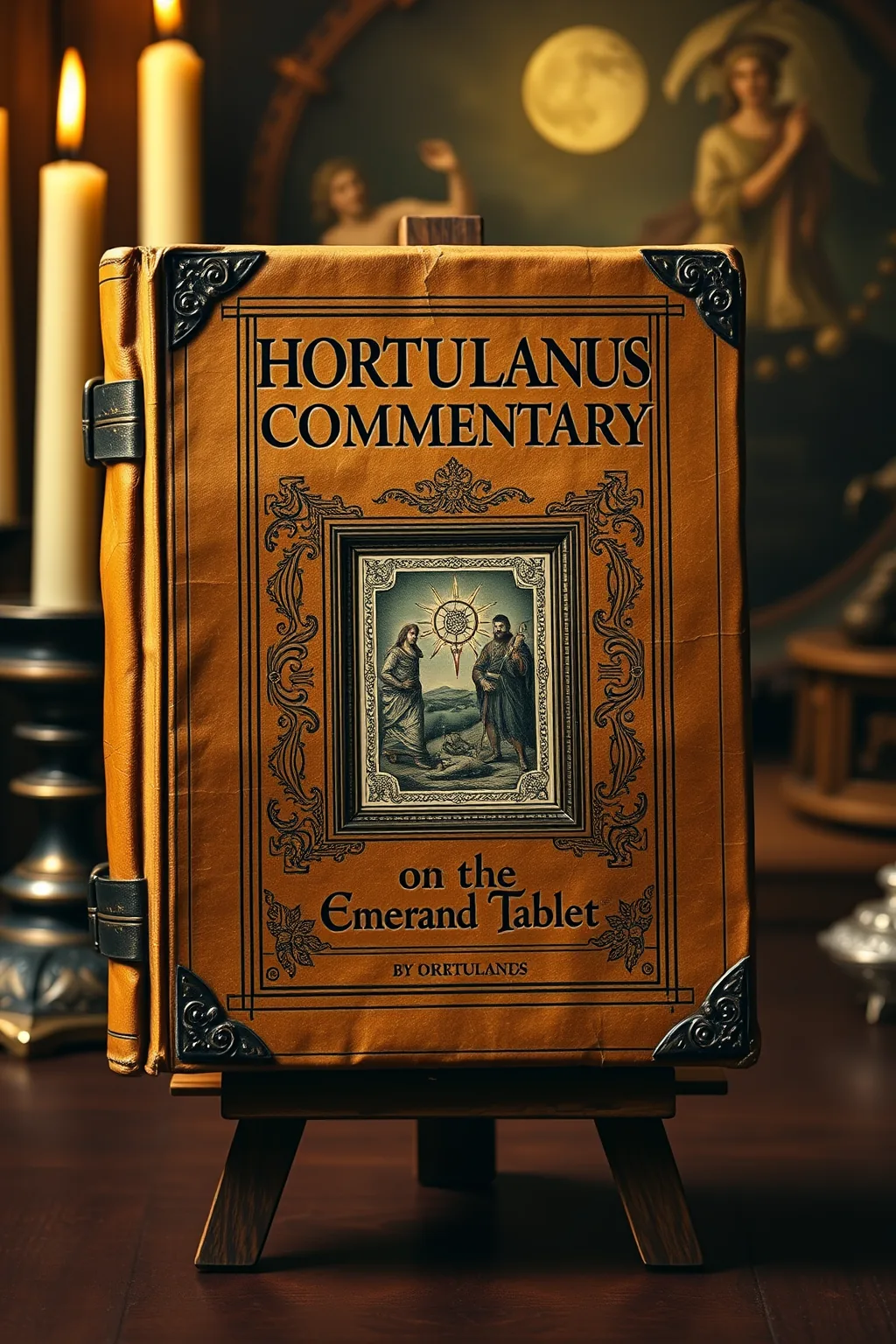
Hortulanus Commentary on the Emerald Tablet
 95
95

Hortulanus Commentary on the Emerald Tablet



Celeste Moreau (Divination & Symbolism Reviewer) — The 'Hortulanus Commentary on the Emerald Tablet' is an indispensable text for serious students of Alchemy and Hermeticism. Hortulanus masterfully deciphers the cryptic pronouncements of the Tablet, revealing profound esoteric insights into the Great Work. His commentary is rich with symbolism, offering clarity on concepts often shrouded in obscurity. The author’s deep understanding of the interconnectedness of the cosmos and the human soul is evident throughout. This work is ideally suited for practitioners seeking to deepen their theoretical and practical knowledge, as well as scholars interested in the historical evolution of alchemical thought. It’s a true gem.
📝 Description
95
The Hortulanus Commentary on the Emerald Tablet offers an alchemical interpretation of Hermes Trismegistus' ancient text.
Written by an author known only as Hortulanus, this commentary unpacks the core ideas of the Emerald Tablet. It focuses on celestial connections, how elements change, and the relationship between the larger universe and individual beings. The text does more than just explain; it aims to guide serious students through allegories and symbols within the hermetic tradition. Each part of the commentary encourages thought about existence itself and the possibility of spiritual change.
This work is for those committed to the hermetic arts. It reveals aspects of knowledge that have influenced esoteric thinking for a very long time. Readers can expect a shift in understanding as the secrets of alchemy are made clearer. It is not a simple book to skim but a significant text for deeper study.
This commentary belongs to the Western esoteric tradition, specifically within alchemy and Hermeticism. It engages with the Emerald Tablet, a text central to these traditions, believed to contain fundamental alchemical principles. The author, Hortulanus, provides an interpretation that aligns with practices and theories of spiritual and material transformation that have been studied for centuries. The focus on symbolism and allegorical meaning is characteristic of esoteric literature, aiming to convey deeper truths beyond literal interpretation.
💡 Why Read This Book?
Unlock the profound secrets of the Emerald Tablet with an expert guide. This commentary offers a gateway to understanding the core principles of Alchemy and Hermeticism, revealing hidden knowledge and symbolic language. Ideal for spiritual seekers, alchemical practitioners, and scholars of esoteric traditions who wish to grasp the philosophical underpinnings of transmutation and cosmic unity.
⭐ Reader Reviews
Honest opinions from readers who have explored this book.
❓ Frequently Asked Questions
What is the Emerald Tablet?
The Emerald Tablet is a highly revered ancient text attributed to Hermes Trismegistus, considered a foundational document of alchemy and hermetic philosophy. It contains cryptic aphorisms about the nature of the universe and the principles of transformation.
Who was Hortulanus?
Hortulanus was an alchemist and philosopher whose commentary on the Emerald Tablet is highly regarded. While his exact identity remains obscure, his work offers a significant and insightful interpretation of the Tablet's mystical teachings.
What is Alchemy?
Alchemy is an ancient philosophical and proto-scientific tradition practiced in Europe, Africa, and Asia. It aimed to purify, mature, and perfect certain objects, often involving the transmutation of base metals into gold, but also encompassing spiritual and philosophical development.
What does 'As Above, So Below' mean?
This famous hermetic principle, often found in relation to the Emerald Tablet, signifies the mirroring of cosmic and terrestrial realities. It suggests that understanding the patterns and laws of the universe can lead to understanding oneself, and vice versa.
Is this book suitable for beginners?
While the text is dense and rich, dedicated beginners with a genuine interest in esoteric philosophy and alchemy will find it rewarding. It is best approached with patience and a willingness to engage with complex symbolic language.
🔮 Key Themes & Symbolism
The Art of Transmutation
This commentary studies the alchemical process not merely as a physical manipulation of matter, but as a profound metaphor for spiritual purification and transformation. It explores the stages of the Great Work, from the nigredo (blackening) to the albedo (whitening) and rubedo (reddening), illustrating how the alchemist seeks to dissolve and reconstitute the self, achieving a state of perfect harmony and enlightenment. The text emphasizes the divine spark within all things and the potential for its elevation through disciplined practice and profound understanding.
Cosmic Correspondences and Microcosmic Reflection
A central theme is the intricate web of connections between the celestial realms and the earthly plane, encapsulated by the hermetic axiom 'As Above, So Below.' Hortulanus meticulously unpacks how planetary influences, elemental forces, and divine energies are mirrored within the human constitution and the alchemical laboratory. Understanding these correspondences is presented as crucial for the practitioner, enabling them to work in concert with universal laws rather than against them, fostering a deeper comprehension of existence itself.
The Language of Symbolism and Allegory
The commentary serves as a vital key to deciphering the collection of symbolism inherent in the Emerald Tablet. Hortulanus illuminates the allegorical nature of alchemical language, revealing how seemingly mundane elements and processes represent profound spiritual truths. From the symbolism of metals and planets to the enigmatic figures and stages of the Work, the text guides the reader to perceive the hidden meanings that unlock the deeper wisdom of the hermetic tradition, fostering intuitive understanding beyond literal interpretation.
💬 Memorable Quotes
Direct passages from the work, attributed to the author.
““This is the true substance, which is not born, nor dies, but is only transmuted.””
— Highlights the eternal nature of the alchemical essence, emphasizing transformation over creation or destruction, a core tenet of the Great Work.
““What is below is like that which is above, and what is above is like that which is below.””
— Expresses the principle of universal correspondence, suggesting a profound interconnectedness between the macrocosm and the microcosm.
““The Sun is its father, the Moon its mother.””
— Refers to the primal generative forces in alchemy, often interpreted as the masculine (solar) and feminine (lunar) principles that must be united.
““All things are derived from One, by the mediation of One.””
— Points to the monistic nature of reality in hermeticism, where all existence originates from a singular divine source.
““Separation and union are the means to perfection.””
— Describes the fundamental alchemical process of breaking down and then reintegrating elements to achieve a higher, perfected state.
🌙 Esoteric Significance
Tradition
This commentary is a core part of the Hermetic tradition, a philosophical and spiritual system rooted in the teachings attributed to Hermes Trismegistus. It forms a vital link in the chain of esoteric knowledge that bridges ancient wisdom with later alchemical and occult movements. Its significance lies in its role as a guide to understanding the fundamental principles of the 'Great Work,' the alchemical pursuit of spiritual perfection and cosmic understanding, deeply intertwined with Gnosticism and Neoplatonism.
Symbolism
The text is saturated with profound symbolism, interpreting the Emerald Tablet's cryptic verses through the lens of alchemical processes and cosmic principles. Key symbols include the Sun and Moon representing masculine and feminine energies, the elements (earth, air, fire, water) as fundamental building blocks, and the 'Philosopher's Stone' as the ultimate goal of transmutation, both material and spiritual. The commentary elucidates how these symbols represent stages of purification, union, and divine realization within the alchemist's journey.
Modern Relevance
In contemporary times, the 'Hortulanus Commentary' remains exceptionally relevant for those seeking deeper meaning in the universe and within themselves. Its exploration of transformation, interconnectedness, and the pursuit of inner perfection speaks to modern spiritual seekers and practitioners of esoteric arts. The text offers timeless wisdom on personal growth, understanding universal laws, and the potential for profound change, making it a valuable resource for reading through the complexities of life from an enlightened perspective.
👥 Who Should Read This Book
This commentary is essential for devoted students of Alchemy and Hermeticism, offering an authoritative interpretation of a foundational text. Scholars of religious history and esoteric traditions will find it important for understanding the development of Western occult thought. Spiritual seekers drawn to the mysteries of transformation and cosmic unity will discover clear insights into the alchemical path. Practitioners of related disciplines, such as astrology or Kabbalah, may also find connections and complementary wisdom within its pages.
📜 Historical Context
The 'Hortulanus Commentary on the Emerald Tablet' emerged during a period of intense alchemical scholarship and practice, likely in the late medieval or early Renaissance era. This was a time when the rediscovery of classical texts, including those attributed to Hermes Trismegistus, fueled a burgeoning interest in esoteric knowledge across Europe. Alchemists sought not only material riches but also spiritual enlightenment, viewing the alchemical process as a path to understanding the divine order of the cosmos. The commentary reflects this complex approach, blending philosophical contemplation with practical experimentation. Its influence can be traced through subsequent generations of alchemists and Hermeticists, solidifying its place as a crucial interpretative work within the Western esoteric tradition, shaping the discourse on the secrets of the Art for centuries.
📔 Journal Prompts
Reflect on the principle of 'As Above, So Below' in your own life. Where do you see cosmic patterns manifested in your personal experiences?
Consider the concept of 'transmutation.' What aspects of yourself or your life do you feel are in need of purification and transformation?
Identify a personal challenge or obstacle. How can you approach it with the alchemical mindset of dissolution and reintegration?
What does the 'Great Work' signify for you personally, beyond the literal alchemical process?
Explore the symbolism of the Sun and Moon in your own inner landscape. How do these energies manifest in your personality and actions?
🗂️ Glossary
Nigredo
The first stage of the alchemical process, often referred to as the 'blackening.' It symbolizes dissolution, putrefaction, and the breakdown of the initial substance, representing a necessary phase of confronting darkness and chaos.
Albedo
The second stage of the alchemical process, the 'whitening.' Following the Nigredo, it signifies purification, washing, and the emergence of clarity and light from the initial dissolution, often associated with spiritual awakening.
Rubedo
The final stage of the alchemical process, the 'reddening.' It represents the culmination of the Great Work, the achievement of the Philosopher's Stone, and the union of opposites, leading to spiritual perfection and enlightenment.
Hermeticism
A religious, philosophical, and esoteric tradition based on writings attributed to Hermes Trismegistus, a syncretic Greco-Egyptian deity. It emphasizes the unity of all things and the potential for human spiritual transformation through knowledge.
Macrocosm
The universe as a whole; the greater world. In Hermetic philosophy, it is seen as a reflection of the microcosm, and understanding its principles is key to self-knowledge.
This book appears in 2 collections
🔮 Readers Also Liked
Browse all →









From the “Hermeticism” Collection
View all →








More Free Alchemy & Hermeticism Books
View all →