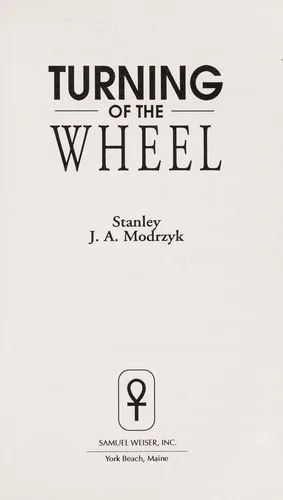
Turning of the wheel
 73
73

Turning of the wheel
Stanley J. A. Modrzyk's 'Turning of the Wheel' offers a dense, if at times challenging, examination of cyclical time. Its strength lies in its comprehensive, albeit sometimes dense, cataloging of various cultural and esoteric understandings of cosmic and terrestrial cycles. Modrzyk’s particular focus on the Great Year, as a lens through which to view historical ages and spiritual evolution, is compelling. However, the prose can occasionally become overly academic, requiring a dedicated reader to parse its intricacies. A notable passage details the symbolic significance of the equinoxes not just as astronomical events but as points of energetic transition, mirroring inner spiritual shifts. While it avoids sensationalism, its depth might prove daunting for casual readers. It serves as a substantial reference for those deeply invested in esoteric cosmology.
📝 Description
73
Stanley J. A. Modrzyk's 1993 book examines existence's cyclical nature through esoteric traditions.
Published in 1993, 'Turning of the Wheel' investigates the concept of cyclical existence as understood within various esoteric traditions. The book moves beyond simple timekeeping to analyze the symbolic meanings embedded in recurring patterns that influence both individual lives and larger cosmic events. Modrzyk suggests that grasping these cycles provides a structure for spiritual development and a deeper connection to universal energies. It is written for students of esoteric philosophy, comparative religion, and anyone interested in the symbolic frameworks of older traditions. The work resonates with those who wish to understand the archetypes and forces that shape human history and personal journeys. Readers familiar with or curious about concepts such as the Great Year, astrological cycles, and mythological patterns will find much to consider. The book emerged during a time of renewed interest in Jungian psychology and archetypal studies, and a growing New Age movement that often incorporated cyclical cosmologies. While not directly tied to academic postmodernism, its focus on recurring patterns and symbolic interpretation offered an alternative to purely linear views of history. Modrzyk engages with ideas from occult circles aiming to unite different spiritual paths, referencing figures and concepts influential in esoteric thought.
This work sits within the tradition of cyclical cosmologies found across many esoteric systems, particularly those influenced by ancient Greek, Gnostic, and Hermetic thought. It engages with the idea of a 'Great Year,' a concept tied to astrological ages and the precession of the equinoxes, which posits vast cycles of cosmic and human history. Modrzyk connects this macro-view to the cyclical patterns observed in nature, human psychology, and individual life stages, drawing parallels between the universal and the personal.
💡 Why Read This Book?
• Gain a structured understanding of the Great Year, a concept central to many ancient cosmologies and astrological traditions, as explored in Chapter 3. • Learn to identify recurring archetypal patterns in historical epochs and personal lives, moving beyond superficial interpretations of change. • Explore the symbolic meaning of astronomical events like equinoxes and solstices as energetic turning points, a key theme discussed throughout the book.
⭐ Reader Reviews
Honest opinions from readers who have explored this book.
❓ Frequently Asked Questions
What is the 'Great Year' as discussed in 'Turning of the Wheel'?
The 'Great Year' in Modrzyk's work refers to the approximately 25,920-year cycle of the precession of the equinoxes, a vast cosmic rhythm that influences the passage of astrological ages.
Does the book discuss specific historical periods in relation to cyclical time?
Yes, the work explores how historical epochs, such as the Age of Pisces, are understood within the framework of the Great Year, suggesting symbolic alignments and energetic shifts.
Who was Stanley J. A. Modrzyk?
Stanley J. A. Modrzyk was an author and researcher focused on esoteric philosophy and cyclical cosmologies, with 'Turning of the Wheel' being a significant contribution to his work published in 1993.
What is the esoteric significance of the equinoxes according to the book?
The book interprets equinoxes not merely as astronomical events but as potent moments of energetic balance and transition, mirroring spiritual renewal and shifts in consciousness.
Is 'Turning of the Wheel' suitable for beginners in esoteric studies?
While comprehensive, the book delves into complex concepts. Beginners may find it more accessible after familiarizing themselves with foundational esoteric or astrological principles.
What is the primary focus of the book's analysis?
The book's primary focus is on the philosophical and symbolic interpretation of cyclical time, examining how these patterns manifest across cosmic, historical, and personal scales.
🔮 Key Themes & Symbolism
Cosmic Cycles and the Great Year
The central theme is the Great Year, a vast astronomical cycle tied to the precession of the equinoxes, which Modrzyk argues dictates the rise and fall of ages and civilizations. The book meticulously details how this macro-cycle is reflected in smaller cycles, from seasonal changes to personal life stages. It posits that understanding these grand, recurring patterns provides a framework for interpreting human history and spiritual evolution, suggesting a divinely ordered, rhythmic universe rather than one of random chance.
Symbolism of Celestial Events
Modrzyk imbues celestial events, particularly equinoxes and solstices, with profound symbolic meaning beyond their astronomical function. These are presented as crucial junctures of energetic transformation, moments where the veil between different states of consciousness thins, facilitating spiritual insight and change. The text explores how various cultures have historically recognized and ritualized these 'turning points,' linking them to themes of death, rebirth, and the continuous renewal of cosmic and personal life.
Archetypes in History and Myth
The book examines how recurring archetypes, as described in mythologies and psychological studies, manifest within the grand sweep of history, guided by the overarching cycles. Modrzyk suggests that the archetypal energies associated with different astrological ages, such as the Age of Pisces, shape collective consciousness, cultural development, and the prevailing spiritual narratives of humanity. This perspective offers a lens for understanding historical epochs as distinct, yet interconnected, phases within a larger, unfolding cosmic drama.
Spiritual Evolution Through Cycles
A core tenet is that spiritual growth is intrinsically linked to navigating and understanding these cosmic and historical cycles. Modrzyk proposes that each phase of the Great Year presents unique challenges and opportunities for humanity's collective evolution. By recognizing these cyclical shifts, individuals can better align themselves with the prevailing energies, fostering personal transformation and contributing to the larger evolutionary trajectory of consciousness.
💬 Memorable Quotes
Direct passages from the work, attributed to the author.
“The precession of the equinoxes marks a grand cycle, a cosmic heartbeat that influences the very fabric of civilization.”
— This highlights the book's core argument: that astronomical cycles like the precession are not mere scientific phenomena but fundamental forces shaping human history and societal development.
“Each age carries its own distinct energetic signature, shaping collective consciousness and spiritual pursuits.”
— This interpretation emphasizes the idea that different astrological ages, determined by the slow shift of the equinox, bring unique psychological and spiritual qualities to humanity.
“Understanding the wheel's turning offers insight into both personal destiny and the broader currents of world events.”
— This suggests that the book connects the macrocosm (world events influenced by cosmic cycles) to the microcosm (individual fate and understanding), positing a unified field of influence.
“Mythology serves as a repository of ancient wisdom concerning these recurring cosmic patterns.”
— This points to the book's method of drawing parallels between esoteric astronomical cycles and the symbolic narratives found in global myths and legends.
“The equinoxes are not just dates, but moments of profound energetic balance and potential for renewal.”
— This captures the book's view of astronomical events as having spiritual and energetic significance, acting as critical junctures for transformation.
🌙 Esoteric Significance
Tradition
The work draws heavily from Western Esoteric traditions, particularly Hermeticism and Pythagorean thought, which emphasize mathematical harmony and cosmic cycles. It also echoes Theosophical interpretations of vast cosmic periods and world-saving epochs. Modrzyk’s approach synthesizes these influences, framing the 'Great Year' not just as an astrological concept but as a fundamental principle governing spiritual evolution and the manifestation of consciousness across immense timescales.
Symbolism
Key symbols include the 'Wheel' itself, representing the cyclical, ever-turning nature of existence and time. The 'Equinoxes' are depicted as potent points of balance and transition, symbolizing moments of cosmic equilibrium and the potential for profound change. The 'Great Year' symbolizes the ultimate cosmic cycle, encompassing the rise and fall of civilizations and the grand evolutionary arc of humanity within a divinely ordered universe.
Modern Relevance
Contemporary practitioners of Western Esotericism, particularly those interested in astrological cycles and comparative cosmology, continue to engage with Modrzyk's ideas. His work informs discussions on historical cycles, archetypal patterns in current events, and the concept of evolutionary spirituality. Thinkers exploring the intersection of consciousness, cosmology, and ancient wisdom traditions may find 'Turning of the Wheel' a valuable reference for understanding these long-term, cyclical influences.
👥 Who Should Read This Book
• Students of Western Esotericism seeking to understand the Great Year and its influence on historical ages. • Researchers in comparative mythology and religion interested in recurring cosmic cycles across cultures. • Individuals drawn to symbolic interpretations of time and history who wish to explore non-linear models of development.
📜 Historical Context
Published in 1993, 'Turning of the Wheel' emerged in an era where esoteric thought was experiencing a resurgence, partly fueled by the New Age movement and a renewed interest in Jungian psychology's archetypal theories. Modrzyk's work engaged with the long-standing tradition of cyclical cosmologies, particularly those found within Western Esotericism, which often referenced concepts like the Great Year. This period saw a divergence between academic historical approaches, which often favored materialist or social explanations, and esoteric perspectives that sought meaning in symbolic and cyclical patterns. Contemporaries like F. David Peat were exploring similar themes of interconnectedness and hidden orders in physics and consciousness, though from a more scientific angle. While not subject to widespread censorship, such works often existed outside mainstream academic discourse, finding their audience among independent researchers and spiritual practitioners interested in alternative interpretations of time and history.
📔 Journal Prompts
The Great Year as a framework for understanding societal shifts.
Reflecting on the symbolism of equinoxes in personal experience.
Archetypal patterns observed across different historical ages.
Personal alignment with perceived cosmic rhythms.
The concept of cyclical renewal in myth and contemporary life.
🗂️ Glossary
Precession of the Equinoxes
The slow, gradual shift in the position of the Earth's axis, causing the timing of the equinoxes to move backward through the zodiac over approximately 25,920 years.
Great Year
A vast cosmological cycle, often equated with the period of the precession of the equinoxes, during which astrological ages succeed one another.
Astrological Age
A period of approximately 2,160 years, defined by the Sun's position at the vernal equinox, moving backward through the zodiac (e.g., Age of Pisces, Age of Aquarius).
Equinox
The moment when the Sun crosses the celestial equator, resulting in nearly equal amounts of daylight and darkness at all latitudes; marks the start of spring and autumn.
Solstice
The moment when the Sun reaches its highest or lowest point in the sky at noon, marking the longest and shortest days of the year; marks the start of summer and winter.
Archetype
A universal, inherited pattern of thought or imagery derived from the collective unconscious, often appearing in myths, symbols, and dreams.
Cosmic Rhythm
The concept that the universe operates according to predictable, cyclical patterns and pulsations, influencing both celestial events and terrestrial phenomena.
🔮 Readers Also Liked
Browse all →






More by Stanley J. A. Modrzyk
All books →
More Free Witchcraft & Paganism Books
View all →






![D. [i. e., Doktor] Balthasar Bekkers reformierten Predigers in Amsterdam bezauberte Welt. ... 1781: Vol 2 Iss 81](/img/thumb/d-i-e-doktor-balthasar-bekkers-reformierten-predigers-in-amsterdam-bezauberte-welt-1781-vol-2-iss-81-bekker-balthasar-1634-1698.webp)

