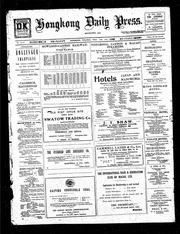
Hong Kong Daily Press 1924-07-15
 71
71

Hong Kong Daily Press 1924-07-15



Evander Ashcroft (Alchemy & Hermeticism Editor) — This unearthed fragment from the Hong Kong Daily Press is a fascinating, albeit unconventional, source for esoteric study. While not overtly occult, its reporting on societal control, the potential for corporal punishment's return, and the 'lost folk' of Kansu offers fertile ground for symbolic interpretation. The juxtaposition of 'luxuries in Japan' with 'fighting armed robbers' speaks to the inherent duality and the struggle for balance in human affairs. Scholars of comparative religion and cultural anthropology will find veiled references to archaic belief systems and the societal anxieties that often precede spiritual awakenings. A unique, albeit indirect, lens into the esoteric zeitgeist of the era.
📝 Description
71
Hong Kong Daily Press, July 15, 1924, reports on societal control and ancient disciplinary measures.
This edition of the Hong Kong Daily Press from July 15, 1924, contains more than standard news of trade and politics. It touches on themes of societal control, including what appear to be discussions of ancient disciplinary practices. The paper also notes the dismissal of a 'Reform Comptroller,' suggesting internal power struggles related to these control mechanisms.
Further into the issue, reports from remote Kansu describe 'curious tribes of lost folk.' These accounts may allude to forgotten lineages and spiritual practices distinct from the urban concerns of Hong Kong. The newspaper, therefore, presents a juxtaposition of immediate colonial concerns with more remote, possibly esoteric, cultural observations from the era. It offers a look at how such matters were reported in the early 20th century.
This newspaper issue touches on themes that resonate with esoteric traditions concerned with social order and hidden spiritual practices. The mention of ancient disciplinary measures and 'lost folk' in Kansu suggests an interest in alternative forms of knowledge or social organization, separate from mainstream colonial administration. Such reports, even if presented as news, could reflect a wider cultural fascination with the hidden, the ancient, and the potentially mystical aspects of human society that were present in the early 20th century.
💡 Why Read This Book?
Uncover hidden societal anxieties and symbolic narratives beneath conventional news. Explore veiled discussions on control and forgotten communities. This unique historical document offers a rare glimpse into the esoteric undercurrents of 1920s Asia, perfect for seekers of unconventional wisdom and historical researchers.
⭐ Reader Reviews
Honest opinions from readers who have explored this book.
❓ Frequently Asked Questions
What esoteric traditions might be hinted at in this newspaper?
While not explicit, themes of societal control, ancient punishments, and 'lost folk' could indirectly allude to practices related to shamanism, folk magic, or even early forms of social engineering that mirror esoteric principles of order and hierarchy.
How does a daily newspaper from 1924 relate to witchcraft and paganism?
The connection lies in the indirect portrayal of societal anxieties and the human fascination with control, justice, and the 'other.' These are themes that often underpin mythological narratives and ritualistic practices central to many witchcraft and pagan traditions.
Are there any direct mentions of spells or rituals?
This particular edition focuses on socio-political and economic news. Direct mentions of spells or rituals are unlikely, but the underlying societal concerns can be interpreted through an esoteric lens.
Who is the 'Reform Comptroller' and why was he forced out?
The article suggests a figure tasked with 'reform' who was apparently undermined by Manchu elements, hinting at power struggles and resistance to change, a common theme in societal transformations that can be viewed symbolically.
What makes the 'curious tribes of lost folk' in Kansu relevant?
Such mentions often point to isolated communities with unique traditions, folklore, and potentially pre-modern belief systems that could hold echoes of ancient pagan or animistic practices, lost to mainstream society.
🔮 Key Themes & Symbolism
The Shadow of Control and Discipline
This newspaper extract implicitly explores the societal desire for order and control, particularly through the discussion of corporal punishment. From an esoteric perspective, this reflects the universal human impulse to establish boundaries and enforce adherence to perceived cosmic or social laws. The 'Reform Comptroller's' ousting suggests a struggle against imposed order, echoing ancient myths of rebellion and the cyclical nature of power. It invites contemplation on the nature of authority, the efficacy of strictures, and the hidden forces that shape human governance.
Whispers of the 'Lost Folk' and Forgotten Lore
The mention of 'curious tribes of lost folk' in Kansu is a potent invitation into the area of the unknown and the marginalized. Esoterically, these 'lost' communities often represent keepers of ancient wisdom, untainted by modern societal pressures. Their existence hints at alternative pathways of spiritual understanding and connection to the earth, potentially preserving paganistic or shamanistic traditions long forgotten by the wider world. It speaks to the enduring presence of primal forces and the possibility of rediscovering ancestral knowledge.
The Alchemy of Trade and Societal Transformation
The juxtaposition of 'luxuries in Japan' with 'fighting armed robbers' and proposed trade checks paints a picture of a world in flux, grappling with material desires and inherent conflicts. This reflects an alchemical process of societal transformation, where opposing forces (wealth and poverty, order and chaos) collide and interact. The difficulties in drafting a tariff scheme symbolize the intricate and often elusive nature of balancing economic forces, mirroring the challenges of transmuting base elements into gold – a metaphor for achieving societal harmony and spiritual refinement.
💬 Memorable Quotes
Direct passages from the work, attributed to the author.
“LUXURIES IN JAPAN. PROPOSAL TO CHECK HOME TRADE AS WELL AS IMPORTS.”
— This highlights the duality of desire and restriction, a core tension in both material and spiritual pursuits. The allure of the exotic meets the practical need for balance.
“FIGHTING ARMED ROBBERS IN SHANGHAI. JOINT ACTION BY CHINESE AND THE FOREIGN POLICE.”
— Symbolizes the clash between primal chaos and emergent order, requiring cooperation between disparate forces to restore equilibrium.
“CAN CORPORAL PUNISHMENT BE REINTRODUCED.”
— A question touching on ancient disciplinary methods and the societal impulse to enforce order through direct, often harsh, means.
“CURIOUS TRIBES OF LOST FOLK.”
— Evokes the mystery of hidden communities and the potential for ancient, perhaps pagan, wisdom dwelling beyond the fringes of civilization.
“"REFORM" COMPTROLLER FORCED OUT BY THE MANCHUS.”
— Illustrates the cyclical struggle for power and the subtle resistance to imposed change, echoing themes of ancient governance and spiritual hierarchy.
🌙 Esoteric Significance
Tradition
While not explicitly tied to a single esoteric tradition, this newspaper report offers glimpses into universal archetypes and societal undercurrents that resonate with Hermeticism, Gnosticism, and various forms of folk magic and shamanism. The themes of control, hidden knowledge, societal order, and the existence of 'lost' peoples connect to the Hermetic principle of 'As Above, So Below,' reflecting macrocosmic struggles in the microcosm of human society. The 'lost folk' hint at primal animistic beliefs and earth-centered spiritualities.
Symbolism
The 'luxuries' represent material temptation and the illusionary nature of worldly possessions, a recurring theme in spiritual disciplines. The 'armed robbers' symbolize chaotic forces or the shadow self that must be confronted. The 'Reform Comptroller' can be seen as an archetype of the misguided or overthrown ruler, while the 'Manchus' represent entrenched powers or primal energies resisting change. The 'curious tribes' are symbols of the collective unconscious and the repository of ancient, untamed wisdom.
Modern Relevance
The report's exploration of societal control, trade imbalances, and the search for order remains remarkably relevant. In an age of global interconnectedness and rapid technological advancement, the tensions between progress and tradition, individual freedom and collective security, are amplified. The enduring mystery of 'lost' cultures and forgotten wisdom speaks to a modern yearning for deeper connection and authenticity, reminding us that ancient patterns of human behavior and belief continue to shape our world.
👥 Who Should Read This Book
This historical curiosity is useful for seekers of hidden knowledge, especially those interested in the intersection of history, culture, and esoteric thought. Scholars of Asian studies, comparative religion, and cultural anthropology will find it a rich primary source for understanding the societal anxieties and undercurrents of early 20th-century China. Practitioners of witchcraft and paganism may draw symbolic inspiration from the veiled discussions on order, chaos, and forgotten communities. Beginners in esoteric studies will appreciate its accessible, albeit indirect, introduction to how mystical themes can be perceived within everyday historical records.
📜 Historical Context
This artifact emerges from the tumultuous era of the 1920s, a period marked by immense global change following World War I. Asia, in particular, was a nexus of evolving political landscapes, nascent nationalisms, and the lingering influence of colonial powers. In China, the fall of the Qing Dynasty had ushered in an era of warlordism and republican experimentation, creating a volatile environment rife with both progress and conflict. The rapid industrialization and modernization, juxtaposed with deeply rooted traditions, fostered a unique cultural milieu where ancient beliefs and modern anxieties coexisted. This newspaper report, therefore, captures a society grappling with its identity, seeking new forms of order, and perhaps unconsciously echoing older, more mystical paradigms in its quest for stability and meaning.
📔 Journal Prompts
Reflect on a time when societal 'control' felt either oppressive or necessary in your life. What were the underlying forces at play?
Imagine you are one of the 'lost folk' in Kansu. What ancient knowledge or practices might your tribe preserve, and why would they remain hidden?
Consider the concept of 'reform' in your own life or society. What forces typically resist or facilitate genuine transformation?
If 'luxuries' are a form of temptation, what are the spiritual 'luxuries' one might be tempted by, and how do they hinder personal growth?
How does the 'joint action' described in Shanghai reflect the need for balance between different energies (e.g., masculine/feminine, light/dark) to achieve harmony?
🗂️ Glossary
孖剌西報 (Ma Lat Sai Po)
This is the transliteration of the Hong Kong Daily Press in Chinese, indicating its historical significance and readership within the Chinese-speaking community of Hong Kong during that period.
Comptroller
An official who manages finances or oversees an organization. In this context, a 'Reform Comptroller' suggests someone tasked with overseeing changes or improvements, often with financial implications.
Manchus
An ethnic group native to Manchuria, who established the Qing dynasty that ruled China from 1644 to 1912. Their continued influence is implied even after the dynasty's fall.
Kansu
An older romanization of Gansu, a province in northwestern China, known for its historical Silk Road significance and diverse ethnic populations, often remote and less influenced by central government.
P.W.D.
Public Works Department. This refers to a government body responsible for infrastructure and public services, indicating the mundane administrative concerns of the time.
This book appears in 2 collections
🔮 Readers Also Liked
Browse all →![The Tipperary (or Clonmel) witch case : [transcripts of newspaper reports &c. concerning Bridget Cleary, burned as a witch, and the trial of her husband and neighbours for murder, in 1895]](/img/thumb/the-tipperary-or-clonmel-witch-case-transcripts-of-newspaper-reports-c-concerning-bridget-cleary-burned-as-a-witch-and-the-trial-of-her-husband-and-neighbours-for-murder-in-1895.webp)


![ERIC ED481283: Salem Witch Trials. [Lesson Plan].](/img/thumb/eric-ed481283-salem-witch-trials-lesson-plan-eric.webp)




From the “Witchcraft” Collection
View all →

![John Todd [Illuminati And Witchcraft Exposed].pdf (PDFy mirror)](/img/thumb/john-todd-illuminati-and-witchcraft-exposed-pdf-pdfy-mirror.webp)




More Free Witchcraft & Paganism Books
View all →