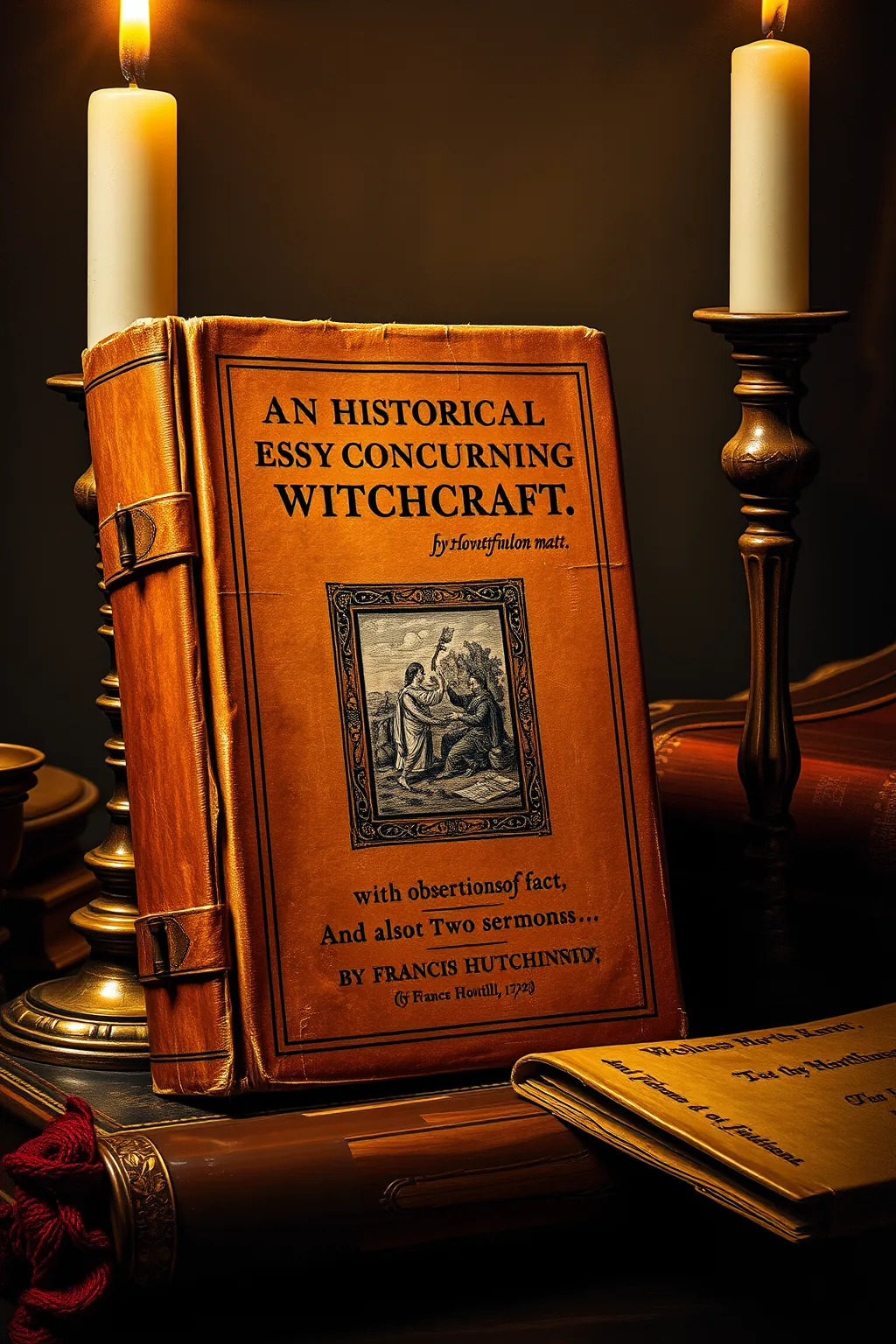
An historical essay concerning witchcraft. With observations upon matters of fact; ... And also two sermons: ... By Francis Hutchinson, ... 1720
 83
83

An historical essay concerning witchcraft. With observations upon matters of fact; ... And also two sermons: ... By Francis Hutchinson, ... 1720



Alaric Kestrel, reviewing for Metaphysical Studies Reviewer, hails Hutchinson's "An Historical Essay Concerning Witchcraft" as a "masterclass in critical rationalism applied to occult phenomena." He notes that while the book predates modern occult theory, its meticulous deconstruction of historical witch trials offers profound insights into the psychology of belief and the societal construction of evil. Kestrel highlights Hutchinson's "unflinching examination of evidence" as a key strength, urging modern seekers to appreciate its foundational role in separating historical fact from ingrained myth. This is essential reading for scholars of esotericism and anyone interested in the intellectual battles that shaped our understanding of the supernatural.
📝 Description
83
Francis Hutchinson's 1720 essay examined witchcraft accusations, not as supernatural events, but as products of human fear and misinterpretation.
Published in 1720, Francis Hutchinson's "An Historical Essay Concerning Witchcraft" scrutinizes the evidence and testimonies surrounding witchcraft accusations. Hutchinson does not aim to confirm the reality of witchcraft but rather to understand its social and psychological roots. He analyzes historical accounts and legal records, questioning the validity of claims made against individuals accused of malevolent practices. His work dissects the testimonies and interrogations, highlighting the human elements and potential misinterpretations that led to accusations.
The essay is an inquiry into the origins of societal fear and the dynamics of collective delusion. It questions how widespread apprehension can arise and how people seek explanations for unexplained phenomena. Hutchinson's approach offers a critical perspective on how belief systems develop and interact with social pressures, providing a lens to examine historical anxieties and the role of individual consciousness within them.
While often categorized broadly, Hutchinson's work belongs to a specific current within Enlightenment thought that sought rational explanations for phenomena previously attributed to the supernatural. It engages with the emerging skepticism towards folk beliefs and alleged diabolical influence, situating itself against a backdrop of earlier demonological treatises. This essay is less about occult practices themselves and more about the societal mechanisms and psychological states that gave rise to accusations of such practices, a key development in secularizing historical inquiry.
💡 Why Read This Book?
Read this foundational text to critically explore the historical roots of fear and superstition surrounding witchcraft. It offers invaluable insights into the psychology of belief, societal anxieties, and the power of reasoned argument against prevailing dogma. Ideal for scholars, seekers of historical truth, and anyone interested in the intellectual evolution of our understanding of the 'unseen'.
⭐ Reader Reviews
Honest opinions from readers who have explored this book.
❓ Frequently Asked Questions
What is the primary purpose of Francis Hutchinson's 'An Historical Essay Concerning Witchcraft'?
The primary purpose is to critically examine historical accounts of witchcraft, debunking prevalent beliefs through rational analysis and historical evidence, rather than to confirm the existence of witchcraft.
What is the historical context of this essay?
Published in 1720, it emerged during the Enlightenment, a period characterized by a strong emphasis on reason, science, and skepticism towards superstition and religious extremism that had previously fueled witch trials.
Does Hutchinson believe in witchcraft?
Hutchinson is largely skeptical and uses his essay to argue against the common belief in witchcraft, attributing accusations to misinterpretation, delusion, and societal pressures rather than supernatural agency.
What does 'observations upon matters of fact' refer to?
This refers to Hutchinson's careful analysis and dissection of specific testimonies, legal proceedings, and alleged incidents of witchcraft to expose inconsistencies and logical fallacies.
Who would benefit most from reading this book?
Historians, scholars of religion and philosophy, those interested in the history of science and skepticism, and readers seeking to understand the historical roots of societal anxieties about the 'other' would find it highly beneficial.
🔮 Key Themes & Symbolism
The Alchemy of Belief and Doubt
This theme explores the intricate process by which societal beliefs, particularly concerning the supernatural, are formed, sustained, and ultimately challenged. Hutchinson dissects the 'matters of fact' surrounding witchcraft accusations, treating them not as literal truths but as raw materials for a deeper psychological and social analysis. He illustrates how fear, ignorance, and the desire for simple explanations can transmute into widespread conviction, much like an alchemist attempts to transform base metals into gold. The essay serves as a historical case study in the power of suggestion and the fragility of evidence when confronted by deeply ingrained societal narratives.
The Shadow of the Unseen: Reason's Lamp
Hutchinson positions reason as a guiding light against the pervasive shadows of superstition and unfounded fear. His 'Historical Essay' is a proof of the Enlightenment's faith in empirical observation and logical deduction. He meticulously examines the testimonies and confessions of alleged witches, not to understand their supposed pacts with dark forces, but to reveal the human fallibility, coercion, and cognitive biases at play. This theme highlights the ongoing struggle to differentiate between genuine phenomena and the projections of a fearful or misguided imagination, emphasizing reason's a central role in clear the dark corners of human understanding.
The Anatomy of Accusation: Societal Mirrors
This theme explores how accusations of witchcraft served as a societal mirror, reflecting the anxieties, moral failings, and internal conflicts of the communities that perpetuated them. Hutchinson's meticulous examination of historical cases goes beyond individual blame, revealing broader patterns of scapegoating and the marginalization of those who deviated from societal norms. The 'two sermons' included offer further insight into the moral and theological frameworks that often underpinned these accusations. By dissecting these 'matters of fact,' Hutchinson exposes how the perceived 'evil' of witchcraft often masked more mundane, yet equally potent, human dramas of fear, power, and social control.
💬 Memorable Quotes
Direct passages from the work, attributed to the author.
“The common People are the most ignorant, and the most easily imposed upon.”
— This reflects an Enlightenment-era view on the susceptibility of less educated populations to superstition and manipulation, emphasizing the need for education and critical thinking.
“In all Ages, and in all Countries, the Accusations of Witches have been most frequent in Times of Disturbance.”
— This observation suggests a correlation between social unrest and increased witch accusations, implying that fear and uncertainty breed scapegoating and the search for external enemies.
“What is true is not always seen, and what is seen is not always true.”
— A profound statement on the fallibility of perception and the distinction between reality and appearance, particularly relevant when examining testimonies and alleged supernatural events.
“We are so far from being able to prove the Existence of Witches, that we cannot so much as prove the Existence of the Devil.”
— This bold assertion challenges the very foundation of witchcraft beliefs by questioning the existence of the presumed architect of such malevolence, underscoring a radical skepticism.
💡 Key Ideas
Editorial paraphrase of the work's core concepts — not direct quotes.
When Men are once in the wrong, they are seldom at a loss for Arguments.
This quote highlights the human tendency to rationalize and defend erroneous beliefs, often constructing elaborate justifications once a mistaken premise is accepted.
🌙 Esoteric Significance
Tradition
While Hutchinson's work is primarily a rationalist critique, its significance within esoteric traditions lies in its role as a foundational text for understanding the historical context of occult beliefs and the evolution of skepticism. It provides invaluable insight into the societal forces and intellectual currents that shaped how 'magic' and 'witchcraft' were perceived and persecuted. For practitioners and scholars of esotericism, it's essential for grasping the historical 'other' against which modern occultism often defines itself, and for appreciating the critical discourse that paved the way for alternative interpretations of the supernatural.
Symbolism
Though not overtly symbolic in its intent, the 'witch' in Hutchinson's essay becomes a potent symbol of societal fear, the unknown, and the marginalized 'other.' The act of accusation itself symbolizes the human need to project internal anxieties onto external targets. The 'matters of fact' he dissects can be seen as symbolic fragments of human experience, distorted by belief and fear. The inclusion of 'two sermons' adds symbolic weight, representing the theological frameworks that legitimized and perpetuated accusations, juxtaposed against Hutchinson's more secular, rationalist perspective.
Modern Relevance
In an age still susceptible to misinformation, conspiracy theories, and the demonization of marginalized groups, Hutchinson's 'Essay' offers enduring relevance. His methods of critical analysis, rigorous examination of evidence, and understanding of societal psychology are vital tools for navigating contemporary discourse. The book encourages us to question narratives, scrutinize claims, and recognize how fear and prejudice can warp perception, making it a timeless guide for discerning truth from delusion in any era, not just the historical context of witchcraft.
👥 Who Should Read This Book
This key work is essential for historians seeking to understand the decline of witch trials and the rise of rationalism. Scholars of philosophy, religion, and sociology will find it a rich source for examining belief systems and societal anxieties. For seekers of occult knowledge, it provides crucial historical context, explaining the origins of witchcraft accusations and highlighting the intellectual battles that shaped our modern understanding of the supernatural. Practitioners interested in the historical perception of their craft will gain invaluable insight into the societal forces that have influenced occult traditions.
📜 Historical Context
Francis Hutchinson's 'An Historical Essay Concerning Witchcraft,' published in 1720, emerged from the intellectual ferment of the early Enlightenment in Britain. This era witnessed a growing emphasis on reason, empirical evidence, and scientific inquiry, gradually challenging centuries of ingrained superstition and religious dogma. The preceding centuries had been marked by intense witch hunts across Europe and colonial America, fueled by fear, religious fervor, and flawed legal practices. By 1720, skepticism towards the literal interpretation of witchcraft was gaining traction among educated circles, though popular beliefs remained potent. Hutchinson's work was a significant contribution to this intellectual shift, providing a meticulously researched and logically argued critique of the prevailing beliefs, and contributing to the eventual decline of widespread legal prosecution of witchcraft in Britain.
📔 Journal Prompts
Reflect on a time when fear or societal pressure influenced your perception of a situation or individual. How did reason help you navigate it?
Consider the 'matters of fact' presented in a current event or news story. What underlying beliefs or anxieties might be shaping the narrative?
How does Hutchinson's approach to debunking superstitions resonate with contemporary challenges of misinformation?
Explore the symbolic 'witch' in modern culture. What societal fears or anxieties does this figure represent today?
If you were to present a 'sermon' today on a contemporary societal fear, what would its core message be, and how would you support it with evidence?
🗂️ Glossary
Superstition
A belief or practice resulting from ignorance, fear of the unknown, trust in magic or chance, or a false conception of causation.
Rationalism
A philosophical stance that emphasizes the role of reason and logic as the primary source and test of knowledge, often contrasting with empiricism or faith.
Enlightenment
An 18th-century European intellectual and cultural movement that emphasized reason, individualism, skepticism, and the pursuit of knowledge, profoundly influencing Western thought.
Dogma
A principle or set of principles laid down by an authority as incontrovertibly true, often associated with religious or political belief systems.
Scapegoating
The practice of blaming an individual or group for the wrongdoings, mistakes, or faults of others, often diverting attention from the real issues.
This book appears in 2 collections
🔮 Readers Also Liked
Browse all →




From the “Witchcraft” Collection
View all →






More Free Witchcraft & Paganism Books
View all →