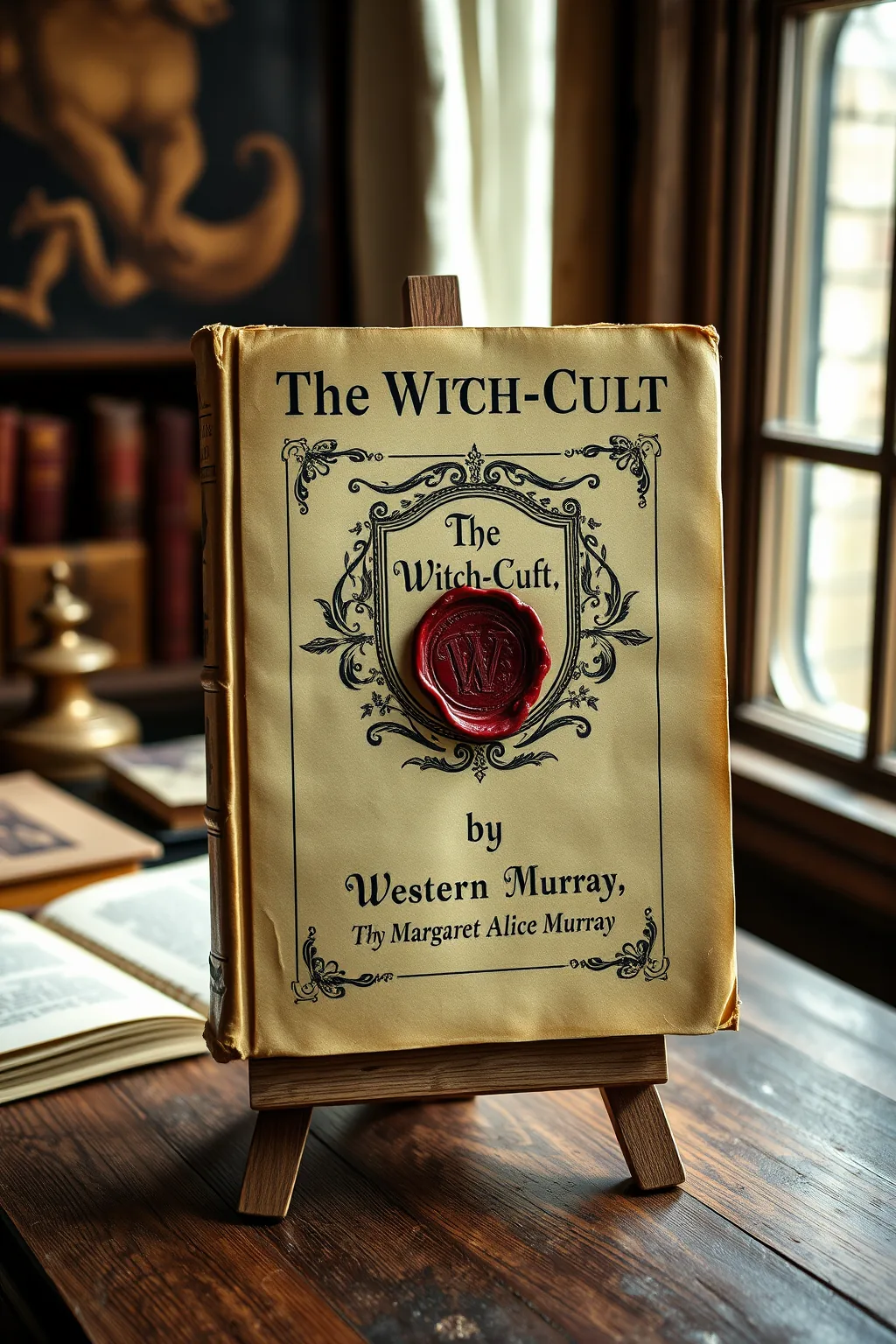
The Witch-Cult in Western Europe
 95
95

The Witch-Cult in Western Europe



Margaret Alice Murray's 'The Witch-Cult in Western Europe' remains an epochal work, a foundational pillar in the study of European witchcraft. Murray's meticulously researched thesis posits a cohesive, ancient pagan religion underlying the persecution of witches. She masterfully synthesizes disparate sources, revealing the enduring presence of a nature-based spiritual system, the worship of a horned deity, and the clandestine continuity of pre-Christian rites. Though debated by modern scholarship, its influence on occult practitioners and historical inquiry is undeniable. This text is essential for anyone seeking to comprehend the historical underpinnings of modern witchcraft and the enduring power of ancient European spiritual traditions.
📝 Description
95
Margaret Alice Murray published 'The Witch-Cult in Western Europe' in 1921.
In 'The Witch-Cult in Western Europe,' Margaret Alice Murray proposed that witchcraft in early modern Europe was not isolated superstition but the continuation of an ancient, organized pagan religion. She argued this cult persisted underground, particularly in rural areas, and maintained its own rituals and beliefs distinct from Christian demonology. Murray drew on a wide array of historical documents, including trial records and folklore collections, to build her case for a widespread, often matriarchal, religious structure.
Her work detailed the supposed practices of this witch-cult, including its reverence for a horned god and its connection to natural cycles. Murray contended that accusations of devil worship during the witch trials were often misinterpretations of these older pagan traditions. The book aimed to show that the persecution of witches was an attempt to eradicate a surviving pre-Christian faith.
Margaret Alice Murray's 1921 book placed her work within the burgeoning field of occult studies that sought to unearth suppressed or forgotten spiritual traditions. At a time when interest in paganism and ancient religions was growing, Murray posited a continuous, organized lineage of witchcraft in Western Europe. This contrasted with contemporary views that often saw witchcraft solely as demonic delusion or isolated folk magic. Her research connected historical persecution with a hypothesized surviving pagan faith, influencing later generations of Wiccans and scholars interested in reconstructed paganism.
💡 Why Read This Book?
Uncover the suppressed history of a pervasive pagan cult that secretly thrived across Western Europe for centuries. 'The Witch-Cult in Western Europe' offers compelling evidence of a continuous, organized spiritual tradition predating Christian dominance. Ideal for seekers of hidden knowledge, scholars of folklore and anthropology, and practitioners interested in the historical roots of witchcraft and earth-based spirituality.
⭐ Reader Reviews
Honest opinions from readers who have explored this book.
❓ Frequently Asked Questions
What is the central argument of 'The Witch-Cult in Western Europe'?
Murray's central argument is that the witch-cult was not a figment of witch trials but a genuine, organized pre-Christian pagan religion that persisted underground throughout Europe, worshipping a horned god and practicing ancient rites.
What historical evidence does Murray use?
She draws upon a wide array of sources including legal records of witch trials, folklore, anthropological studies, and accounts of pagan practices from various European regions.
Is Murray's thesis widely accepted by modern scholars?
While groundbreaking for its time, Murray's thesis has been subject to significant debate and revision by contemporary historians and folklorists. However, its impact on the study of witchcraft remains profound.
What is the significance of the 'horned god' in Murray's theory?
Murray identifies the horned god, often depicted as a male deity with animalistic features, as the central figure of worship within the witch-cult, representing fertility, nature, and ancient power.
How does this book relate to modern paganism?
The book is foundational for many modern pagan and Wiccan traditions, providing a historical narrative and symbolic framework that informed their reconstruction of ancient spiritual practices and beliefs.
🔮 Key Themes & Symbolism
The Continuity of Ancient Paganism
Murray posits a powerful argument for the unbroken lineage of pre-Christian pagan practices and beliefs that survived the ascendancy of Christianity. She meticulously details how these ancient traditions, often centered around nature worship and fertility rites, continued to be practiced in secret by organized covens. The book explores the resilience of these old ways, suggesting they were not merely remnants but a living, breathing spiritual force that permeated the fabric of European society for centuries, often obscured by persecution and misinterpretation.
The Horned God and Matriarchal Power
A central tenet of Murray's thesis is the worship of a distinct horned deity, often identified with figures like the Devil in Christian demonology but understood by the cult as a benevolent god of nature and fertility. This theme is intrinsically linked to the concept of matriarchal power structures within the witch-cult. Murray suggests that women held significant authority as priestesses and leaders, embodying the sacred feminine and guiding the community's spiritual and social life in ways that contrasted sharply with patriarchal Christian norms.
The Social and Ritualistic Range of the Witch-Cult
This work studies the clandestine social structures and ritualistic practices of the witch-cult. Murray reconstructs the clandestine gatherings, secret initiation rites, and symbolic ceremonies that defined these groups. The book illuminates the community aspect of the cult, portraying it not as isolated individuals but as interconnected covens with their own laws, traditions, and sacred spaces. It emphasizes the deep connection to the natural world, the cycles of the seasons, and the profound symbolism embedded in their rituals, offering a vivid picture of a hidden spiritual subculture.
💬 Memorable Quotes
Direct passages from the work, attributed to the author.
“The witch-cult was a religion, and it was a religion of great antiquity.”
— This statement captures Murray's core thesis: that witchcraft was not random superstition but a structured, ancient faith with deep historical roots.
“The Devil was the Horned God of the witches.”
— This highlights the reinterpretation of the Christian 'Devil' as the pre-Christian Horned God, central to the witches' worship and symbolic system.
“The worship of the Horned God was a ritual of fertility and abundance.”
— This emphasizes the life-affirming and nature-connected aspects of the cult's religious practices, focusing on generative forces.
“The evidence suggests a continuous organization of witches from the earliest times to the present day.”
— This underscores Murray's belief in the enduring, unbroken transmission of the witch-cult's traditions across millennia.
“The witch-cult was a secret society, its members bound by oath and ritual.”
— This points to the clandestine nature of the cult, emphasizing the importance of secrecy, communal bonds, and shared spiritual practices.
🌙 Esoteric Significance
Tradition
This book is a starting point for understanding the historical roots of Western esotericism, particularly those traditions that seek to reconstruct or connect with pre-Christian European paganism. It provides a foundational narrative for many modern witchcraft and Wiccan covens, influencing their understanding of ritual, deity worship (especially the Horned God), and the concept of a continuous, secret spiritual lineage that survived Christianization.
Symbolism
The text illuminates the potent symbolism associated with the witch-cult, most notably the Horned God, representing primal masculine energy, nature's fertility, and wildness. It also touches upon the symbolism of the sabbat (gathering), the sacred dance, and the deep connection to the lunar cycles and the earth's rhythms. These symbols represent a holistic worldview rooted in the immanent sacredness of the natural world, contrasting with later abstract theological concepts.
Modern Relevance
Despite scholarly debates, Murray's work remains highly relevant for its contribution to the resurgence of pagan and witchcraft practices in the 20th and 21st centuries. It provided a compelling historical framework for those seeking to revive ancient traditions and reclaim a lost spiritual heritage. The book continues to inspire practitioners to explore the historical depths of their craft, understand the symbolic language of nature, and recognize the enduring power of earth-based spirituality in the modern world.
👥 Who Should Read This Book
This essential volume is for the dedicated seeker of hidden histories and ancient spiritualities. **Beginners** will find it an useful introduction to the historical context of witchcraft and paganism, offering a foundational narrative. **Scholars** of folklore, anthropology, and religious history will appreciate Murray's rigorous research and groundbreaking thesis, even as they engage with its critiques. **Practitioners** of modern witchcraft and pagan traditions will find in its pages the historical underpinnings and symbolic inspirations that have shaped their paths. **Seekers** of alternative spiritualities will discover a compelling vision of a suppressed yet persistent earth-based religion.
📜 Historical Context
Published in 1921, 'The Witch-Cult in Western Europe' emerged during a period of intense intellectual ferment and a growing fascination with ancient cultures, folklore, and the nascent fields of anthropology and psychology. The aftermath of World War I brought a questioning of established norms and a search for deeper, more primal truths. Margaret Alice Murray, a pioneering anthropologist, was at the forefront of challenging conventional historical narratives. Her work tapped into a growing interest in pre-Christian European spirituality and the occult, offering a radical reinterpretation of the witch trials not as isolated incidents of mass hysteria, but as the suppression of a persistent, organized pagan religion.
📔 Journal Prompts
Reflect on the concept of a 'hidden religion' persisting through centuries of persecution. How does this idea resonate with your understanding of spiritual resilience?
Consider the symbolism of the Horned God as presented by Murray. What does this archetype represent to you in terms of nature, power, and the divine?
Murray suggests matriarchal elements within the witch-cult. How might this contrast with or inform contemporary understandings of gender roles in spirituality?
If you practice or are drawn to earth-based spirituality, how does Murray's historical reconstruction inform your personal connection to nature and its cycles?
How does the idea of clandestine rituals and secret societies for spiritual practice influence your perception of community and shared belief?
🗂️ Glossary
Witch-Cult
As defined by Margaret Murray, a widespread, organized, and continuous pre-Christian pagan religion practiced in Western Europe, distinct from individual sorcery.
Horned God
The central deity worshipped by the witch-cult, often depicted with animalistic horns, representing fertility, nature, and primal masculine energy.
Coven
A group or assembly of witches, typically numbering thirteen, who gathered for ritualistic purposes, as described in Murray's research.
Sabbat
The nocturnal or clandestine meetings of the witch-cult, often held on specific astronomical or seasonal dates, for worship and ritual.
Paganism
A broad term referring to ancient polytheistic religions, particularly those prevalent in Europe before the rise of Christianity, characterized by nature worship and ritual.
This book appears in 2 collections
🔮 Readers Also Liked
Browse all →









From the “Witchcraft” Collection
View all →





More Free Witchcraft & Paganism Books
View all →