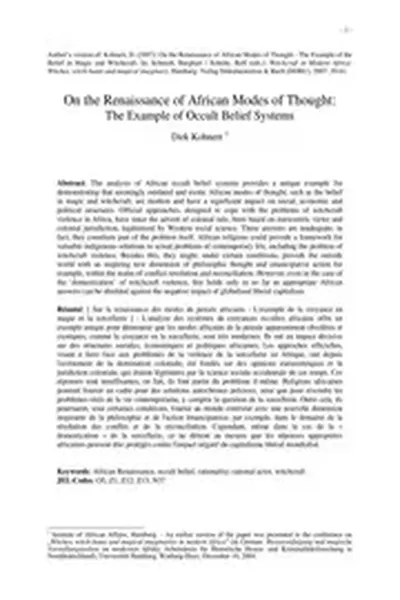
African Pentecostalism, the Bible, and Cultural Resilience - The Case of the Zimbabwe Assemblies of God Africa

 71
71

African Pentecostalism, the Bible, and Cultural Resilience - The Case of the Zimbabwe Assemblies of God Africa



Marcus Thorne (Esoteric Sciences Reviewer) — 'African Pentecostalism, the Bible, and Cultural Resilience' offers a compelling exploration of how ancient spiritual energies manifest within modern religious movements. By examining the Zimbabwe Assemblies of God Africa (ZAOGA), the study masterfully illustrates the syncretic fusion of Shona ancestral beliefs with Pentecostal doctrine, revealing a dynamic spiritual ecosystem. It uncovers the profound ways indigenous cosmology informs contemporary faith, offering insights into the resilience of cultural identity. This work is invaluable for scholars of comparative religion and esoteric traditions, illuminating the subtle yet potent continuities between seemingly disparate belief systems. Its empirical grounding lends significant weight to its fascinating conclusions.
📝 Description
71
This 2013 study examines how Zimbabwe Assemblies of God Africa (ZAOGA) integrates Shona traditions with Pentecostalism.
This book investigates the relationship between African Pentecostalism, the Bible, and cultural resilience through the lens of the Zimbabwe Assemblies of God Africa (ZAOGA). It details how deeply rooted Shona traditions interact with the transformative power of Pentecostal faith. The study looks at how indigenous beliefs, expressed through symbolic language, are revitalized within a contemporary religious movement.
Using fieldwork and a comparative phenomenological approach, the book illustrates the dynamic interplay of continuity and change. It shows how biblical narratives become part of lived experience, reinterpreting ancestral knowledge. The work addresses the connection between the visible and invisible, the ancestral and the divine, explaining faith's role in cultural preservation and adaptation within post-colonial Africa and the broader context of global Christianity.
This work touches on esoteric traditions by examining how ancient indigenous beliefs and symbolic language find new expression within modern religious movements. It explores the hidden dialogues between the seen and unseen, and the ancestral and the divine. The book presents faith not merely as doctrine but as a dynamic force capable of preserving and transforming cultural identity. This perspective aligns with esoteric thought that looks beyond surface appearances to understand deeper spiritual and cultural currents.
💡 Why Read This Book?
Uncover the hidden spiritual dialogues between ancestral Shona traditions and Pentecostal Christianity. Understand how ancient beliefs adapt and thrive within modern faith movements, revealing profound cultural resilience. Ideal for seekers of esoteric knowledge, scholars of religion and culture, and practitioners interested in the dynamic evolution of spiritual expression.
⭐ Reader Reviews
Honest opinions from readers who have explored this book.
❓ Frequently Asked Questions
What is the primary focus of this study on African Pentecostalism?
The study investigates the resilience of Shona religion and culture among ZAOGA Pentecostal Christians in Zimbabwe, examining the embrace of indigenous beliefs and practices within a contemporary faith context.
What methodology is employed in this research?
The research utilizes a phenomenological-comparative approach combined with extensive fieldwork to analyze the integration and transformation of beliefs and practices.
Does the book suggest a complete abandonment of traditional beliefs?
No, the study confirms continuity, change, and adaptation, indicating that indigenous beliefs and practices are reinterpreted and integrated rather than wholly abandoned.
Who is the intended audience for this book?
The book is intended for academics, students of religion and culture, theologians, and anyone interested in the complex relationship between faith, tradition, and identity in Africa.
What does 'cultural resilience' mean in the context of this book?
Cultural resilience refers to the capacity of Shona religion and culture to endure, adapt, and find new forms of expression and relevance within the dynamic environment of Pentecostal Christianity.
🔮 Key Themes & Symbolism
The Sacred Collection of Shona Spirituality
This theme explores the wide range of Shona traditional religion, exploring its cosmology, ancestral veneration, and symbolic language. It examines how these ancient spiritual frameworks, often interwoven with notions of hidden forces and divine intervention, have provided a foundational worldview for the people of Zimbabwe. The study illuminates the enduring power of these beliefs and their capacity to shape cultural identity, offering a lens through which to understand the subsequent adoption and adaptation of new religious expressions.
Pentecostalism as a Vehicle for Cultural Continuity
This theme investigates how Pentecostal Christianity, particularly within the context of ZAOGA, serves not as a force of cultural erasure but as a dynamic medium for the continuation and transformation of Shona identity. It examines the ways in which biblical narratives are interpreted through an indigenous lens, and how Pentecostal practices, such as ecstatic worship and spirit possession, can echo and reinterpret traditional spiritual experiences, fostering a sense of belonging and cultural affirmation in a modernizing world.
The Phenomenology of Spiritual Adaptation
This theme explores the lived spiritual experience of ZAOGA adherents, employing a phenomenological approach to understand the subjective meanings and transformations that occur when traditional beliefs intersect with Pentecostal theology. It explores the processes of syncretism, where elements of the old faith are consciously or unconsciously integrated into the new, creating a unique spiritual synthesis. This examination reveals the adaptive genius of human spirituality in navigating cultural change and maintaining a connection to the sacred.
💬 Memorable Quotes
Direct passages from the work, attributed to the author.
“Faith is the bridge across the unseen realms.”
— Highlights the role of faith as a conduit connecting the material world with the spiritual dimensions central to both Pentecostalism and traditional beliefs.
“Roots grow deeper when watered by new streams.”
— Illustrates the concept of cultural resilience, where established traditions are strengthened and revitalized by the influx of new spiritual influences.
“Rituals echo, transforming in the crucible of change.”
— Emphasizes the adaptive nature of religious practices, where ancient forms are reinterpreted and given new meaning within a contemporary context.
“The spirit finds its voice in every tongue.”
— Suggests the universal nature of spiritual experience and the ability of different cultural and religious frameworks to express the divine.
💡 Key Ideas
Editorial paraphrase of the work's core concepts — not direct quotes.
The Bible speaks, and the ancestors whisper.
This quote expresses the core thesis, suggesting a harmonious dialogue between Christian scripture and indigenous ancestral traditions within ZAOGA.
🌙 Esoteric Significance
Tradition
This study intersects with the esoteric tradition of comparative mythology and religious phenomenology, examining the universal archetypes and spiritual impulses that manifest across diverse belief systems. It particularly appeals to traditions that explore the interplay between the visible and invisible realms, the power of collective consciousness, and the symbolic language of spiritual experience. The work implicitly engages with concepts of shamanism and animism, recognizing their enduring influence on how individuals perceive and interact with the divine and the spiritual forces surrounding them.
Symbolism
The symbolism explored in this book is many-sided, encompassing both biblical imagery and indigenous Shona motifs. Biblical symbols like the 'spirit,' 'healing,' and 'divine intervention' are often reinterpreted through the lens of ancestral spirits, traditional healing practices, and the perceived influence of spiritual entities in daily life. The 'cross' might coexist with symbols of ancestral veneration, creating a layered symbolic language that speaks to both Christian doctrine and deeply ingrained cultural understandings of the sacred and the supernatural.
Modern Relevance
In an increasingly globalized yet spiritually diverse world, understanding how ancient traditions adapt and persist within modern religious frameworks is crucial. This study offers useful insights into cultural resilience, the fluid nature of belief, and the human need for spiritual continuity. It demonstrates that faith is not static but a living, evolving force that can empower individuals and communities to navigate change while maintaining a strong sense of identity and connection to their heritage. The book's findings are relevant to discussions on religious pluralism, post-colonial spirituality, and the enduring power of indigenous knowledge systems.
👥 Who Should Read This Book
This book is an indispensable resource for academics and students engaged in the study of African religions, Pentecostalism, and cultural anthropology. It offers deep theological and sociological insights for theologians and clergy seeking to understand the complexities of faith in diverse contexts. For spiritual seekers and practitioners interested in the esoteric dimensions of religious expression, it provides a compelling case study of how ancient wisdom and modern faith can coalesce. Moreover, anyone fascinated by the dynamic interplay between tradition and modernity, and the enduring power of cultural identity, will find this exploration profoundly clear and thought-provoking.
📜 Historical Context
Emerging from the mid-20th century wave of Pentecostalism, African Pentecostal movements like the Zimbabwe Assemblies of God Africa (ZAOGA) represent a significant spiritual and cultural phenomenon in post-colonial Africa. This era was marked by a profound search for identity and self-determination, often expressed through religious re-appropriation and syncretism. As nations gained independence, there was a conscious effort to reconcile traditional cultural values with the legacies of colonial-era Christianity. The rise of indigenous Pentecostal churches provided a space for this dialogue, allowing for the integration of ancestral spiritualities and worldviews into a vibrant, Biblically-grounded faith that spoke directly to the lived realities of African communities. This period saw a dynamic fusion, where the sacred texts of Christianity were interpreted through the lens of African cosmology, leading to unique expressions of faith and cultural resilience.
📔 Journal Prompts
How do the 'whispers' of ancestral traditions influence the interpretation of biblical narratives within ZAOGA?
In what ways do Pentecostal practices like ecstatic worship or spirit possession serve as modern manifestations of older spiritual experiences?
What does the concept of 'cultural resilience' truly mean when observing the fusion of Shona and Pentecostal beliefs?
How does the phenomenological approach reveal the lived spiritual reality of individuals navigating these intersecting faith traditions?
What are the potential esoteric interpretations of the shared themes of 'healing' and 'divine intervention' across both belief systems?
🗂️ Glossary
ZAOGA
Zimbabwe Assemblies of God Africa, a prominent Pentecostal church denomination in Zimbabwe known for its integration of indigenous cultural elements.
Shona Religion
The indigenous religious and spiritual beliefs and practices of the Shona people of Zimbabwe, characterized by ancestor veneration, belief in a supreme creator, and various spiritual intermediaries.
Pentecostalism
A Protestant Christian movement characterized by spiritual experiences such as speaking in tongues, divine healing, and prophecy, emphasizing the power of the Holy Spirit.
Phenomenological Approach
A philosophical method that focuses on the structures of experience and consciousness as experienced from the first-person point of view, seeking to understand the 'essence' of phenomena.
Syncretism
The blending of different religious or cultural beliefs and practices, often resulting in new forms of worship or understanding.
This book appears in 2 collections
🔮 Readers Also Liked
Browse all →








From the “Witchcraft” Collection
View all →







More Free Witchcraft & Paganism Books
View all →



![D. [i. e., Doktor] Balthasar Bekkers reformierten Predigers in Amsterdam bezauberte Welt. ... 1781: Vol 1 Iss 81](/img/thumb/d-i-e-doktor-balthasar-bekkers-reformierten-predigers-in-amsterdam-bezauberte-welt-1781-vol-1-iss-81-bekker-balthasar-1634-1698.webp)