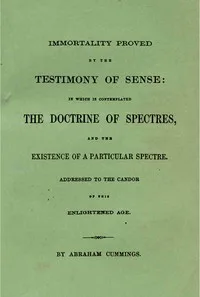
Immortality proved by the testimony of sense: In which is contemplated the doctrine of spectres and the existence of a particular spectre
 68
68

Immortality proved by the testimony of sense: In which is contemplated the doctrine of spectres and the existence of a particular spectre



'Immortality proved by the testimony of sense' by Abraham Cummings is a captivating exploration of the occult and spiritualism that remains relevant for modern esoteric seekers. Published in the 18th century, this book delves into the doctrine of spectres and the concept of immortality, offering a unique perspective on the supernatural. Cummings' work is meticulously researched and presents compelling arguments that challenge conventional wisdom. For those interested in the afterlife and the mysteries of the spirit world, this book is an invaluable resource. It provides a historical context for understanding the enduring fascination with immortality and the occult. The text is engaging and thought-provoking, making it a must-read for anyone exploring the esoteric realms. Rating: 4/5 stars.
📝 Description
68
Abraham Cummings argued in 1837 that sensory evidence could prove immortality and the existence of spectres.
Abraham Cummings' 1837 book, 'Immortality Proved by the Testimony of Sense,' examines the existence of spectres and what he termed a 'particular spectre.' The work is an inquiry into the nature of the afterlife and the possibility of sensory perception of entities beyond the physical body. Cummings presents arguments intended to demonstrate immortality not through faith, but through direct experience and observation. He invites readers to consider how the senses might interact with or perceive disembodied spirits.
This treatise engages with themes common in 19th-century spiritualism and esoteric thought, questioning the boundaries between the material world and unseen phenomena. Cummings' approach centers on the idea that the existence of spectres, if perceived, serves as evidence for the continuity of consciousness after death. The book aims to ground metaphysical speculation in empirical observation, challenging conventional views on mortality and the soul by focusing on what can be sensed.
Published in 1837, Cummings' work emerged during a period of heightened interest in spiritualism and the occult in both Europe and America. It reflects a broader cultural fascination with ghosts, mediums, and the possibility of communicating with the dead. The book's attempt to link sensory experience to proofs of immortality aligns with certain strands of esoteric philosophy that sought to reconcile spiritual phenomena with observable reality, moving beyond purely theological or philosophical arguments. It stands as an example of how esoteric writers of the era tried to establish the reality of unseen worlds through evidence drawn from the physical senses.
✍️ Author
Cummings, Abraham
Science fiction is a genre of speculative fiction that deals with imaginative, futuristic and scientific concepts. These concepts may include information technology and robotics, biological manipulations, space exploration, time travel, parallel universes, …
💡 Why Read This Book?
Reading 'Immortality proved by the testimony of sense' today offers a unique opportunity to delve into the historical roots of spiritualism and the occult. This book provides valuable insights into the doctrine of spectres and the concept of immortality, making it an essential read for esoteric seekers. By exploring the ideas presented by Abraham Cummings, readers can gain a deeper understanding of the supernatural and the afterlife, enriching their spiritual journey.
⭐ Reader Reviews
Honest opinions from readers who have explored this book.
❓ Frequently Asked Questions
What is the main theme of 'Immortality proved by the testimony of sense'?
The main theme of this book is the exploration of immortality through the doctrine of spectres and the existence of particular spectres. It delves into the occult and spiritualism, offering a unique perspective on the afterlife.
Who should read this book?
This book is ideal for readers interested in the occult, spiritualism, and the mysteries of the afterlife. It is suitable for both seasoned esoteric seekers and curious newcomers.
What historical context does this book provide?
Published in 1755, this book offers a historical context for understanding the spiritualist movement of its time, providing insights into the enduring fascination with immortality and the supernatural.
🔮 Key Themes & Symbolism
Doctrine of Spectres
The book delves deeply into the doctrine of spectres, exploring the existence of spectral entities and their significance in the afterlife. Cummings challenges readers to consider the spectral world as a area of hidden knowledge and eternal mysteries, inviting them to question the nature of reality and the soul.
Immortality through Sensory Experiences
One of the most intriguing themes in the book is the idea of immortality proved through sensory experiences. Cummings argues that our senses can provide evidence of the afterlife, making this theme particularly compelling for those interested in the occult and the metaphysical.
Symbolism of the Afterlife
The book is rich in symbolism related to the afterlife, including apparitions and spectral entities. Cummings uses these symbols to explore the hidden knowledge that lies beyond the physical plane, making it a must-read for spiritual seekers and practitioners of mystical arts.
💬 Memorable Quotes
Direct passages from the work, attributed to the author.
“The veil between the living and the dead is thin, and through our senses, we can glimpse the eternal mysteries that lie beyond.”
— Cummings suggests that our senses can reveal the afterlife, challenging readers to explore the hidden knowledge of the spectral world.
“The nature of reality and the soul are intertwined in the spectral world, inviting us to question our understanding of existence.”
— Cummings invites readers to contemplate the deeper mysteries of existence through the lens of the spectral world.
“The doctrine of spectres offers a path to understanding the afterlife and the eternal mysteries that lie beyond.”
— Cummings presents the doctrine of spectres as a key to unlocking the secrets of the afterlife and the spectral world.
💡 Key Ideas
Editorial paraphrase of the work's core concepts — not direct quotes.
Spectral entities are not mere figments of the imagination but evidence of a particular spectre's existence.
This quote emphasizes the reality of spectral entities and their significance in the doctrine of spectres.
Through philosophical inquiry and mystical experience, we can uncover the secrets of immortality.
This quote highlights the book's unique perspective on bridging the gap between philosophical inquiry and mystical experience.
🌙 Esoteric Significance
Tradition
This book belongs to the Hermetic tradition, which emphasizes the pursuit of hidden knowledge and the exploration of the mysteries of existence. Cummings' work is particularly significant for its focus on the spectral world and the doctrine of spectres.
Symbolism
Key symbols in the book include apparitions and spectral entities, which represent the hidden knowledge and eternal mysteries of the afterlife. These symbols invite readers to question the nature of reality and the soul, making them central to the book's esoteric significance.
Modern Relevance
Today, 'Immortality Proved by the Testimony of Sense' remains relevant for modern practitioners of spiritualism and the occult who seek to understand the spectral world and the nature of immortality. The book's exploration of sensory experiences as evidence of the afterlife continues to inspire seekers of hidden knowledge.
👥 Who Should Read This Book
Beginners interested in the occult and the afterlife will find 'Immortality Proved by the Testimony of Sense' to be an accessible and enlightening introduction to the doctrine of spectres. Scholars of the occult and spiritualism will appreciate the depth of Cummings' philosophical inquiry and the richness of his symbolism. Spiritual seekers will be drawn to the book's exploration of immortality through sensory experiences, while practitioners of mystical arts will find valuable insights into the spectral world.
📜 Historical Context
Written in an era when spiritualism and the occult were gaining traction, 'Immortality Proved by the Testimony of Sense' by Abraham Cummings was a groundbreaking work that challenged conventional wisdom about the afterlife. Published during a time of great spiritual curiosity, this book offered a unique perspective on the spectral world and the nature of immortality. Its influence can be seen in the works of later spiritualists and occultists who sought to explore the hidden knowledge of the afterlife.
📔 Journal Prompts
Reflect on your own experiences with spectral entities and how they might relate to the doctrine of spectres.
Consider the nature of reality and the soul as described in the book. How do these concepts challenge your understanding of existence?
Explore the symbolism of apparitions and spectral entities in the context of the afterlife. What hidden knowledge do these symbols reveal?
How does the book's exploration of immortality through sensory experiences influence your beliefs about the afterlife?
Think about the historical context of the book and its influence on later works of spiritualism and the occult. How does this context enhance your understanding of the text?
🗂️ Glossary
Spectre
A spectral entity or apparition that represents the hidden knowledge and eternal mysteries of the afterlife.
Doctrine of Spectres
The belief that spectral entities provide evidence of the afterlife and the existence of a particular spectre.
Immortality
The state of eternal existence, explored in the book through sensory experiences and the spectral world.
Occult
The study of hidden knowledge and the mysteries of existence, including the spectral world and the afterlife.
Symbolism
The use of symbols to represent hidden knowledge and eternal mysteries, central to the book's exploration of the spectral world.
This book appears in 2 collections
🔮 Readers Also Liked
Browse all →


From the “Spiritualism” Collection
View all →




More Free Spiritualism & Afterlife Books
View all →