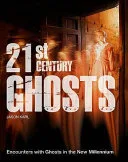
21st Century Ghosts
 76
76

21st Century Ghosts
Jason Karl's *21st Century Ghosts* offers a robust counterpoint to the notion that modernity has eradicated belief in the supernatural. Its strength lies in the sheer volume and diversity of contemporary eyewitness accounts, sourced from multiple countries. The insistence on presenting these as raw, unvarnished narratives, rather than psychoanalyzed case studies, lends a certain authenticity. However, the book's limitation is its inherent reliance on anecdotal evidence; Karl presents these stories compellingly but offers little in the way of critical analysis or investigation into potential psychological or environmental explanations, which might have added another layer for skeptics and believers alike. A particularly striking section details an Australian family's persistent encounters with a spectral figure in their new home, illustrating the book's commitment to recent, personal accounts. Ultimately, *21st Century Ghosts* serves as a valuable, if uncritical, repository of modern spectral folklore.
📝 Description
76
Jason Karl's 2007 book gathered firsthand accounts of ghost sightings from around the globe.
Published in 2007, *21st Century Ghosts* by Jason Karl collects contemporary ghost sightings and haunting experiences from individuals in Britain, France, Germany, the United States, and Australia. Karl, who is known for his paranormal writing and television work, argues that interest in spectral phenomena continues even in an age often seen as dominated by scientific thinking. The book focuses on eyewitness testimony, including many previously unpublished stories of encounters with ghosts.
This compilation is for people interested in how ghost stories persist today. It is especially suited for those who value anecdotal evidence of the paranormal and appreciate firsthand accounts. Readers who enjoy cross-cultural perspectives on hauntings and experiences that challenge easy scientific explanations will find value here. The book speaks to those who question the limits of scientific understanding and are open to subjective experiences of the uncanny.
This work fits within the broader tradition of documenting alleged supernatural encounters. While not strictly occult or ritualistic, it engages with the persistent human fascination with spirits and the afterlife. The book relies on personal testimony, a method common in spiritualist and parapsychological literature that seeks to validate subjective experiences that fall outside conventional scientific frameworks. It reflects a modern continuation of ghost lore collection, adapting to new communication technologies while addressing core questions about life, death, and consciousness.
💡 Why Read This Book?
• You will gain an understanding of how ghost stories continue to manifest in the 21st century, drawing on contemporary accounts collected globally, as seen in the eyewitness testimonies featured throughout the book. • You will encounter diverse, never-before-published ghostly events from various countries, offering a cross-cultural perspective on hauntings beyond anecdotal urban legends. • You will explore the concept of subjective experience as a form of evidence for paranormal phenomena, challenging purely rationalistic viewpoints through Karl's presentation of personal narratives.
⭐ Reader Reviews
Honest opinions from readers who have explored this book.
❓ Frequently Asked Questions
What is the primary focus of 21st Century Ghosts?
The book primarily focuses on contemporary ghost sightings and haunting experiences, presenting firsthand eyewitness accounts from individuals across the globe collected in the modern era.
Who is the author, Jason Karl, and what is his background?
Jason Karl is a paranormal author and television presenter known for his work exploring supernatural phenomena. His background lends credibility to his collection of ghost stories.
Does the book offer scientific explanations for the reported hauntings?
No, the book emphasizes eyewitness accounts and contemporary experiences rather than providing scientific analysis or explanations for the phenomena described.
What geographical regions are covered in the book?
The book includes accounts from multiple countries, specifically mentioning Britain, France, Germany, the United States, and Australia, offering a diverse range of global perspectives.
When was 21st Century Ghosts first published?
21st Century Ghosts was first published in 2007, positioning its collection of stories within the early years of the 21st century.
Are the ghost stories in the book previously published?
The book concentrates on contemporary encounters, featuring eye-witness accounts and specifically highlighting never-before published ghostly events submitted by the public.
🔮 Key Themes & Symbolism
Persistence of Folklore
The central theme is how ancient folklore, specifically ghost stories, not only survives but thrives in the hyper-modern, technologically advanced 21st century. Karl argues against the idea that scientific progress eradicates belief in the supernatural, instead showcasing a global resurgence of interest. The book collects contemporary narratives, demonstrating that spectral encounters are not confined to historical accounts but are actively experienced and reported by people today, challenging the assumption that rationality has entirely supplanted superstition.
Eyewitness Testimony
Karl places significant emphasis on the validity and power of direct, personal accounts. *21st Century Ghosts* is built upon a foundation of eyewitness testimony, featuring stories submitted by ordinary individuals. This approach elevates subjective experience as a form of evidence, suggesting that these firsthand encounters, however inexplicable, hold their own truth. The book prioritizes the raw, unmediated voice of the experiencer, moving beyond academic interpretation to present the phenomenon as it is reported.
Cross-Cultural Hauntings
By gathering accounts from Britain, France, Germany, the US, and Australia, the book highlights the universality of ghost experiences while also noting potential cultural nuances. It demonstrates that the fascination with spectral phenomena transcends national borders and diverse cultural backgrounds. This global perspective suggests common threads in human perception and fear, even as the specific manifestations of hauntings might subtly reflect local contexts and beliefs.
The Unexplained in Modernity
The work directly confronts the paradox of increased paranormal interest in an age of science and logic. It posits that the modern world, with its stresses and complexities, may paradoxically open individuals to experiences that defy conventional explanation. The book serves as a collection of anomalies, presenting phenomena that existing scientific frameworks struggle to accommodate, thereby carving out space for the continued exploration of the unexplained.
💬 Memorable Quotes
Direct passages from the work, attributed to the author.
“In this new millennium dominated by logic and science, why is it that people's interest in ghosts and hauntings has never been greater?”
— This rhetorical question, from the original blurb, captures the book's central premise: the enduring, perhaps even growing, fascination with the paranormal in a supposedly rational age.
“The book concentrates on eye-witness accounts and never-before published ghostly events.”
— This highlights the book's methodological approach, prioritizing direct, personal testimony and original, unpublished stories as its core content.
“paranormal author and TV presenter Jason Karl proves that ghost stories are alive and well in the modern world.”
— This statement frames Karl's role and the book's objective: to demonstrate the continued vitality of ghost lore through contemporary evidence.
“He provides a collection of contemporary encounters, submitted by members of the public.”
— This emphasizes the source of the material: authentic, unsolicited reports from ordinary individuals, lending a grassroots feel to the collected phenomena.
“21st Century Ghosts collects reports from Britain, France, Germany, the US and Australia.”
— This detail underscores the international scope of the collected accounts, suggesting a global phenomenon rather than a localized curiosity.
🌙 Esoteric Significance
Tradition
While not strictly adhering to a single esoteric lineage, *21st Century Ghosts* taps into the broader tradition of spiritualism and mediumship that gained prominence in the 19th century. It carries the core tenets of Spiritualism, which asserted the possibility of communication with the spirits of the deceased and validated personal experiences of the supernatural. Karl’s work departs from more formalized esoteric systems like Theosophy or Hermeticism by focusing on raw, often uninterpreted, spontaneous phenomena rather than structured doctrines or magical practices.
Symbolism
The primary symbol is the 'ghost' itself, representing the persistence of consciousness beyond physical death, a core concept in many spiritualist and occult traditions. Another motif is the 'haunted space' – a location imbued with residual energy or the presence of a discarnate entity. This symbolizes the entanglement of the material and immaterial realms, suggesting that places can retain imprints of intense emotional or traumatic events, acting as focal points for spectral manifestations.
Modern Relevance
This work remains relevant for contemporary paranormal investigators, ghost tour operators, and amateur researchers who rely heavily on anecdotal evidence and eyewitness testimony. It provides a corpus of modern case studies that inform discussions in online paranormal communities and forums. Thinkers and practitioners within the broader New Age movement, who often explore themes of consciousness, life after death, and subtle energies, can draw upon the raw material presented in Karl's collection to support their explorations.
👥 Who Should Read This Book
• Individuals curious about contemporary paranormal accounts: Those who enjoy reading about modern ghost sightings and hauntings, seeking compelling firsthand narratives that challenge purely rational explanations. • Researchers of folklore and popular belief: Students and enthusiasts interested in how traditional beliefs about ghosts persist and evolve in the 21st century, particularly in a global context. • Skeptics and believers exploring anecdotal evidence: Readers who wish to examine a wide range of reported phenomena without immediate scientific dismissal, offering material for critical thought on the nature of belief and perception.
📜 Historical Context
Published in 2007, *21st Century Ghosts* arrived during a period marked by a resurgence of popular interest in the paranormal, often termed the 'paranormal boom,' heavily influenced by cable television programming and the burgeoning internet. This era saw figures like Ghostwatch and Most Haunted gaining traction, blurring lines between entertainment and investigation. While academic circles largely maintained a skeptical stance, influenced by Enlightenment rationalism and scientific materialism, popular culture embraced narratives of the uncanny. Karl's work fits within this cultural milieu, directly challenging the perceived dominance of logic and science by showcasing a persistent global engagement with spectral phenomena. Unlike earlier folklorists who might have focused on historical accounts or rural legends, Karl’s emphasis on contemporary, digitally-shared (or at least, post-internet) experiences marked a shift. His approach offered a counter-narrative to the purely empirical, finding resonance with a public seeking experiences beyond the mundane, a sentiment echoed by authors exploring similar themes in popular psychology and fringe science.
📔 Journal Prompts
The contemporary ghost sightings reported by the public.
Cross-cultural variations in reported spectral encounters.
The persistence of ghost stories in a logic-dominated era.
Eyewitness testimony as a source of paranormal data.
Personal reflection on the concept of 'haunted spaces'.
🗂️ Glossary
Discarnate entity
A being or consciousness that exists without a physical body, often referred to as a spirit or ghost in the context of paranormal phenomena.
Eyewitness testimony
Firsthand accounts or statements given by individuals who directly observed an event, crucial in paranormal research for its directness.
Haunting
The phenomenon of a location or object being perceived as the site of paranormal activity, often attributed to spirits or residual energies.
Paranormal
Phenomena that are beyond the scope of normal scientific understanding or explanation, including ghosts, ESP, and psychokinesis.
Residual energy
A theory suggesting that strong emotions or events can leave an imprint on a location, which may manifest as recurring sensory experiences without conscious intelligence.
Spiritualism
A belief system centered on the idea that spirits of the dead can communicate with the living, often through mediums, popular in the 19th and early 20th centuries.
Supernatural
Attributed to some force beyond scientific understanding or the laws of nature; often used interchangeably with paranormal.