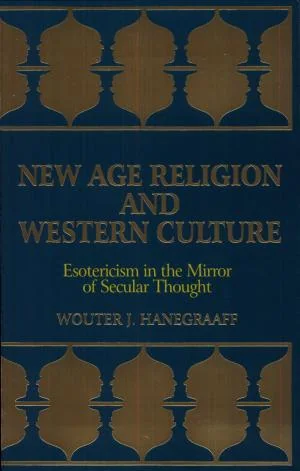
New Age Religion and Western Culture
 80
80

New Age Religion and Western Culture
Wouter J. Hanegraaff's "New Age Religion and Western Culture" remains a significant academic contribution, even decades after its initial publication. Its strength lies in its methodical deconstruction of a nebulous spiritual movement into discernible patterns and historical threads. Hanegraaff’s meticulous use of primary sources prevents the work from devolving into mere speculation, offering instead a sober analysis of beliefs and practices. A particular strength is his tracing of the lineage from earlier esoteric movements, such as Theosophy, to the emergent New Age of the late 20th century. However, the book's academic rigor, while admirable, can also be its limitation for a general audience; the prose is dense, and the focus remains squarely on analysis rather than narrative engagement. The discussion of 'spiritual self-help' as a manifestation of New Age ideals, for instance, is insightful but requires careful reading. Ultimately, it is an indispensable reference for serious students of contemporary spirituality.
📝 Description
80
### What It Is This foundational text offers a rigorous academic examination of the New Age movement, moving beyond superficial descriptions to analyze its historical roots and core theological tenets. Wouter J. Hanegraaff grounds his analysis in extensive primary source material, dissecting the diverse manifestations of New Age thought from a comparative religion perspective. The book aims to provide a framework for understanding this complex spiritual landscape, which has seen rapid growth and proliferation in recent decades.
### Who It's For Scholars of religion, sociology, and cultural studies will find this a vital resource for understanding the New Age as a distinct spiritual phenomenon. Students seeking to grasp the origins and intellectual currents of modern esoteric movements will benefit from its systematic approach. Anyone interested in the intersection of Western spirituality, psychology, and alternative belief systems will appreciate the depth of research and clarity of exposition.
### Historical Context The late 20th century witnessed a significant resurgence of interest in esoteric and spiritual traditions outside of mainstream Western religions. Hanegraaff's work emerged in this environment, offering a much-needed scholarly lens. It contextualizes the New Age within a broader history of Western esotericism, tracing influences from Gnosticism, Theosophy, and various forms of occultism. The book was instrumental in establishing the New Age as a legitimate subject of academic inquiry, moving it from the periphery of popular culture into serious study.
### Key Concepts Hanegraaff systematically unpacks concepts central to New Age belief, such as the divine spark within each individual, the idea of spiritual evolution, and the synthesis of diverse religious traditions. He explores the movement's relationship with psychology, particularly Jungian thought, and its engagement with Eastern religions and indigenous spiritualities. The analysis highlights how the New Age often reinterprets traditional doctrines through a modern, individualistic, and therapeutic lens.
💡 Why Read This Book?
• Understand the historical lineage of New Age thought, tracing its connections to earlier esoteric traditions like Theosophy, as detailed in the historical context sections. • Gain analytical tools to dissect the diverse beliefs within the New Age movement, moving beyond generalizations to specific thematic analyses presented in the core chapters. • Appreciate the academic framework for studying modern spirituality, recognizing how Hanegraaff applies comparative religion methodologies to contemporary phenomena first explored in the book's initial publication year.
⭐ Reader Reviews
Honest opinions from readers who have explored this book.
❓ Frequently Asked Questions
When was "New Age Religion and Western Culture" first published?
The book was first published on November 20, 1997, marking it as a key scholarly work from the late 20th century analyzing the burgeoning New Age movement.
What is the primary academic discipline Wouter J. Hanegraaff uses to analyze the New Age?
Hanegraaff primarily employs the study of religions and comparative religion methodologies to dissect the beliefs, practices, and historical context of New Age phenomena.
Does the book cover specific New Age figures or organizations?
While the book focuses on thematic analysis and historical currents, it implicitly addresses the manifestations of the New Age movement, drawing from primary sources that would include the writings and teachings of its prominent figures and groups.
What distinguishes Hanegraaff's approach from popular accounts of the New Age?
Hanegraaff's approach is characterized by its academic rigor, extensive use of primary sources, and a focus on historical and theological analysis rather than anecdotal reporting or advocacy.
How does "New Age Religion and Western Culture" relate to Western Esotericism?
The work situates the New Age movement within the broader history of Western Esotericism, exploring its roots and continuities with earlier occult and mystical traditions.
What kind of primary sources does Hanegraaff utilize?
Hanegraaff's analysis is based on extensive use of primary sources, including texts, manifestos, and other materials directly produced by or representative of the New Age movement itself.
🔮 Key Themes & Symbolism
Historical Roots of New Age
This work meticulously traces the New Age movement's lineage, connecting it to earlier esoteric traditions. Hanegraaff demonstrates how concepts prevalent in the New Age, such as spiritual evolution and the synthesis of diverse mythologies, have precedents in movements like Theosophy, founded by Helena Blavatsky in the late 19th century. By grounding the New Age in this historical continuum, the book offers a critical perspective that moves beyond viewing it as a purely modern or superficial phenomenon, highlighting its deep roots in Western occult and mystical thought.
Thematic Analysis of Beliefs
Hanegraaff systematically dissects the core theological and philosophical tenets that characterize New Age spirituality. He examines concepts such as the divine immanence, the belief in a spiritual hierarchy, and the therapeutic reinterpretation of religious experiences. The analysis emphasizes the syncretic nature of New Age beliefs, showing how they often draw from a wide array of global religious traditions, including Eastern philosophies and indigenous shamanism, to form a personalized spiritual framework for adherents.
New Age and Psychology
A significant focus is placed on the intersection of New Age thought with modern psychology, particularly the influence of Carl Jung and his theories of archetypes and the collective unconscious. The book explores how New Age practices often align with therapeutic goals, emphasizing personal growth, self-realization, and healing. This connection highlights the movement's engagement with Western cultural trends that prioritize individual experience and psychological well-being, often recasting spiritual concepts in psychological terms.
Syncretism and Modern Spirituality
The work underscores the highly syncretic nature of the New Age, where diverse religious and philosophical elements are blended to create new spiritual pathways. Hanegraaff examines how this eclecticism reflects a modern search for meaning that transcends traditional religious boundaries. The book analyzes how ancient symbols and concepts are often reinterpreted through a contemporary lens, adapted to fit individualistic and often therapeutic frameworks, making spirituality a personalized quest.
💬 Memorable Quotes
“The New Age movement can be understood as a religion of the Book of Revelation.”
— This statement, while needing contextualization within Hanegraaff's larger argument, suggests an interpretation of the New Age's eschatological undertones and its often apocalyptic or transformative worldview, linking it to a specific, albeit reinterpreted, biblical narrative.
“The phenomenon of the New Age is characterized by an eclectic synthesis of diverse religious and philosophical traditions.”
— This captures the syncretic essence of the New Age, highlighting its tendency to draw from a wide array of global spiritual sources, including Eastern religions, indigenous beliefs, and Western esotericism, to form a unique spiritual outlook.
“The movement often emphasizes spiritual self-help and personal transformation.”
— This points to a core function of the New Age for many adherents: it serves as a framework for individual psychological and spiritual development, prioritizing personal experience and inner change.
“Hanegraaff analyzes New Age beliefs from the perspective of the study of religions.”
— This describes the book's methodological approach, positioning it as an academic study that applies established scholarly tools to understand the New Age as a religious phenomenon, rather than a sociological or purely cultural one.
“The historical background of the New Age is deeply rooted in Western esotericism.”
— This highlights a crucial argument of the book: that the New Age is not an entirely novel development but has significant antecedents in earlier Western mystical, occult, and philosophical traditions.
🌙 Esoteric Significance
Tradition
This work is deeply embedded within the academic study of Western Esotericism, a field that seeks to understand and contextualize occult, mystical, and magical traditions. Hanegraaff's approach, however, is analytical rather than participatory. He treats the New Age as a complex religious phenomenon with specific historical antecedents, tracing its lineage through Gnosticism, Hermeticism, and Theosophy, thereby situating it within a long, continuous, albeit heterodox, current of Western spiritual thought.
Symbolism
While not focused on specific esoteric symbols in a devotional manner, the book implicitly discusses how New Age adherents reinterpret traditional symbols. For instance, the concept of the 'divine spark' within each individual can be seen as a modern Gnostic or Hermetic echo, emphasizing immanent divinity. The widespread use of mandalas or fractal patterns in New Age art and practice can be linked to ancient cosmological diagrams and the idea of interconnectedness, reflecting a re-engagement with universalist symbolism.
Modern Relevance
Hanegraaff's analytical framework remains highly relevant for understanding contemporary spiritual landscapes. Thinkers and practitioners in fields like religious studies, sociology of religion, and cultural theory continue to reference his work when examining emergent spiritualities, the impact of globalization on belief systems, and the role of the internet in disseminating esoteric ideas. His detailed analysis of the New Age's syncretic nature and its emphasis on individual experience offers valuable insights into modern spiritual seeking and the evolution of religious expression.
👥 Who Should Read This Book
• Academic researchers in religious studies, sociology, and cultural history seeking a foundational text for understanding the New Age movement's historical and theological underpinnings. • Students of Western Esotericism interested in how diverse occult, mystical, and philosophical traditions have synthesized into a modern spiritual phenomenon. • Individuals curious about the intellectual and historical roots of contemporary alternative spiritualities, moving beyond popular media portrayals to a scholarly perspective.
📜 Historical Context
Published in 1997, Wouter J. Hanegraaff's "New Age Religion and Western Culture" emerged during a period of intense academic and popular interest in the New Age movement. The late 20th century saw a proliferation of esoteric ideas, alternative spiritualities, and self-help philosophies that coalesced under the New Age umbrella. Hanegraaff situated his work within the burgeoning field of Western Esotericism studies, a discipline gaining academic traction largely through scholars like Antoine Faivre. While popular accounts often sensationalized or dismissed the New Age, Hanegraaff provided a sober, analytical framework, drawing heavily on primary sources to map its diverse manifestations. His work was a direct engagement with earlier, less systematic descriptions of the movement and offered a comparative religion approach that contrasted with purely sociological analyses. The book’s reception marked a significant step in establishing the New Age as a legitimate subject for scholarly inquiry, moving it beyond mere cultural ephemera.
📔 Journal Prompts
The historical antecedents of New Age syncretism.
The role of psychological concepts in New Age belief systems.
Analyzing the New Age's reinterpretation of traditional religious doctrines.
The impact of the 1997 publication date on the reception of Hanegraaff's New Age analysis.
The concept of spiritual evolution within the New Age context.
🗂️ Glossary
New Age Movement
A broad, eclectic spiritual and cultural phenomenon that emerged in the late 20th century, characterized by a synthesis of various religious, philosophical, and psychological beliefs, often emphasizing personal transformation and holistic well-being.
Western Esotericism
A broad category encompassing mystical, magical, and occult traditions that have developed within Western civilization, including Hermeticism, Gnosticism, Kabbalah, and Theosophy.
Syncretism
The merging or attempted merging of different religions, cultures, or schools of thought, evident in the New Age's eclectic incorporation of diverse spiritual elements.
Theosophy
A spiritual movement founded in the late 19th century by Helena Blavatsky, which sought to synthesize Eastern and Western esoteric philosophies and religions, influencing many later New Age ideas.
Gnosticism
A complex set of religious ideas and systems from the early centuries of the Common Era, emphasizing knowledge (gnosis) for salvation and often featuring a dualistic worldview and esoteric interpretations of religious texts.
Hermeticism
A philosophical and religious tradition based on writings attributed to Hermes Trismegistus, emphasizing divine knowledge, the correspondence between the macrocosm and microcosm, and spiritual transformation.
Comparative Religion
The academic study of the beliefs, practices, and historical development of different religions, used by Hanegraaff to analyze the New Age as a distinct religious phenomenon.