致富寶典:招財開運祕笈
 82
82

致富寶典:招財開運祕笈
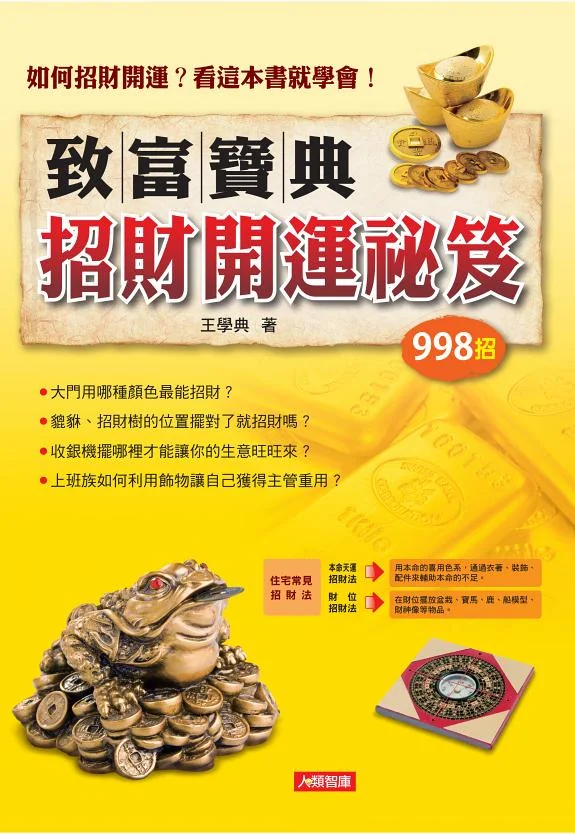
Wang Xuedian’s 《致富寶典:招財開運祕笈》 tackles the perennial human desire for prosperity with a refreshing directness. Its primary strength lies in its Q&A format, which effectively breaks down complex Feng Shui concepts into digestible pieces. Unlike many esoteric texts that can feel abstract, this book offers concrete advice, such as where to place a cash register for optimal business flow. I particularly appreciated the chapter discussing auspicious colors for main doors, a simple yet impactful detail. However, the sheer volume of illustrations, while a feature, sometimes feels overwhelming rather than clarifying, with a few visuals lacking the depth needed for true understanding. Despite this, the book serves as a practical primer for those new to geomancy. It’s a functional guide for immediate application, if not a deep philosophical treatise.
📝 Description
82
Published January 24, 2013, 《致富寶典:招財開運祕笈》 demystifies Chinese Feng Shui for modern prosperity.
This practical guide, 《致富寶典:招財開運祕笈》 (Treasury of Wealth: Secrets to Attracting Fortune and Luck), uses a question-and-answer format to explain traditional Chinese Feng Shui principles. It addresses common questions about attracting wealth, improving luck, and making homes and offices more prosperous. The book aims for clarity, offering actionable advice that moves beyond complex academic writing. It is designed for people seeking concrete ways to improve their financial luck and general welfare through changes in their environment. Office workers, business owners, and anyone curious about how space influences fortune can find its direct approach useful. The Q&A style makes it accessible even for those new to Feng Shui.
Its publication in 2013 places it within a modern resurgence of Feng Shui studies. While ancient texts established core ideas, this work translates them into easily understood guidance for today's world. The book's accessible format contrasts with older, more scholarly works that demand significant prior knowledge. It taps into a widespread interest in geomancy across East Asian societies.
This book draws from the long tradition of Chinese Feng Shui, a practice rooted in understanding the flow of energy (qi) in the environment. While classical texts like Guo Pu's *Book of Burial* (Zang Shu) from the 4th century CE laid down foundational principles for geomancy, modern interpretations aim to make these concepts practical for daily life. This work specifically translates ancient ideas about spatial harmony and energetic balance into actionable advice for contemporary homes and businesses, reflecting a continuing adaptation of these traditional beliefs.
💡 Why Read This Book?
• You will learn specific, actionable advice on how to arrange your home and office for financial gain, such as the recommended placement for a cash register, directly addressing the "旺宅" (making a residence prosperous) principles. • You will gain practical knowledge about using personal talismans and accessories to attract career advancement, a key component of the "開運" (opening luck/fortune) strategy detailed in the book. • You will understand the significance of specific symbols like Pixiu and wealth trees, and how their correct placement, as illustrated throughout the book, is crucial for "招財" (attracting wealth).
⭐ Reader Reviews
Honest opinions from readers who have explored this book.
❓ Frequently Asked Questions
What is the primary purpose of 《致富寶典:招財開運祕笈》?
The book aims to provide practical, easy-to-understand methods for attracting wealth and good fortune by applying traditional Feng Shui principles to home and business environments.
How does the book explain wealth attraction techniques?
It explains techniques through a question-and-answer format, covering topics like auspicious colors for doors, placement of wealth symbols, and optimal arrangement of business spaces.
Who is the intended audience for this Feng Shui guide?
The book is designed for a broad audience, including students, office workers, business owners, and anyone interested in practical Feng Shui for personal and professional prosperity.
What distinguishes this book from other Feng Shui guides?
Its main distinction is the use of over 1000 illustrations and a simple Q&A format, making complex Feng Shui concepts accessible and visually clear for readers.
What are the three main sections of the book?
The book is divided into three main parts: '招財' (Attracting Wealth), '開運' (Opening Luck/Fortune), and '旺宅' (Making a Residence Prosperous).
When was 《致富寶典:招財開運祕笈》 first published?
The book was first published on January 24, 2013, making it a relatively modern interpretation of traditional practices.
🔮 Key Themes & Symbolism
Strategic Spatial Arrangement
The book emphasizes that physical space directly influences financial outcomes. It details how the placement of objects, furniture, and even the orientation of entrances can either attract or repel wealth. For instance, it discusses the optimal positioning of a cash register within a shop to ensure a steady flow of business and profit. This theme underscores the belief that meticulous attention to environmental details is key to manifesting prosperity, aligning with core tenets of practical Feng Shui.
Symbolism for Prosperity
Central to the book's approach is the use of specific symbols and objects believed to attract fortune. Items like the Pixiu (a mythical winged lion) and wealth trees are presented not merely as decorations but as potent tools for financial enhancement. The text provides guidance on where to place these symbols within a home or business to maximize their auspicious effects, illustrating how visual cues and symbolic representations are integral to the practice of attracting wealth.
Personal Aura and Career Luck
Beyond environmental factors, the book addresses how individuals can enhance their personal luck and career prospects. It suggests utilizing specific colors and accessories as talismans to gain favor with superiors or improve one's professional standing. This aspect highlights the integration of personal adornment and energetic alignment with broader Feng Shui principles, aiming to create a holistic approach to fortune enhancement that encompasses both external surroundings and internal disposition.
Clarifying Feng Shui
A significant theme is the book's commitment to making Feng Shui accessible. By employing a question-and-answer format and abundant illustrations, it seeks to overcome the common perception of Feng Shui as arcane or difficult to understand. This approach caters to a general audience, providing clear, step-by-step instructions and visual aids to empower readers to implement these practices effectively in their daily lives without requiring extensive prior study.
💬 Memorable Quotes
Direct passages from the work, attributed to the author.
“Which color main door attracts wealth the most?”
— This question captures the book's practical, direct approach, seeking specific, actionable advice on a common household feature and its potential impact on financial fortune.
“Is the placement of Pixiu and wealth trees crucial for attracting fortune?”
— This highlights the book's focus on auspicious symbols and their correct positioning, treating them as active agents in the process of wealth accumulation rather than mere decorative items.
“How can office workers use accessories to get promoted?”
— This points to the book's expansion beyond home and business environments to include personal career enhancement, linking individual choices to professional success through symbolic means.
“Where should the cash register be placed for booming business?”
— This question exemplifies the book's focus on practical business applications of Feng Shui, offering concrete solutions for entrepreneurs aiming to improve their commercial fortunes.
“The book uses a Q&A format with illustrations to explain wealth attraction.”
— This is an interpretation of the book's pedagogical method, emphasizing its accessibility and visual learning approach to complex esoteric topics.
🌙 Esoteric Significance
Tradition
This work draws heavily from the tradition of Chinese Feng Shui, a practice deeply rooted in Taoist philosophy and the understanding of Qi (vital energy). It aligns with schools of thought that view the environment as intrinsically linked to human fortune and well-being. While not strictly a philosophical treatise, it operationalizes principles concerning the flow of energy, the balance of elements, and auspicious alignments, making these concepts practical tools for adherents seeking material prosperity and good luck.
Symbolism
Key symbols include the Pixiu, a creature believed to attract wealth and guard against evil, often depicted with a gaping mouth to swallow riches. Wealth trees, typically adorned with coins or jewels, symbolize abundance and continuous growth. The book likely interprets colors based on traditional associations: for example, red for prosperity and good luck, green for growth, and specific hues for main doors to invite positive Qi.
Modern Relevance
Contemporary practitioners of Feng Shui, particularly those focused on practical applications in urban environments, continue to reference guides like this one. It appeals to modern interior designers and business consultants who incorporate Feng Shui principles into their services. The book's accessible format also appeals to younger generations and those in the diaspora seeking to connect with cultural practices related to luck and prosperity in a simplified, actionable manner.
👥 Who Should Read This Book
• Individuals seeking practical, step-by-step guidance on improving their financial luck and creating more prosperous living or working spaces. • Business owners and entrepreneurs who want to optimize their shop or office layout for increased success and customer flow, using concrete examples from the book. • Students and newcomers to Feng Shui who prefer a visually-driven, question-and-answer format over dense theoretical texts.
📜 Historical Context
Published in 2013, 《致富寶典:招財開運祕笈》 belongs to a wave of accessible guides that emerged to meet a growing public interest in traditional Chinese geomancy, or Feng Shui. This interest had been rekindled and adapted significantly since the late 20th century. Unlike the dense, classical texts like the *Han Shu*'s treatise on geography or more scholarly works that might engage with figures like Yang Yun-song (fl. 8th century CE), Wang Xuedian’s book prioritizes practical application for the everyday person. It operates within a popular culture landscape where Feng Shui, while sometimes viewed skeptically by academic circles, has maintained a strong presence in East Asian societies. The book's Q&A structure and heavy reliance on illustrations can be seen as a direct response to the perceived difficulty and esoteric nature of earlier manuals, aiming for broad appeal rather than deep theoretical engagement.
📔 Journal Prompts
The strategic placement of a Pixiu: what intention does its positioning serve?
Personal accessories for career advancement: how might they influence perception?
The auspicious color of a main door: what underlying principle governs its choice?
Optimizing a business space: which element requires the most careful arrangement?
The role of wealth trees: how does their symbolism translate to financial growth?
🗂️ Glossary
招財 (Zhāo Cái)
Literally 'attract wealth.' Refers to the practice and methods used to bring financial prosperity and abundance into one's life or environment.
開運 (Kāi Yùn)
Literally 'open luck' or 'open fortune.' Encompasses techniques for enhancing overall good fortune, removing obstacles, and inviting positive opportunities.
旺宅 (Wàng Zhái)
Literally 'prosperous residence.' Pertains to making a home or dwelling energetically supportive of wealth, health, and happiness for its inhabitants.
貔貅 (Pí Xiū)
A mythical creature in Chinese culture, often depicted as a winged lion, believed to attract wealth and protect against evil spirits. It is said to have a large appetite for gold and silver.
風水 (Fēng Shuǐ)
The traditional Chinese practice of arranging physical environments to achieve harmony with the flow of natural energy (Qi), believed to influence health, wealth, and overall well-being.
氣 (Qì)
The vital life force or energy that permeates all things in the universe, according to Chinese philosophy. Feng Shui aims to harmonize the flow of Qi.
招財樹 (Zhāo Cái Shù)
Literally 'wealth-attracting tree.' Often refers to a plant or decorative item, such as a jade plant or a cluster of coins, symbolizing abundance and continuous financial growth.
This book appears in 1 collection
🔮 Readers Also Liked
Browse all →







From the “Geomancy” Collection
View all →






More Free Occult Philosophy Books
View all →