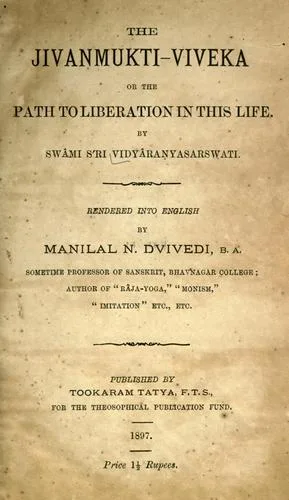
The Jivanmukti-viveka
 80
80

The Jivanmukti-viveka
Madhava's The Jivanmukti-viveka offers a systematic exposition of a core concept within Vedanta, presenting a clear, almost legalistic, breakdown of what it means to be liberated while still embodied. Its strength lies in its thoroughness, dissecting the qualities and stages of the Jivanmukta with an analytical precision that aids comprehension. However, this very analytical rigor can, at times, make the text feel dense, requiring considerable focus from the reader. A particularly striking passage describes the Jivanmukta's equanimity, unperturbed by the dualities of pleasure and pain, a state achieved not through suppression, but through profound understanding. While the 1984 publication date signifies its accessibility to a modern audience, its scholarly tone demands dedicated study. The work provides a valuable, if demanding, map to a profound state of being.
📝 Description
80
Madhava's 1984 treatise, The Jivanmukti-viveka, details the state of spiritual freedom while alive.
The Jivanmukti-viveka, authored by Madhava, examines the concept of the Jivanmukta, an individual liberated while still in the physical body. The text meticulously describes the characteristics of this realized person, the path they follow, and the nature of their ultimate attainment. It offers a detailed account of what it means to achieve spiritual freedom within the framework of the Vedanta tradition.
This book is aimed at serious students of Indian philosophy, especially those focused on Advaita Vedanta and the practical aspects of liberation. Scholars of comparative religion, practitioners interested in the yogic path, and individuals drawn to the idea of achieving enlightenment in one's current life will find it of value. A basic understanding of Hindu philosophical concepts is recommended for readers.
Madhava's work addresses core Vedantic ideas such as Avidya (ignorance) and its removal through Jnana (knowledge). It also covers Viveka (discrimination) as a means to distinguish reality from unreality, and the final realization of the self's (Atman) identity with the Absolute (Brahman).
Madhava's treatise on Jivanmukti situates itself within the Vedanta school, a major philosophical system of Hinduism. Its focus on liberation while still embodied connects it to contemplative traditions that seek direct realization of ultimate truth. The text engages with established interpretations of Vedanta, offering a particular perspective on the culmination of spiritual practice. Its appearance in English in 1984 coincided with a growing Western academic and spiritual interest in Indic philosophies, particularly Yoga and Vedanta.
💡 Why Read This Book?
• Gain a structured understanding of Jivanmukti, the state of liberation while living, as detailed in Madhava's meticulous analysis, offering a philosophical blueprint distinct from devotional or purely experiential accounts. • Explore the concept of Viveka (discrimination) as presented in the text, learning how this critical faculty is employed to discern reality from illusion, a method directly applicable to spiritual discernment. • Understand the practical implications of realizing Atman-Brahman identity, as explained by Madhava, providing insight into the psychological and ethical transformation that accompanies true spiritual freedom.
⭐ Reader Reviews
Honest opinions from readers who have explored this book.
❓ Frequently Asked Questions
What is the core philosophy presented in The Jivanmukti-viveka?
The book centers on Jivanmukti, the Vedanta concept of achieving spiritual liberation and self-realization while still alive and embodied, detailing the path and characteristics of such an individual.
Who is the author Madhava and when was this work first published?
Madhava is the author of The Jivanmukti-viveka. The first English publication of this significant work occurred in 1984, making its detailed exploration of liberation accessible to a wider audience.
What is the role of Avidya and Jnana in achieving Jivanmukti?
The text explains that Avidya, or ignorance of one's true nature, is the primary obstacle. Jnana, the direct knowledge of the identity of Atman and Brahman, is the means by which Avidya is dispelled, leading to liberation.
How does The Jivanmukti-viveka differentiate between liberation and death?
It distinguishes Jivanmukti from Videhamukti (liberation after death). The former is achieved while living, characterized by freedom from mental afflictions and karmic bondage, whereas the latter is the final release upon physical death.
What is the significance of Viveka in this text?
Viveka, or discriminative discernment, is presented as a crucial tool. It allows the aspirant to differentiate the eternal Self (Atman) from the transient phenomenal world, a key step in dissolving ignorance and realizing the Absolute.
Is this book suitable for beginners in Advaita Vedanta?
While comprehensive, the book's analytical depth and philosophical rigor are best suited for those with some prior understanding of Vedanta concepts like Brahman, Atman, and Maya.
🔮 Key Themes & Symbolism
The Jivanmukta State
The central theme is the description of the Jivanmukta, the individual who has attained spiritual freedom while still alive. This state is characterized by the complete dissolution of ignorance (Avidya) and the direct realization of the non-dual nature of reality (Brahman). The text elaborates on the qualities of such a person: their equanimity in the face of dualities like pleasure and pain, their detachment from sensory experiences, and their freedom from the binding effects of karma. It presents this not as a mystical attainment beyond reach, but as a discernible state of being achievable through specific spiritual disciplines and wisdom.
The Path of Discrimination (Viveka)
Integral to achieving Jivanmukti is the practice of Viveka, or right discernment. Madhava's work emphasizes the critical role of distinguishing the eternal, unchanging Self (Atman) from the impermanent, ever-changing world of phenomena (Maya). This intellectual and intuitive process chips away at the illusion of individuality and separateness. The text details how Viveka, cultivated through contemplation and scriptural study, leads to the dawn of knowledge (Jnana), which ultimately eradicates the root cause of suffering and bondage: ignorance of one's true, divine nature.
The Nature of Ignorance and Knowledge
The book frames spiritual liberation as the overcoming of Avidya, a cosmic ignorance that veils the ultimate reality. This ignorance creates the illusion of a separate self and fuels the cycle of birth and death. The antidote presented is Jnana, the direct, unmediated knowledge of the Self. Madhava's treatise explores how this knowledge is not merely intellectual assent but a profound experiential realization of the identity between the individual consciousness (Atman) and the universal consciousness (Brahman), leading to the transcendence of all limitations.
The Dissolution of Karma
A significant aspect of the Jivanmukti state discussed is the cessation of the binding effects of karma. While the Jivanmukta may still perform actions, these actions no longer create new karmic impressions or contribute to future rebirths. This is because their actions stem from a place of non-attachment and are performed with the awareness of their true Self, untainted by egoic desires or motivations. The work explains how the accumulated karma is also rendered inert, like burnt seeds that can no longer sprout, upon the attainment of liberating knowledge.
💬 Memorable Quotes
Direct passages from the work, attributed to the author.
“The Jivanmukta is free from the shackles of ignorance, even while living in the body.”
— This highlights the core thesis: liberation is not an posthumous event but a present reality achievable in earthly existence, emphasizing the transformative power of spiritual insight.
“Discrimination between the real and the unreal is the sharpest sword to cut the knot of ignorance.”
— This powerful metaphor illustrates the function of Viveka as the essential tool for dispelling illusion and revealing the true nature of the Self, cutting through confusion.
“Actions performed by the liberated soul do not create further bondage.”
— This explains how the Jivanmukta's actions are free from egoic attachment, thus they do not generate the karmic consequences that bind ordinary individuals to the cycle of rebirth.
“He who knows Brahman becomes Brahman.”
— This concise statement captures the Advaita Vedanta principle of non-duality, suggesting that the realization of Brahman is not an acquisition of something external, but the recognition of one's own inherent nature.
“The liberated one remains unaffected by the pairs of opposites, such as pleasure and pain.”
— This describes the equanimity characteristic of the Jivanmukta, who perceives these dualities as transient phenomena of the material world, not touching their true, unchanging Self.
🌙 Esoteric Significance
Tradition
The Jivanmukti-viveka is firmly rooted in the Advaita Vedanta tradition of Hinduism, a prominent school of thought within the broader spectrum of Indian esoteric and philosophical literature. It represents a systematic exploration of a core realization within this lineage: that liberation (Moksha) is achievable in this life (Jivanmukti). While Vedanta is not typically categorized alongside Western esoteric traditions like Hermeticism or Kabbalah, its philosophical depth, emphasis on inner realization, and sophisticated cosmology place it within the global discourse of esoteric knowledge and spiritual science.
Symbolism
The text implicitly engages with symbols of freedom and realization. The concept of the 'body' itself can be seen as a symbol of worldly existence and limitation from which the Jivanmukta transcends, not by abandoning it, but by transforming their relationship to it. The 'knot of ignorance' (Avidya-granthi) is a potent motif, symbolizing the complex, deeply ingrained illusions that bind the individual soul. Its 'cutting' by knowledge (Jnana) signifies a decisive, irreversible spiritual breakthrough.
Modern Relevance
Contemporary teachers and practitioners of Advaita Vedanta, as well as those in related mindfulness and self-inquiry movements, continue to draw upon the philosophical framework established by texts like Madhava's. The precise delineation of the liberated state and the path towards it remains a touchstone for understanding spiritual maturity. Thinkers and groups focused on non-dual awareness, psychological liberation from suffering, and the practical application of philosophical insights to daily life find resonance in its methodical approach.
👥 Who Should Read This Book
• Students of Advaita Vedanta seeking a comprehensive textual analysis of the Jivanmukta concept, moving beyond introductory overviews to detailed philosophical reasoning. • Comparative religion scholars interested in the soteriology (doctrine of salvation) within Indic traditions, specifically how liberation is conceptualized and attained within the Vedanta framework. • Dedicated spiritual practitioners aiming for profound self-understanding and liberation, who benefit from a text that systematically outlines the characteristics and process of achieving enlightenment while alive.
📜 Historical Context
Madhava's The Jivanmukti-viveka, first published in English in 1984, arrived during a period of significant global interest in Indian spiritual traditions. The preceding decades had seen the rise of movements like Theosophy and the popularization of Yoga and Vedanta by figures such as Swami Vivekananda in the late 19th century, and later, gurus like Maharishi Mahesh Yogi. This created a fertile ground for academic and spiritual exploration of texts like Madhava's. The work engaged with established schools of Vedanta, offering a detailed examination of the Jivanmukta concept, which had been a subject of discussion for centuries within traditions like Advaita Vedanta. While not facing significant censorship, its scholarly nature and focus on specific philosophical tenets meant its reception was primarily within academic circles and among dedicated practitioners of Vedanta, rather than achieving broad popular appeal.
📔 Journal Prompts
The Jivanmukta's equanimity in dualities, reflected in your own experiences.
The role of Viveka in distinguishing the eternal from the transient in your daily life.
Manifestations of Avidya in societal narratives and personal beliefs.
The impact of realizing Atman-Brahman identity on actions and motivations.
Interpreting the metaphor of the 'burnt seeds' regarding karmic residue.
🗂️ Glossary
Jivanmukti
The state of being liberated (mukta) while alive (jiva) in the physical body. It signifies the attainment of spiritual freedom and self-realization in this lifetime.
Jivanmukta
An individual who has achieved Jivanmukti; a person who is spiritually free and enlightened while still inhabiting a physical form.
Avidya
Cosmic ignorance; the fundamental misconception of one's true nature as the limited individual self, rather than the infinite, non-dual Brahman.
Jnana
Knowledge, particularly spiritual knowledge or wisdom. In Advaita Vedanta, it refers to the direct realization of the identity of Atman and Brahman, which eradicates Avidya.
Viveka
Discrimination or discernment. The intellectual and intuitive ability to distinguish between the real (Atman) and the unreal (the phenomenal world and ego-identity).
Atman
The Self; the innermost essence of an individual. In Advaita Vedanta, Atman is identical with Brahman.
Brahman
The Absolute Reality; the ultimate, unchanging ground of all existence. It is considered impersonal, infinite, and without attributes (Nirguna Brahman).
🔮 Readers Also Liked
Browse all →









More by Madhava
All books →

More Free Occult Philosophy Books
View all →