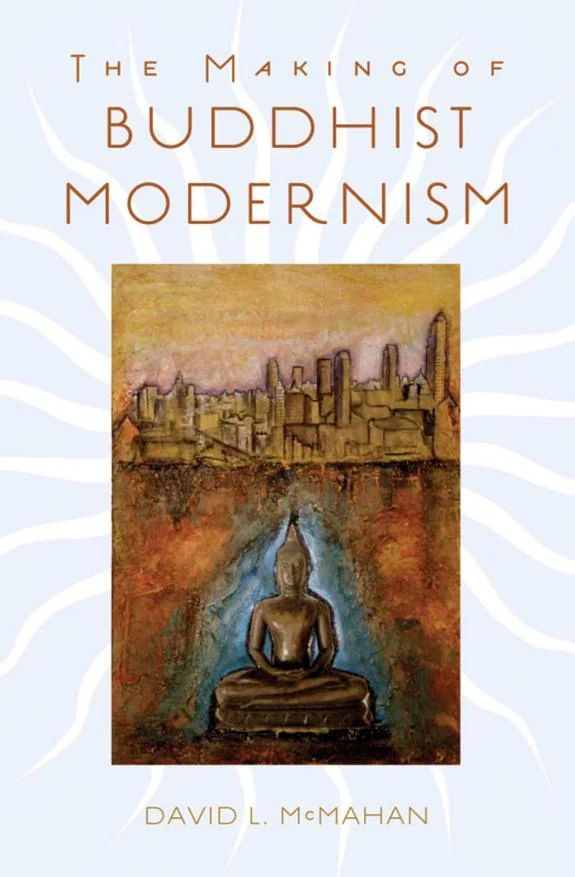
The Making of Buddhist Modernism
 83
83

The Making of Buddhist Modernism
McMahan’s "The Making of Buddhist Modernism" offers a critical lens on how Buddhist traditions were reconfigured to meet the demands of modernity. Rather than presenting a smooth evolution, he details the often-contentious processes of adaptation and selective reinterpretation. A notable strength is his examination of how Buddhist thinkers, facing Western scientific and philosophical critiques, actively reshaped doctrines and practices. For instance, the discussion on the Western reception of mindfulness, stripped of its original soteriological context, exemplifies this adaptation. However, the dense academic prose can sometimes obscure the very dynamism the book seeks to illuminate, making certain sections demanding for the uninitiated. The work compellingly argues that "Buddhist Modernism" is a historically contingent construct, not an inherent characteristic of Buddhism itself. McMahan’s analysis provides a vital corrective to simplistic understandings of Buddhist history.
📝 Description
83
### What It Is David L. McMahan's "The Making of Buddhist Modernism" meticulously analyzes the historical construction of modern Buddhism. It argues that "Buddhist Modernism" is not a monolithic entity but a dynamic product of various responses to secularization, Western influence, and intellectual challenges arising from the modern era. The work traces how Buddhist traditions adapted to survive and thrive in contexts vastly different from their origins.
### Who It's For This book is essential for scholars of religious studies, comparative religion, and Buddhist history. It will also engage students of philosophy, sociology of religion, and anyone interested in how ancient traditions engage with modernity. Those seeking to understand the historical roots of contemporary Buddhist practices and thought, particularly in the West, will find it illuminating.
### Historical Context McMahan's study emerged in the late 2000s, a period marked by increasing academic interest in global Buddhism and its engagement with Western modernity. It contextualizes shifts within Buddhism that occurred from the 19th century onwards, particularly in response to colonial encounters and the rise of scientific thought. The work implicitly engages with scholars like Gananath Obeyesekere and Donald Lopez Jr. who were also examining the intersection of Buddhism and Western culture.
### Key Concepts The book explores concepts such as "Protestant Buddhism," the adaptation of Buddhist meditation for secular audiences, and the reinterpretation of Buddhist doctrines through a modern, often rationalist, lens. It highlights the influence of figures who sought to present Buddhism as compatible with science and philosophy, often downplaying or reconfiguring elements perceived as superstitious or mythological.
💡 Why Read This Book?
• Understand the specific historical forces that shaped contemporary Buddhist practices, such as the "Protestant Buddhism" movement which sought to align Buddhist tenets with Western scientific reasoning. • Gain insight into how global Buddhist traditions engaged with colonial powers and Western intellectual currents from the 19th century onward, leading to significant doctrinal and practical shifts. • Examine the reinterpretation of core Buddhist concepts like meditation and emptiness to fit secular Western frameworks, as detailed in McMahan's analysis of modernization.
⭐ Reader Reviews
Honest opinions from readers who have explored this book.
❓ Frequently Asked Questions
What is meant by "Buddhist Modernism" in McMahan's work?
In "The Making of Buddhist Modernism," "Buddhist Modernism" refers to a historical phenomenon where Buddhist traditions were reconfigured in response to modernity, particularly Western secularism, science, and colonialism, often emphasizing rationalism and ethics over ritual.
When did the major shifts contributing to Buddhist Modernism begin?
The significant transformations that contributed to Buddhist Modernism began to accelerate in the 19th century, intensifying throughout the 20th century as Buddhist leaders and thinkers engaged with global intellectual and political landscapes.
How did Western influence shape modern Buddhism according to the book?
Western influence, including scientific thought, philosophical critiques, and colonial administrative policies, prompted Buddhist reformers to present Buddhism as a rational philosophy or ethical system, sometimes downplaying or reinterpreting devotional or ritualistic aspects.
Does the book discuss specific countries or regions where Buddhist Modernism developed?
Yes, the work explores the development of Buddhist Modernism across various regions, particularly focusing on its emergence and manifestation in South and Southeast Asia, as well as its reception and adaptation in the West.
Is "The Making of Buddhist Modernism" suitable for someone new to Buddhist studies?
While academically rigorous, the book provides crucial historical context for understanding contemporary Buddhism. Readers new to the subject might benefit from supplemental introductory materials on Buddhism before diving into McMahan's detailed analysis.
What key concerns of the modern era does McMahan identify as influencing Buddhism?
McMahan identifies secularization, the rise of scientific epistemology, colonial encounters, and the need to present Buddhism as a viable intellectual and ethical system in a globalized world as key modern concerns shaping Buddhist responses.
🔮 Key Themes & Symbolism
Secularization and Buddhist Reform
The work critically examines how Buddhist traditions responded to the increasing dominance of secular worldviews, particularly in the 19th and 20th centuries. This involved reformers selectively emphasizing aspects of Buddhism that aligned with modern rationalism, science, and ethics, often downplaying or reinterpreting ritual, cosmology, and supernatural elements to make Buddhism more palatable to Western audiences and educated elites.
The Influence of Colonial Encounters
McMahan illustrates how colonial interactions significantly impacted the development of Buddhist Modernism. Facing Western academic scholarship and administrative policies, Buddhist intellectuals were compelled to articulate their traditions in new ways, often adopting Western scholarly methods and categories to defend, reform, and propagate Buddhism globally. This encounter fostered a sense of crisis and a drive for modernization.
Reimagining Buddhist Practice
A central theme is the transformation of Buddhist practices, especially meditation, for modern consumption. The book explores how techniques like Vipassanā were detached from their original monastic and soteriological contexts and repackaged as secular mindfulness techniques for stress reduction and well-being, reflecting a broader trend of adapting ancient wisdom for contemporary secular life.
Buddhism as Philosophy and Science
The book details the efforts by proponents of Buddhist Modernism to position Buddhism not as a religion steeped in superstition, but as a rational philosophy or even a precursor to modern psychology and science. This involved reinterpreting core doctrines and ethical teachings through a lens compatible with Enlightenment values and empirical observation.
💬 Memorable Quotes
“Modern Buddhism is a complex historical process constituted by a variety of responses to some of the most important concerns of the modern era.”
— This statement frames Buddhist Modernism not as an inherent evolution but as a dynamic, contingent set of reactions to challenges posed by modernity, such as secularism and Western intellectual dominance.
“The encounter with the West was a crucial catalyst for Buddhist reform movements.”
— This highlights the pivotal role of colonial and cross-cultural interactions in prompting Buddhist thinkers to re-evaluate, reformulate, and actively disseminate their traditions in new, often Western-inflected, ways.
“Meditation techniques were often presented in secularized forms.”
— This points to the adaptation of Buddhist contemplative practices, such as mindfulness, stripping them of their traditional religious context to appeal to a broader, secular audience seeking psychological benefits.
“Buddhist modernists sought to demonstrate Buddhism's compatibility with science.”
— This reflects the strategic effort by some Buddhist reformers to align their tradition with the perceived authority of modern science, positioning it as a rational philosophy rather than a faith-based religion.
“The reinterpretation of doctrines often involved emphasizing ethical and psychological dimensions.”
— This suggests that when faced with modern critiques, Buddhist teachings were often reframed to highlight their relevance to ethics and the human mind, aligning them with contemporary philosophical and psychological discourse.
🌙 Esoteric Significance
Tradition
While not strictly an esoteric text in the Western Hermetic sense, "The Making of Buddhist Modernism" is highly relevant to esoteric studies by revealing the historical processes through which esoteric-like elements within Buddhism (e.g., advanced contemplative states, subtle body concepts) were either suppressed, reinterpreted, or selectively emphasized to align with modern sensibilities. It illuminates how esoteric traditions often adapt their presentation to remain relevant in changing intellectual landscapes.
Symbolism
The book implicitly deals with the symbolism of adaptation itself. For instance, the re-presentation of meditation as 'mindfulness' acts as a symbolic shift, transforming a complex spiritual technology into a secularized tool. The emphasis on logic and reason over mythic narratives also functions symbolically, aligning Buddhism with Enlightenment ideals rather than traditional cosmologies.
Modern Relevance
Contemporary scholars and practitioners interested in the intersection of Eastern contemplative traditions and Western psychology, neuroscience, and secular ethics draw heavily on McMahan's historical analysis. His work provides a critical framework for understanding the origins of secular mindfulness movements and the ongoing dialogue between Buddhist thought and contemporary philosophical and scientific inquiry.
👥 Who Should Read This Book
• Scholars of comparative religion and Buddhist studies seeking a rigorous historical account of how Buddhism transformed in response to modernity. • Students of social and intellectual history interested in the impact of secularization and Western thought on non-Western traditions. • Practitioners of modern meditation techniques looking to understand the historical roots and potential recontextualization of their practices beyond secular applications.
📜 Historical Context
David L. McMahan's "The Making of Buddhist Modernism" emerged in the late 2000s, a period when scholarship on global Buddhism was increasingly focused on its interaction with Western modernity. Published in 2008, it followed decades of work by scholars like Gananath Obeyesekere, who analyzed the "Protestantization" of Buddhism in Sri Lanka. McMahan's book situates itself within this discourse by examining the diverse ways Buddhist traditions across Asia and the West adapted to secularization, colonialism, and the rise of scientific thought from the 19th century onwards. It implicitly engages with the intellectual currents that saw Buddhism presented as a philosophy or psychology, distinct from its more devotional or ritualistic aspects. The work's reception contributed to a nuanced understanding of how Buddhist movements became global phenomena, often reshaped by the very forces they sought to engage with.
📔 Journal Prompts
The historical process of Buddhist Modernism and its specific responses to the modern era.
The influence of colonial encounters on the presentation and adaptation of Buddhist doctrines.
The secularization of Buddhist meditation techniques and their implications.
The reinterpretation of Buddhist philosophy to align with scientific and rationalist frameworks.
The concept of 'Protestant Buddhism' as a response to Western intellectual challenges.
🗂️ Glossary
Buddhist Modernism
A historical phenomenon characterized by the adaptation and reinterpretation of Buddhist traditions in response to modernity, often emphasizing rationalism, ethics, and compatibility with science, particularly in response to Western influence and secularization.
Secularization
The process by which religion or religious influence declines in a society or political sphere, leading to a separation of religious institutions from public life and a growing emphasis on non-religious values and explanations.
Protestant Buddhism
A term used to describe reform movements within Buddhism that sought to emulate aspects of Protestant Christianity's emphasis on scripture, rationalism, individual experience, and social reform, often in contrast to perceived 'Catholic' or 'folk' elements of tradition.
Vipassanā
A traditional Buddhist meditation practice, often translated as 'insight meditation,' aimed at developing awareness of the true nature of reality. In modern contexts, it has frequently been secularized and adapted for stress reduction.
Soteriology
The doctrine of salvation; in Buddhism, this refers to the teachings and practices concerned with liberation from suffering and the cycle of rebirth (samsara).
Epistemology
The theory of knowledge, especially with regard to its methods, validity, and scope. Epistemology is the investigation of what distinguishes justified belief from opinion.
Colonialism
The policy or practice of acquiring full or partial political control over another country, occupying it with settlers, and exploiting it economically. Its encounter with Buddhism spurred significant reform movements.