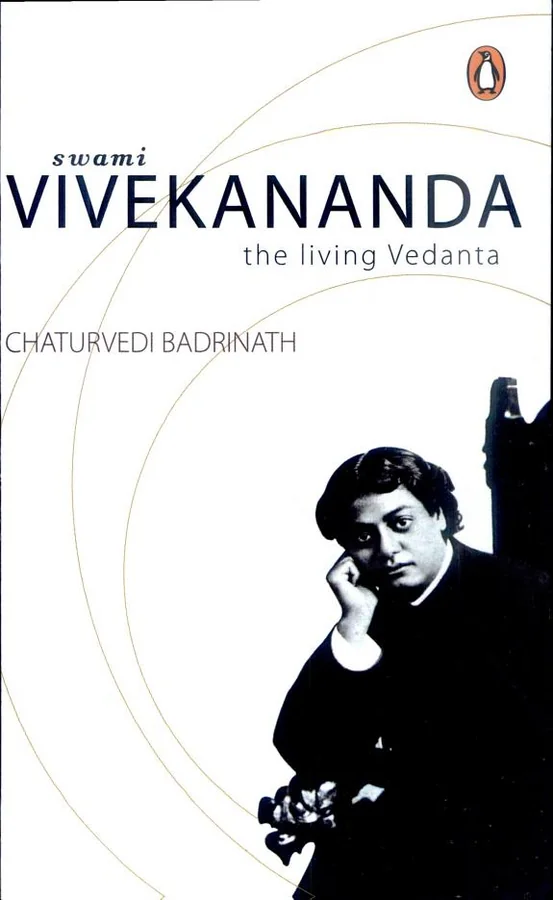
Swami Vivekananda, the Living Vedanta
 72
72

Swami Vivekananda, the Living Vedanta
Chaturvedi Badrinath’s biography offers a refreshingly grounded look at Swami Vivekananda, eschewing the typical veneration for a more analytical approach. The author excels in portraying the human dimension of the monk, juxtaposing his prophetic stature with relatable personal quirks, such as his documented fondness for ice cream. A particular strength lies in Badrinath's careful contextualization of Vivekananda's work within the socio-political and intellectual milieu of late 19th-century India, illustrating how the monk responded to colonial pressures and Western philosophical currents. However, the book occasionally suffers from a dense prose style that can make tracing the intricate philosophical arguments somewhat challenging for the casual reader. The exploration of Vivekananda's interactions with figures like Sister Nivedita, while informative, could have been expanded to further illuminate the cross-cultural dialogues he initiated. Ultimately, "Swami Vivekananda, the Living Vedanta" provides a valuable, nuanced perspective for those seeking to understand the man and his enduring philosophy.
📝 Description
72
Chaturvedi Badrinath's biography examines Swami Vivekananda's life and teachings, published in 2003.
Chaturvedi Badrinath's "Swami Vivekananda, the Living Vedanta" examines the life of the man who died at 39 but significantly shaped modern Indian spiritual thought. Badrinath details Vivekananda's ability to reconcile deep philosophical discourse with everyday matters, noting his enjoyment of simple pleasures alongside his spiritual work. The book presents Vivekananda as a whole person, not just an icon, making his philosophy and life story relatable.
The biography places Vivekananda within the context of late 19th-century India, an era of cultural resurgence against colonial pressures and Western intellectual influence. Badrinath highlights Vivekananda's role in connecting ancient Indian thought with contemporary needs. The 1893 Parliament of Religions address in Chicago, which introduced Vedanta globally and established his reputation, is a key event discussed.
This biography situates Swami Vivekananda within the Neo-Vedanta movement, a modern interpretation of Hindu philosophy that gained prominence in the late 19th century. This tradition sought to present Vedanta's core tenets, particularly Advaita Vedanta, in a way that resonated with both Indian audiences and the West. Vivekananda was instrumental in this effort, articulating complex philosophical ideas in accessible terms and demonstrating their relevance to contemporary life and social reform. The book follows his engagement with these currents, showing how he adapted and transmitted these teachings globally.
💡 Why Read This Book?
• Gain insight into the concept of 'Practical Vedanta' as articulated by Vivekananda, learning how to integrate spiritual realization with social action, a key theme in Badrinath's analysis. • Understand Vivekananda's role in the 1893 Parliament of Religions in Chicago, recognizing how this specific event introduced Eastern philosophical concepts to the West and shaped global spiritual discourse. • Appreciate the synthesis of Advaita Vedanta with a focus on strength and character development, moving beyond abstract metaphysics to actionable principles for personal growth, as detailed in the book's exploration of his teachings.
⭐ Reader Reviews
Honest opinions from readers who have explored this book.
❓ Frequently Asked Questions
What is 'Living Vedanta' as presented in Chaturvedi Badrinath's book?
Living Vedanta, as explored in the book, refers to Vivekananda's philosophy of applying the core principles of Vedanta, particularly Advaita, to everyday life. It emphasizes realizing the divine within and expressing it through service, strength, and fearlessness, making spirituality a dynamic, active force.
How does the book portray Swami Vivekananda's personality?
The book depicts Swami Vivekananda as a complex individual, balancing profound spiritual insight and prophetic stature with a very human side. It highlights his intellectual rigor, his compassion, and even his simple earthly pleasures, such as a love for ice cream, presenting a well-rounded portrait.
What was Swami Vivekananda's significance in the late 19th century?
In the late 19th century, Swami Vivekananda emerged as a key figure in revitalizing Indian spiritual traditions and presenting them to the West. His participation in the 1893 Parliament of Religions in Chicago was a landmark event, introducing Vedanta and Yoga to a global audience.
Does the book discuss Vivekananda's influence on Indian nationalism?
Yes, the book touches upon Vivekananda's influence, portraying him as a spiritual leader who inspired a sense of national pride and cultural renaissance in India during a period of colonial rule. His emphasis on strength and self-reliance resonated deeply with the burgeoning nationalist movement.
What philosophical traditions does the book connect Vivekananda to?
The book firmly connects Vivekananda to the Advaita Vedanta tradition, exploring his interpretations and practical applications of its core tenets. It also situates his work within the broader context of Hindu reform movements and his engagement with Western philosophical thought.
Is 'Swami Vivekananda, the Living Vedanta' suitable for beginners to Vedanta?
The book offers a detailed examination suitable for those with some interest in philosophy or spiritual figures. While it provides context, beginners might benefit from supplementary material to fully grasp the nuances of Advaita Vedanta discussed in relation to Vivekananda's life.
🔮 Key Themes & Symbolism
Practical Vedanta in Action
This theme explores Vivekananda's revolutionary concept of 'Practical Vedanta,' moving beyond abstract philosophical contemplation to emphasize the direct application of spiritual truths in daily life. Badrinath details how Vivekananda advocated for seeing the divine in every being and serving humanity as the highest form of worship. This approach aimed to bridge the gap between spiritual ideals and social realities, urging followers to embody strength, compassion, and selfless action as manifestations of their inner divinity, a departure from purely ascetic or ritualistic practices.
The Synthesis of East and West
The book examines Vivekananda's pivotal role in introducing Vedanta philosophy to the Western world, particularly following his influential address at the 1893 Parliament of Religions in Chicago. Badrinath illustrates how Vivekananda skillfully adapted his teachings to resonate with Western audiences while remaining true to the essence of Hindu thought. This synthesis involved not only presenting philosophical doctrines but also advocating for a holistic approach to life that integrated spiritual wisdom with intellectual inquiry and social engagement, fostering a global dialogue on spirituality.
Inner Strength and Character Building
A significant focus is placed on Vivekananda's emphasis on cultivating inner strength, self-reliance, and fearlessness as integral components of spiritual development. Badrinath highlights Vivekananda's belief that true spirituality empowers individuals, enabling them to overcome limitations and achieve their full potential. This theme underscores his call for individuals to recognize their inherent divinity and to build character through discipline, courage, and unwavering commitment to their ideals, moving away from any notion of spiritual pursuit as passive or weak.
The Human Element of a Monk
This theme delves into the portrayal of Swami Vivekananda as a complete human being, not merely an ascetic or a spiritual icon. Chaturvedi Badrinath skillfully juxtaposes Vivekananda's profound spiritual insights and prophetic status with his relatable human qualities, including his intellectual curiosity, his administrative acumen, and even his simple earthly pleasures, such as a documented liking for ice cream. This nuanced depiction aims to demystify the figure, making his life and teachings more accessible and demonstrating the integration of the spiritual and the mundane.
💬 Memorable Quotes
“The goal is not to know, but to be.”
— This paraphrase captures Vivekananda's emphasis on experiential realization over mere intellectual understanding. It suggests that true spiritual growth lies in embodying spiritual truths rather than simply acquiring theoretical knowledge, transforming one's being.
“Strength, strength is what I want.”
— This concept highlights Vivekananda's conviction that spiritual progress requires inner fortitude, courage, and self-reliance. He believed that a strong individual, both physically and mentally, is better equipped to serve humanity and realize their divine potential.
“Each soul is potentially divine.”
— This paraphrase encapsulates a core tenet of Advaita Vedanta as interpreted by Vivekananda. It posits that the divine essence is inherent in every individual, waiting to be discovered and expressed, rather than being an external entity to be sought.
“Service is worship.”
— This concise statement reflects Vivekananda's 'Practical Vedanta,' where selfless service to humanity is seen as a direct form of spiritual practice and devotion. It elevates social action to the level of religious observance.
“The world is the great gymnasium where the soul must work out its strength.”
— This interpretation emphasizes Vivekananda's view of worldly life as a training ground for spiritual development. Challenges and experiences in the world are opportunities for the soul to build resilience, wisdom, and character.
🌙 Esoteric Significance
Tradition
Vivekananda's work is deeply rooted in the Advaita Vedanta tradition of Hinduism, a major school of Indian philosophy emphasizing non-dualism. However, he significantly departed from purely scholastic or monastic interpretations by infusing it with a strong emphasis on practical application and social action. His philosophy aligns with the esoteric goal of realizing the inherent divinity within, but he democratized this pursuit, making it accessible through service and character building, rather than solely through renunciation or complex yogic practices.
Symbolism
While not overtly focused on Western esoteric symbols, Vivekananda's teachings carry potent symbolic weight. The concept of the 'Atman' (the true Self) symbolizes the unconditioned, divine core of every being, a fundamental esoteric truth of unity. His emphasis on 'Shakti' (divine energy or power) symbolizes the dynamic, creative force within the universe and the individual, which must be harnessed through strength and self-discipline. The 'Om' symbol, though not detailed in this summary, implicitly represents the ultimate reality and the sound of creation in Hindu tradition.
Modern Relevance
Vivekananda's synthesis of Eastern spirituality with Western pragmatism continues to influence contemporary thought. Thinkers and practitioners in fields ranging from yoga and meditation to transpersonal psychology and global ethics draw inspiration from his teachings. His emphasis on 'Practical Vedanta' finds echoes in modern social entrepreneurship and the application of mindfulness in secular contexts. Contemporary spiritual leaders and organizations often reference his work when advocating for a more integrated, holistic approach to personal growth and societal well-being.
👥 Who Should Read This Book
• Students of comparative religion and philosophy seeking to understand the cross-cultural transmission of spiritual ideas in the late 19th century. • Individuals interested in the life and teachings of Swami Vivekananda, particularly those curious about the origins of modern Vedanta and its global impact. • Readers exploring the intersection of spirituality, ethics, and social action, looking for frameworks that integrate inner development with outward contribution.
📜 Historical Context
Swami Vivekananda emerged during a critical juncture in late 19th-century India, a period marked by British colonial rule and the concurrent reawakening of indigenous philosophical and religious thought. The intellectual climate was a complex interplay of traditional Indian philosophies, the reformist fervor of movements like the Brahmo Samaj, and the impact of Western education and scientific rationalism. Vivekananda's life and work, particularly his address at the 1893 Parliament of Religions in Chicago, represented a significant moment in this era. This event, organized by John Henry Barrows, allowed Vivekananda to present Vedanta to a global audience, challenging prevailing Western stereotypes of Indian spirituality. His teachings offered a powerful articulation of Hindu philosophy that resonated with both Indian nationalists seeking cultural revival and Westerners intrigued by Eastern mysticism, positioning him as a key figure bridging disparate worlds. His influence contrasted with the more ascetic or purely philosophical interpretations of Vedanta prevalent at the time, advocating for its active integration into life.
📔 Journal Prompts
The paradox of Vivekananda's life: spiritual heights and earthly pleasures.
Practical Vedanta as a call to action: identifying one area for application.
The concept of 'strength' in Vivekananda's philosophy: what it means beyond physicality.
Synthesizing East and West: how does this influence contemporary spiritual thought?
Realizing the divine within: how does this concept challenge conventional beliefs?
🗂️ Glossary
Vedanta
A school of Hindu philosophy based on the Upanishads, exploring themes of reality, consciousness, and the nature of the Self (Atman) and its relationship to the ultimate reality (Brahman).
Advaita Vedanta
A prominent sub-school of Vedanta, meaning 'non-dualism.' It posits that the individual soul (Atman) is identical to the ultimate reality (Brahman), and the perceived world of multiplicity is an illusion (Maya).
Atman
In Hindu philosophy, the eternal, unchanging Self or soul that resides within each individual. It is considered identical to Brahman in Advaita Vedanta.
Brahman
The ultimate, unchanging reality or consciousness that underlies all existence in Hinduism. It is the supreme cosmic spirit, the source and sustainer of the universe.
Maya
A Sanskrit term in Hindu philosophy referring to illusion, delusion, or the power that conceals the true nature of reality. It is often seen as the force that creates the appearance of a manifold world.
Upanishads
Ancient Sanskrit texts that contain some of the philosophical concepts and ideas of Hinduism. They form the theoretical basis of Vedanta philosophy.
Parliament of Religions (1893)
A landmark event held in Chicago during the World's Columbian Exposition, where religious leaders from various traditions gathered to discuss and present their faiths, significantly including Swami Vivekananda's introduction of Vedanta.