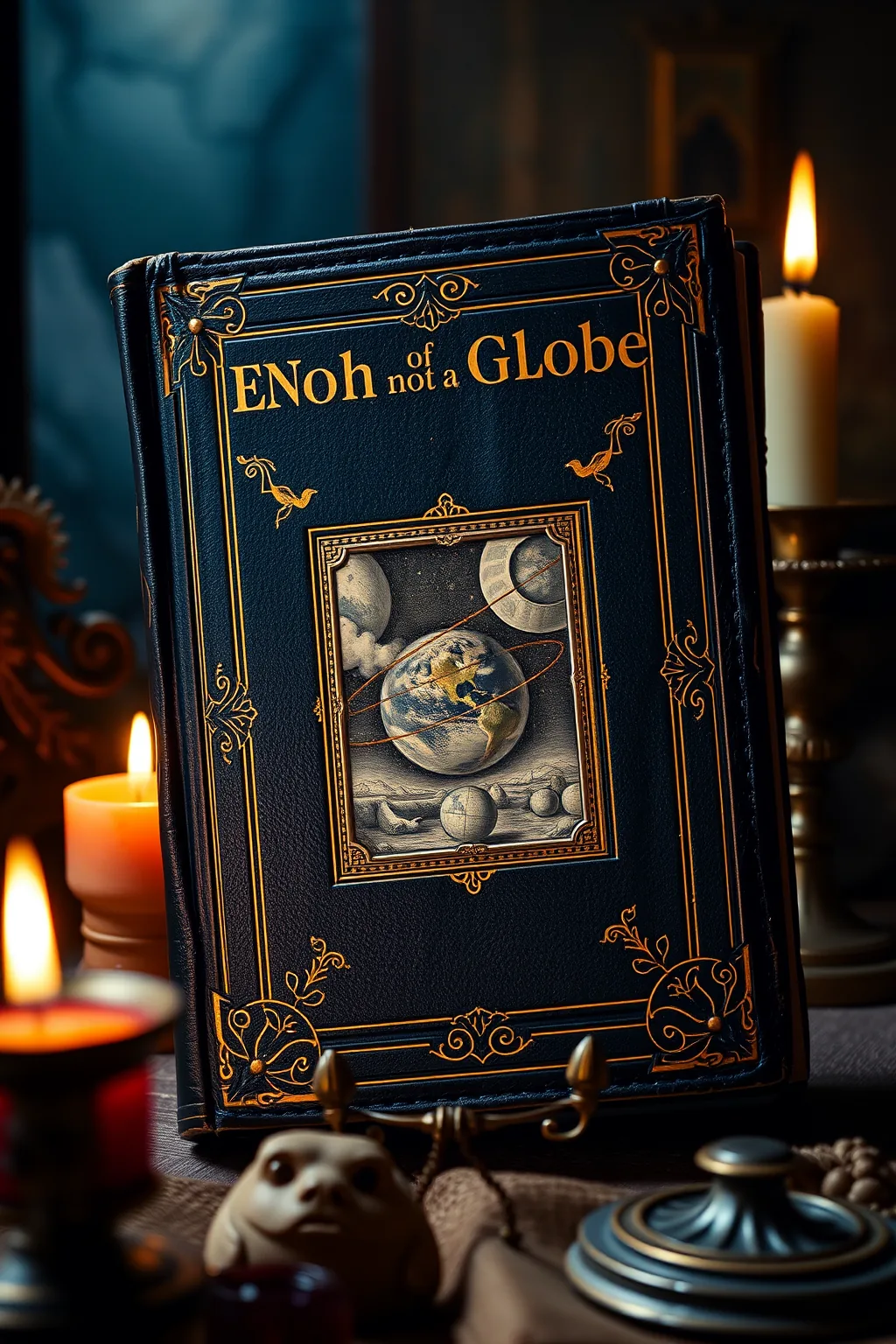
Earth Not a Globe
 74
74

Earth Not a Globe


Isolde Whitaker, Sacred Texts Editor: 'Earth Not a Globe' by Parallax (Samuel Birley Rowbotham) is a seminal work that deserves renewed attention from esoteric scholars and curious minds alike. Rowbotham's meticulous arguments, drawn from direct observation and a deep skepticism of prevailing scientific theories, present a compelling alternative worldview. This book is a treasure trove for those interested in the history of alternative cosmologies and the philosophical underpinnings of belief systems. Its strength lies in its unwavering commitment to sensory evidence and its implicit critique of abstract, unverified theories. A must-read for anyone seeking to understand the intellectual currents that challenged Victorian science and continue to resonate with seekers of hidden knowledge.
📝 Description
74
In 1865, Samuel Rowbotham argued the Earth was flat, a claim detailed in 'Earth Not a Globe'.
Samuel Rowbotham, writing as Parallax, published 'Earth Not a Globe' in 1865. The book presents a detailed argument for a flat, stationary Earth. Rowbotham rejects the heliocentric model and the concept of gravity as commonly understood. He instead bases his cosmology on literal interpretations of scripture and what he considered direct sensory observation. The work systematically attempts to dismantle prevailing scientific theories of his time, proposing an alternative model of the cosmos.
Rowbotham’s text focuses on Newtonian physics and astronomical observations, reinterpreting them to fit his geocentric view. He challenges established scientific consensus through lengthy arguments and experiments, often described in the book. The author’s intent was to demonstrate that the commonly accepted spherical model of the Earth was not supported by empirical evidence or biblical accounts, advocating instead for a terrestrial understanding rooted in a different interpretation of natural laws and divine order. This work remains a significant text for those interested in historical challenges to scientific orthodoxy.
This book emerged during a period of intense debate over scientific and religious doctrines. Rowbotham’s work aligns with certain esoteric traditions that question mainstream scientific narratives and seek alternative explanations for the cosmos, often drawing from scriptural literalism or a perceived deeper, hidden order. It reflects a broader historical current of thought that prioritizes intuitive or revealed knowledge over purely rational or empirically validated theories, resonating with groups who find traditional cosmologies more aligned with spiritual or philosophical frameworks.
💡 Why Read This Book?
Unearth a lost cosmology that challenges modern scientific dogma. 'Earth Not a Globe' offers a unique perspective on Earth's structure, rooted in observation and questioning authority. Ideal for seekers of hidden knowledge, historical researchers, and those fascinated by alternative philosophies and the evolution of scientific thought. Read it to stimulate critical thinking and explore a powerful counter-narrative.
⭐ Reader Reviews
Honest opinions from readers who have explored this book.
❓ Frequently Asked Questions
What is the core argument of 'Earth Not a Globe'?
The book's central thesis is that the Earth is not a spinning sphere, but a flat, stationary plane, a concept Rowbotham developed through empirical observation and interpretation of natural phenomena, challenging the heliocentric model.
Who was 'Parallax'?
'Parallax' was the pseudonym of Samuel Birley Rowbotham, an English inventor, lecturer, and author who dedicated two decades to promoting his flat Earth theory through extensive public speaking and publications.
What is the historical significance of this book?
It represents a significant voice in the history of alternative cosmologies and skepticism towards established scientific consensus, particularly during the Victorian era, influencing later flat Earth movements.
Does the book rely on scientific evidence?
Yes, Rowbotham presents arguments based on his interpretations of experiments, observations of water's behavior, astronomical phenomena, and biblical scripture, framing them as empirical evidence for his model.
Is this book still relevant today?
For esoteric enthusiasts and critical thinkers, it remains relevant as a study in historical skepticism, alternative interpretations of evidence, and the enduring human quest to understand our place in the cosmos.
🔮 Key Themes & Symbolism
Challenging Dogma and Sensory Revelation
This theme explores Parallax's radical departure from accepted scientific doctrine, emphasizing a return to direct sensory experience as the ultimate arbiter of truth. The book advocates for a worldview constructed from what can be seen, felt, and measured, rather than abstract theories or mathematical models. It champions the power of individual observation against established authority, urging readers to trust their own perceptions and question the prevailing narratives that might obscure fundamental realities. This perspective aligns with many esoteric traditions that prioritize inner knowing and empirical spiritual experience over external pronouncements.
The Symbolic Architecture of Creation
Beyond a literal geographical model, 'Earth Not a Globe' hints at a divinely ordered and symbolically rich universe. The flat, stationary Earth is presented not merely as a physical structure, but as a evidence of a deliberate, intelligent design. This view speaks to ancient cosmologies where the Earth often served as a sacred center, a microcosm reflecting a greater cosmic order. The book invites contemplation on the deeper meanings embedded within the world's form, suggesting that its perceived structure holds keys to understanding spiritual truths and humanity's relationship with the divine architect.
Resonance with Ancient Cosmologies
Parallax's vision of a flat, enclosed Earth echoes ancient beliefs found across numerous cultures and spiritual traditions. The book implicitly connects with a lineage of thought that predates modern spherical cosmology, suggesting a forgotten or suppressed understanding of our world. This connection appeals to those interested in the perennial wisdom, the idea that certain fundamental truths have been known and expressed in various forms throughout human history. By revisiting this ancient framework, 'Earth Not a Globe' opens a dialogue with the past, inviting a re-evaluation of how we perceive creation and our place within it, moving beyond the purely scientific into the field of the sacred and symbolic.
💬 Memorable Quotes
Direct passages from the work, attributed to the author.
“The senses are the inlets of the soul.”
— This highlights the importance of sensory perception as the primary means by which we apprehend reality and gain knowledge, a core tenet of Rowbotham's empirical approach.
“We are not to take the word of any man, or body of men, but to test all things by the senses.”
— A direct call to skepticism and personal verification, urging readers to rely on their own faculties rather than blindly accepting pronouncements from authorities.
“The heavens declare the glory of God.”
— This biblical sentiment, when applied to Rowbotham's cosmology, suggests that the observed structure of the cosmos, as he perceives it, is a direct evidence of the divine creator's magnificence.
“Truth is truth, whether it be palatable or not.”
— An assertion of the inherent value of truth, regardless of whether it conforms to popular opinion or comfortable beliefs, reflecting the author's unwavering conviction.
💡 Key Ideas
Editorial paraphrase of the work's core concepts — not direct quotes.
Nature is the book of God, and he who runs may read.
This quote emphasizes the divine revelation found in observing the natural world, suggesting that truth is accessible through direct experience and keen observation, not solely through abstract learning.
🌙 Esoteric Significance
Tradition
This work speaks to traditions emphasizing empirical observation and skepticism towards dogma, echoing Gnostic principles of seeking hidden knowledge and questioning societal illusions. It also aligns with certain hermetic and alchemical philosophies that view the material world as a symbolic manifestation of divine principles, suggesting a deeper, ordered reality beneath the surface.
Symbolism
The flat Earth itself can be viewed as a potent symbol of stability, centrality, and a contained, divinely managed cosmos, contrasting with the perceived chaos of an infinite, expanding universe. The 'firmament' or celestial dome symbolizes a protective, ordered boundary, reflecting ancient notions of a sacred enclosure separating the earthly realm from the divine.
Modern Relevance
In an age saturated with information and often abstract scientific concepts, 'Earth Not a Globe' offers a compelling call to reconnect with direct perception and critical thinking. It encourages a re-examination of accepted truths and fosters an appreciation for the diversity of human understanding, reminding us that questioning established paradigms is vital for intellectual and spiritual growth.
👥 Who Should Read This Book
This book is essential for esoteric scholars and historians of alternative cosmologies. Seekers of hidden knowledge and critical thinkers who enjoy challenging prevailing narratives will find it intellectually stimulating. Practitioners of contemplative or philosophical disciplines may find its alternative worldview a fertile ground for meditation and reflection. Beginners interested in the history of skepticism and unconventional ideas should approach it with an open mind, appreciating its historical context and unique perspective on the nature of reality.
📜 Historical Context
Published in the mid-19th century, 'Earth Not a Globe' emerged during a period of intense scientific advancement and intellectual ferment. The Victorian era saw the rise of empirical science and the solidification of the heliocentric model, yet it also fostered a climate ripe for skepticism and the exploration of alternative viewpoints. Rowbotham, under his pseudonym 'Parallax,' tapped into a vein of public curiosity and a distrust of increasingly abstract scientific theories. His work reflects a broader cultural tension between established authority and individual interpretation, between the burgeoning scientific method and older, more intuitive or religiously-informed understandings of the cosmos. The book's multiple editions and continued circulation suggest it resonated with a segment of society seeking a more grounded, perhaps more spiritually resonant, view of existence.
📔 Journal Prompts
Reflect on a time your own sensory experience contradicted a widely accepted idea. How did you reconcile the two?
Consider the symbolism of a 'flat' plane versus a 'spherical' planet in different cultural or spiritual contexts.
How does the concept of a 'firmament' or celestial dome evoke feelings of safety, order, or confinement?
If the Earth were demonstrably flat and stationary, what fundamental shifts in human society, philosophy, and spirituality might occur?
Explore the tension between trusting external authorities (science, tradition) and trusting your own direct perception and intuition.
🗂️ Glossary
Heliocentric Model
The astronomical model in which the Earth and planets revolve around the Sun. Rowbotham critically challenges this dominant scientific paradigm.
Empirical Observation
Knowledge acquired through direct sensory experience and experimentation, a central to Rowbotham's methodology.
Firmament
A term often used in ancient cosmologies to describe the sky or the vault of heaven, sometimes conceived as a solid dome above the Earth.
Cosmology
The study of the origin, evolution, and eventual fate of the universe; in this context, the specific model of the Earth and its place in the universe presented by Rowbotham.
Dogma
A principle or set of principles laid down by an authority as incontrovertibly true, which Rowbotham actively disputes in his work.
This book appears in 3 collections
🔮 Readers Also Liked
Browse all →









From the “Out-of-Body Experience” Collection
View all →






More Free Esoteric History & Biography Books
View all →