Reading Cusanus
 83
83

Reading Cusanus
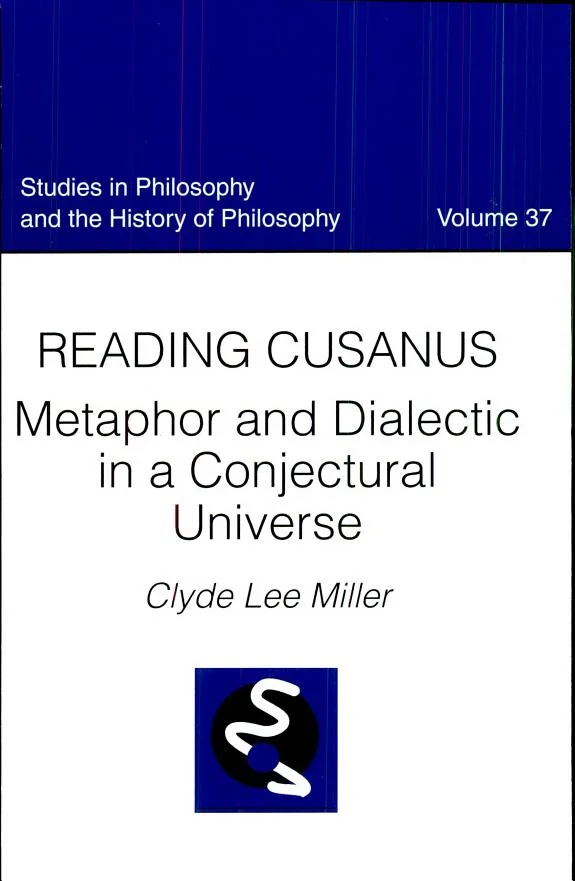
Clyde Lee Miller’s *Reading Cusanus* attempts to demystify Nicholas of Cusa’s dense theological philosophy, focusing on the paradoxical concept of "learned ignorance." Miller succeeds in highlighting Cusa’s innovative use of metaphor, particularly in illustrating the relationship between God and creation. The explication of Cusa’s "coincidence of opposites" offers a clear window into his departure from traditional Aristotelian logic. However, the book sometimes feels more like a summary of Cusa’s ideas than a critical engagement. While the blurb mentions "striking metaphors for God," the analysis could benefit from a deeper dive into the symbolic efficacy of these metaphors, moving beyond mere description. Miller’s work is a useful primer, but it doesn’t quite capture the full intellectual force or the spiritual implications that Cusa’s writings evoke. It serves as a competent, if somewhat dry, introduction to a formidable thinker.
📝 Description
83
### What It Is Reading Cusanus by Clyde Lee Miller offers an accessible entry into the complex philosophical and theological writings of Nicholas of Cusa. The book dissects Cusa's central concept of "learned ignorance" (docta ignorantia), a paradoxical state where true knowledge of God arises from recognizing the limits of human understanding. Miller focuses on how Cusa employed striking metaphors to articulate God's nature and the relationship between the divine and the created world, moving beyond purely scholastic or mystical interpretations.
### Who It's For This work is primarily for students and scholars of late medieval philosophy and theology, particularly those interested in Neoplatonic influences and early Renaissance thought. It will also appeal to readers exploring the philosophical underpinnings of mysticism, comparative theology, and the history of ideas concerning negative theology. Those seeking to understand the intellectual lineage of later mystics or contemplatives who grapple with ineffability will find value here.
### Historical Context Nicholas of Cusa (1401-1464) was a pivotal figure bridging medieval scholasticism and Renaissance humanism. He lived during a period of significant intellectual ferment, marked by the Council of Constance and the burgeoning rediscovery of classical texts. His work emerged in dialogue with nominalism and the speculative mysticism of figures like Meister Eckhart, yet Cusa forged a distinct path. His mathematical and cosmological theories, alongside his theological innovations, positioned him as an influential thinker whose ideas were debated across Europe, impacting later philosophers and theologians.
### Key Concepts The book centers on Nicholas of Cusa's concept of "learned ignorance," which posits that the finite human mind cannot grasp the infinite God through direct apprehension. Instead, true knowledge is achieved by acknowledging this very limitation. Cusa's "coincidence of opposites" is another vital theme, where contrary notions (like God and creation, or unity and multiplicity) are seen to converge in the divine. The work also explores Cusa's use of metaphors, such as the "isthmus" connecting God and the world, to illustrate these abstruse relationships.
💡 Why Read This Book?
• Understand "learned ignorance" as articulated by Nicholas of Cusa, a key concept for grasping the limits of human intellect in relation to the divine, as explored in Miller's analysis of Cusa's 15th-century thought. • Explore the "coincidence of opposites," a philosophical framework where seemingly contradictory ideas converge in the divine, offering a unique perspective on theological paradoxes discussed in the book. • Gain insight into Cusa's metaphorical language, such as the "isthmus" linking God and creation, providing concrete symbolic representations for abstract theological concepts presented in Miller's text.
⭐ Reader Reviews
Honest opinions from readers who have explored this book.
❓ Frequently Asked Questions
What is the central idea of Nicholas of Cusa's "learned ignorance"?
Nicholas of Cusa's "learned ignorance" (docta ignorantia) is the philosophical and theological concept that true wisdom about God is achieved not through exhaustive intellectual comprehension, but by recognizing the inherent limitations of the human mind to grasp the infinite divine.
When was Nicholas of Cusa active?
Nicholas of Cusa was a prominent figure in the 15th century, living from 1401 to 1464. His intellectual contributions bridge the late medieval period and the early Renaissance.
What is the "coincidence of opposites" in Cusa's philosophy?
The "coincidence of opposites" refers to Cusa's idea that in God, contraries such as unity and multiplicity, or being and non-being, are not contradictory but are unified. This concept challenges conventional logic.
What kind of metaphors did Nicholas of Cusa use?
Cusa employed striking metaphors, such as the "isthmus" connecting God and creation, and the "contracted infinity" of the created world mirroring God's absolute infinity, to articulate complex theological ideas.
Who was Clyde Lee Miller?
Clyde Lee Miller is the author of *Reading Cusanus*, published first in 2003. He has written extensively on philosophy and theology, aiming to make complex thinkers more accessible.
What historical period does *Reading Cusanus* cover?
The book focuses on the philosophical and theological work of Nicholas of Cusa, a key thinker of the 15th century, placing his ideas within the context of late medieval scholasticism and early Renaissance humanism.
🔮 Key Themes & Symbolism
Learned Ignorance
The core of Cusa's thought, as presented by Miller, is "learned ignorance" (docta ignorantia). This isn't mere lack of knowledge, but a profound understanding that arises from recognizing the infinite gulf between the human intellect and God. It involves a conscious humbling of reason before the divine mystery, leading to a higher form of knowledge that transcends logical categories. This concept is crucial for understanding Cusa's approach to theology and mysticism, positioning him as a precursor to later thinkers who explored the limits of language and cognition in spiritual contexts.
Coincidence of Opposites
Miller explains Cusa's concept of the "coincidence of opposites" as a way to describe the absolute unity of God, where all distinctions and dualities dissolve. In God, maximal and minimal, simple and complex, being and non-being are one. This principle allows Cusa to speak of God as the "non-other" and to reconcile seemingly contradictory attributes. It’s a radical departure from Aristotelian logic and central to understanding Cusa's mystical theology and his view of divine simplicity, influencing subsequent philosophical and theological explorations of paradox.
Metaphors for God and Creation
A significant focus of *Reading Cusanus* is Cusa's use of striking metaphors to bridge the ineffable divine with the finite created realm. Miller highlights metaphors like the "isthmus" (a narrow strip of land connecting two larger bodies of water, representing creation as the link between God and nothingness) and "contracted infinity" (the idea that creation, while finite, reflects God’s infinite nature in a limited way). These symbolic devices are Cusa's tools for articulating his complex metaphysics and cosmology, offering visual and conceptual anchors for abstract theological ideas.
The Absolute and the Contracted
Miller's work elucidates Cusa's distinction between the Absolute (God) and the contracted. The Absolute is God in His infinite, unconditioned being. Creation, by contrast, is a "contracted" form of God's being – an expression of God's infinite power and goodness within finite limitations. This concept explains how a singular, infinite God can be the source of a diverse, finite universe without diminishing His own nature. It's a key element in Cusa's cosmological and theological system, influencing later discussions on divine immanence and transcendence.
💬 Memorable Quotes
“The work reveals how Nicholas' project of "learned ignorance" is played out in striking metaphors for God and the relation of God to creation.”
— This quote, from the original blurb, encapsulates the book's core focus. It highlights Cusa's paradoxical approach to knowing God through acknowledging unknowing, and his use of vivid imagery to bridge the conceptual gap between the infinite divine and the finite world.
“In God, all opposites coincide.”
— This paraphrased concept represents Cusa's doctrine of the 'coincidence of opposites.' It signifies that in the absolute unity of God, logical contradictions and dualities that exist in the created world are resolved and unified, pointing to God's supra-rational nature.
“The human mind cannot grasp the infinite God through direct apprehension.”
— This statement captures the essence of 'learned ignorance.' It asserts that finite human reason has inherent limitations when attempting to comprehend the infinite nature of God, necessitating a different path to theological understanding.
“Creation is a 'contracted' reflection of God's infinity.”
— This paraphrased concept illustrates Cusa's view of the created universe. It suggests that while finite, the world participates in and reflects God's infinite attributes in a limited, or 'contracted,' manner, establishing a connection between the Absolute and the relative.
“Cusa used metaphors like the 'isthmus' to explain divine-creation relationships.”
— This highlights Cusa's reliance on symbolic language. The 'isthmus' metaphor specifically points to creation as a liminal space or connection between God and nothingness, underscoring his creative use of imagery to convey complex theological ideas.
🌙 Esoteric Significance
Tradition
Nicholas of Cusa’s work, as interpreted through *Reading Cusanus*, sits at the confluence of Christian Neoplatonism and nascent Renaissance humanism. While firmly rooted in Catholic theology, his exploration of the limits of human reason and his concept of "learned ignorance" echo themes found in mystical traditions across various faiths, particularly those emphasizing apophatic theology (negative theology). His philosophy offers a bridge between scholastic intellectualism and the experiential knowledge sought in contemplative practices, making it relevant to traditions that seek to articulate the ineffable nature of the divine.
Symbolism
Key symbols in Cusa's thought, as illuminated by Miller, include the "isthmus" and "contracted infinity." The "isthmus" symbolizes creation as the intermediary point between God and nothingness, a fragile yet essential link. "Contracted infinity" represents how the finite universe embodies a limited aspect of God's infinite perfection, acting as a mirror. These symbols are not mere decorations but are integral to his metaphysical system, providing conceptual handles for understanding the relationship between the Absolute and the relative, the One and the many.
Modern Relevance
Contemporary thinkers in fields ranging from philosophy of religion to speculative theology draw on Cusa's challenging ideas. His concept of learned ignorance remains relevant for discussions on epistemology, particularly concerning the limits of scientific and rational inquiry when applied to ultimate reality. Mystics and contemplative practitioners continue to find value in his emphasis on humility of intellect before the divine. Furthermore, his re-evaluation of paradox and opposites has found echoes in postmodern thought and process theology, demonstrating the enduring power of his intellectual innovations.
👥 Who Should Read This Book
• Students of Western Esotericism: Those interested in the philosophical underpinnings of mystical thought will find Cusa’s approach to the divine and the limits of knowledge highly relevant. • Comparative Theology Scholars: Researchers exploring how different traditions grapple with the ineffability of God and the relationship between the finite and infinite will benefit from Cusa’s unique framework. • Philosophy of Religion Enthusiasts: Individuals seeking to understand the historical development of theological concepts and the interplay between reason and faith in the 15th century will find this work illuminating.
📜 Historical Context
Nicholas of Cusa (1401-1464) was a towering intellectual figure whose work spanned the transition from the late medieval period to the early Renaissance. He operated within a world shaped by the aftermath of the Avignon Papacy and the Council of Constance, and the concurrent rediscovery of classical texts fueled by humanism. His philosophical theology engaged with, yet diverged from, the dominant scholastic traditions, particularly Aristotelianism, and offered a counterpoint to the rising nominalism of thinkers like William of Ockham. Cusa’s ideas, particularly his "learned ignorance" and the "coincidence of opposites," were considered radical and were debated by contemporaries and successors alike. While not subject to formal censorship in the way some later mystics were, his theological innovations certainly provoked considerable intellectual discussion and were a significant departure from established doctrines, influencing later Renaissance thinkers and mystics who sought to reconcile faith and reason in novel ways.
📔 Journal Prompts
Reflect on the concept of 'learned ignorance' as a path to knowledge.
How does the metaphor of the 'isthmus' help visualize the connection between God and creation?
Consider the implications of the 'coincidence of opposites' for understanding paradox.
Analyze the limitations of human language in describing the divine, inspired by Cusa's ideas.
Explore the tension between the Absolute and the contracted in your own experience.
🗂️ Glossary
Learned Ignorance (Docta Ignorantia)
A philosophical and theological concept, central to Nicholas of Cusa, asserting that true knowledge of God is achieved by recognizing the limits of human intellect and acknowledging the unknowability of the infinite.
Coincidence of Opposites
Cusa's doctrine that in God, all dualities and contradictions (e.g., being/non-being, unity/multiplicity) converge and are unified, reflecting God's absolute simplicity and supra-rational nature.
Absolute
In Cusa's philosophy, the Absolute refers to God in His infinite, unconditioned, and primordial state, the ultimate source of all reality.
Contracted
Referring to created reality, which is seen as a finite, limited, or 'contracted' manifestation or reflection of God's infinite being and attributes.
Isthmus
A metaphor used by Cusa to describe creation as a narrow strip connecting God (the Absolute) and nothingness, highlighting its intermediary and dependent nature.
Apophatic Theology
A theological approach that defines God by negation, emphasizing what God is not, rather than what God is, due to the ineffability of the divine essence.
Neoplatonism
A school of philosophy originating with Plotinus, heavily influenced by Plato, which posits a hierarchical structure of reality emanating from a supreme, ineffable 'One'.