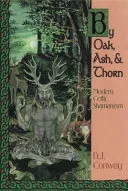
By Oak, Ash, & Thorn
 80
80

By Oak, Ash, & Thorn



Deanna J. Conway's "By Oak, Ash, & Thorn" offers a vital corrective to the often narrowly defined understanding of shamanism. Rather than rehashing familiar narratives, Conway anchors her study firmly in the soil of European history, presenting a compelling case for the continent's own rich shamanic heritage. Her strength lies in meticulous historical reconstruction, detailing practices that predate and coexist with dominant religious structures. A notable limitation is the academic tone, which, while precise, can make the material less accessible to those seeking immediate practical application. Conway's exploration of the "spirit flight" concept, drawing parallels between Norse seidr and other European ecstatic traditions, exemplifies her rigorous approach. The work serves as an essential, if dense, contribution to understanding the widespread roots of shamanic consciousness.
📝 Description
80
### What It Is By Oak, Ash, & Thorn by Deanna J. Conway is a scholarly examination of European shamanism, moving beyond common associations with Indigenous American and African traditions. Conway meticulously reconstructs a forgotten spiritual heritage, presenting shamanism not as a monolithic practice, but as a diverse set of techniques and worldviews found across various ancient European cultures. The work focuses on the practical application and philosophical underpinnings of these traditions.
### Who It's For This book is for serious students of comparative religion, Western esotericism, and historical spirituality. It will appeal to practitioners of modern witchcraft, paganism, or animism who seek deeper roots in European folklore and ancient practices. Readers interested in the intersection of anthropology, mythology, and spiritual exploration will find Conway's research particularly valuable. It is not a beginner's guide to ritual, but an academic exploration for those with a foundational interest.
### Historical Context Conway's research grounds shamanic practices within the historical and cultural landscapes of ancient and medieval Europe. The book details how these traditions existed alongside, and sometimes influenced, the development of later religious and folk practices. It highlights the persistence of animistic beliefs and spirit communication techniques even after the widespread adoption of Christianity, demonstrating a continuity of spiritual technology.
### Key Concepts The central thesis posits that shamanism was a widespread European phenomenon, distinct from but analogous to shamanism found elsewhere. Conway explores concepts such as spirit journeys, communication with the land, and the use of altered states of consciousness for divination and healing. The work also examines the role of specific natural elements, like the oak, ash, and thorn trees mentioned in the title, as conduits for spiritual power and connection to the otherworld.
💡 Why Read This Book?
• Gain a nuanced understanding of European shamanism, moving beyond common associations by exploring Conway's specific research into Celtic and Germanic spirit flight traditions documented in the text. • Discover the historical continuity of animistic beliefs in Europe, learning how these practices persisted alongside Christianity, as detailed in the book's analysis of post-Roman European folkways. • Understand the symbolic significance of natural elements like the oak, ash, and thorn, as Conway elucidates their role as spiritual conduits within the specific framework of European shamanic cosmology presented in the book.
⭐ Reader Reviews
Honest opinions from readers who have explored this book.
❓ Frequently Asked Questions
What is the primary focus of Deanna J. Conway's "By Oak, Ash, & Thorn"?
The book's primary focus is on reconstructing and examining the historical practice of shamanism within European cultures, moving beyond the common association with Indigenous American and African traditions.
When was "By Oak, Ash, & Thorn" first published?
Deanna J. Conway's "By Oak, Ash, & Thorn" was first published in 1995.
Does the book offer practical shamanic techniques for modern practitioners?
While it provides historical context and theoretical understanding, the book is primarily an academic exploration. It details historical techniques and concepts rather than offering a step-by-step guide for modern practice.
What specific European cultures are examined in relation to shamanism?
The book examines various European cultures, with particular attention paid to Celtic and Germanic peoples, exploring their unique shamanic traditions and beliefs.
How does "By Oak, Ash, & Thorn" differentiate itself from other books on shamanism?
It distinguishes itself by concentrating on the often-overlooked European roots of shamanism, presenting it as a pan-European phenomenon with distinct regional expressions, supported by historical and anthropological evidence.
What does the title "By Oak, Ash, & Thorn" refer to symbolically?
The title refers to the symbolic importance of these specific trees within European folklore and shamanic traditions, often seen as conduits or sacred elements connecting the earthly and spiritual realms.
🔮 Key Themes & Symbolism
European Shamanic Heritage
This theme centers on Conway's argument that shamanism was a widespread practice across Europe, not confined to specific continents. The work meticulously reconstructs the historical presence of shamanic techniques among various European peoples, including the Celts and Germanic tribes. It highlights how these traditions, involving spirit journeys, divination, and interaction with the natural world, formed a significant part of pre-Christian and even syncretic post-Christian European spirituality. The book posits that understanding this heritage is crucial for a complete picture of global shamanism.
Spirit Flight and Ecstatic Techniques
A core concept explored is the 'spirit flight,' a shamanic technique involving altered states of consciousness to travel to other realms or gain spiritual knowledge. Conway draws parallels between various European traditions, such as Norse seidr and other ecstatic practices, to illustrate this phenomenon. The book examines the methods used to induce these states, the symbolism associated with the journeys, and the purpose of such experiences, whether for healing, prophecy, or communion with spirits.
Animism and Nature Connection
The book emphasizes the animistic worldview inherent in European shamanism, where natural elements—trees, stones, rivers, and animals—are seen as imbued with spirit and agency. Conway details how these beliefs informed the practices of ancient Europeans, fostering a deep connection to the land. The symbolic significance of trees like the oak, ash, and thorn, which give the book its title, is explored as potent examples of nature-based spiritual technology and communication pathways.
Continuity of Ancient Practices
This theme addresses the persistence of shamanic and animistic beliefs in Europe despite the rise of organized religions like Christianity. Conway illustrates how these older spiritual technologies were often adapted, disguised, or integrated into folk customs and later esoteric movements. The work challenges the notion of a complete break with ancient spiritual traditions, arguing for a continuous, albeit transformed, thread of shamanic consciousness running through European history.
💬 Memorable Quotes
“Shamanism was not an exotic import but an indigenous European path.”
— This statement encapsulates the book's central thesis: that European cultures possessed their own robust shamanic traditions, often overlooked in favor of non-European examples. It reframes the study of shamanism to include a Western perspective.
“The spirit flight allowed practitioners to commune with the ancestral realm.”
— This highlights a key shamanic technique discussed in the book. It emphasizes the purpose of altered states of consciousness: to connect with the spirits of ancestors for guidance, wisdom, or to understand lineage.
“Trees like the oak, ash, and thorn served as significant bridges to the otherworldly.”
— This interpretation focuses on the symbolic power of specific natural elements. It suggests these trees were not merely flora but active participants in spiritual practice, facilitating passage between worlds.
“Pre-Christian European spirituality often maintained an animistic framework.”
— This points to the book's exploration of the underlying worldview of ancient Europeans. It asserts that a belief in the inherent spirit and agency of nature was fundamental to their spiritual practices.
“The work reconstructs forgotten European shamanic traditions.”
— This is a concise summary of the book's scholarly endeavor. It emphasizes the 'reconstruction' aspect, implying that these practices were documented but perhaps lost or suppressed over time.
🌙 Esoteric Significance
Tradition
This work fits within the broader context of Western Esotericism, specifically the revival and reinterpretation of ancient European spiritual practices. It acts as a bridge between academic historical research and contemporary Neopagan and witchcraft movements. While not strictly Hermetic or Gnostic, it taps into a lineage of interest in altered states, spirit communication, and nature-based spirituality that underpins many Western esoteric traditions. Conway's contribution lies in grounding these interests in specific historical European shamanic practices, rather than solely relying on Neoplatonic or Kabbalistic frameworks.
Symbolism
The title itself, "By Oak, Ash, & Thorn," points to potent symbols in European lore. The oak often signifies strength, endurance, and divine power (e.g., Zeus/Jupiter's oak). The ash tree, famously Yggdrasil in Norse mythology, connects the worlds and represents cosmic order and knowledge. Thorn bushes, particularly hawthorn, are frequently associated with the Fae, liminal spaces, and protective magic. Conway likely explores these trees as literal and symbolic conduits for spirit journeys, healing, and accessing otherworldly wisdom within the European shamanic context.
Modern Relevance
Conway's research remains highly relevant for contemporary practitioners of European-based spiritual paths, including modern witchcraft, paganism, and animism. Thinkers and groups focused on reclaiming indigenous European spirituality often cite or are influenced by works that demonstrate historical continuity. Her work provides a scholarly foundation for understanding practices that emphasize deep ecological connection and spirit communication, aligning with modern movements advocating for a more immanent, nature-attuned spirituality. It supports the idea that potent shamanic techniques are not culturally exclusive but have diverse historical expressions.
👥 Who Should Read This Book
• Students of comparative religion and historical European spirituality seeking to understand shamanism beyond common geographical associations. • Modern witchcraft and pagan practitioners interested in exploring the historical roots of their traditions within Celtic and Germanic cultures. • Anthropologists and scholars of folklore investigating the persistence of animistic beliefs and ecstatic practices in pre-Christian and medieval Europe.
📜 Historical Context
Published in 1995, "By Oak, Ash, & Thorn" emerged during a period of renewed interest in Paganism, Wicca, and esoteric studies in the West. This era saw a surge in books exploring witchcraft, Druidry, and related traditions, often drawing heavily on Celtic and Norse mythologies. Conway's work distinguished itself by offering a more academically rigorous and historically grounded examination of European shamanism, directly challenging the prevailing narrative that shamanism was primarily a phenomenon of Indigenous American, Siberian, or African cultures. While authors like Mircea Eliade had previously explored shamanism broadly, Conway focused specifically on excavating the European dimension, a less-trodden path. Her research engaged with anthropological findings and historical texts concerning Germanic and Celtic peoples, providing a counterpoint to more mythologically romanticized accounts. The book's reception likely resonated with practitioners seeking deeper historical roots for their spiritual paths, while also contributing to academic discourse on comparative religion and European folk traditions.
📔 Journal Prompts
Reflect on the symbolic significance of the oak, ash, and thorn in your personal spiritual landscape.
Consider the concept of 'spirit flight' as described by Conway; how might such journeys be understood metaphorically or practically today?
Explore the potential for animistic worldview in your immediate natural environment.
How does the idea of indigenous European shamanism challenge or expand your previous understanding of spiritual practices?
What historical parallels can be drawn between the ecstatic techniques mentioned and modern meditative or trance practices?
🗂️ Glossary
Shamanism
A range of indigenous spiritual practices characterized by a practitioner's ability to engage with the spirit world, often through altered states of consciousness, for purposes of healing, divination, or spiritual guidance.
Spirit Flight
A core shamanic concept involving the practitioner's consciousness traveling to other realms or dimensions, often to interact with spirits, ancestors, or gain knowledge.
Animism
The belief that natural objects, phenomena, and the universe itself possess souls or spirits; a worldview prevalent in many indigenous and ancient cultures.
Ecstatic Techniques
Methods used to induce altered states of consciousness, such as drumming, chanting, fasting, or ritual dance, enabling communication with the spirit world.
Seidr
A form of Norse magic associated with divination and weaving fate, often practiced by women (völva) and involving trance states and spirit journeys.
Liminal Space
A threshold or transitional place, both physically and psychologically, often considered a potent zone for spiritual activity or interaction with the otherworldly.
Folkway
A traditional or customary practice or belief within a particular community or culture, often passed down orally through generations.