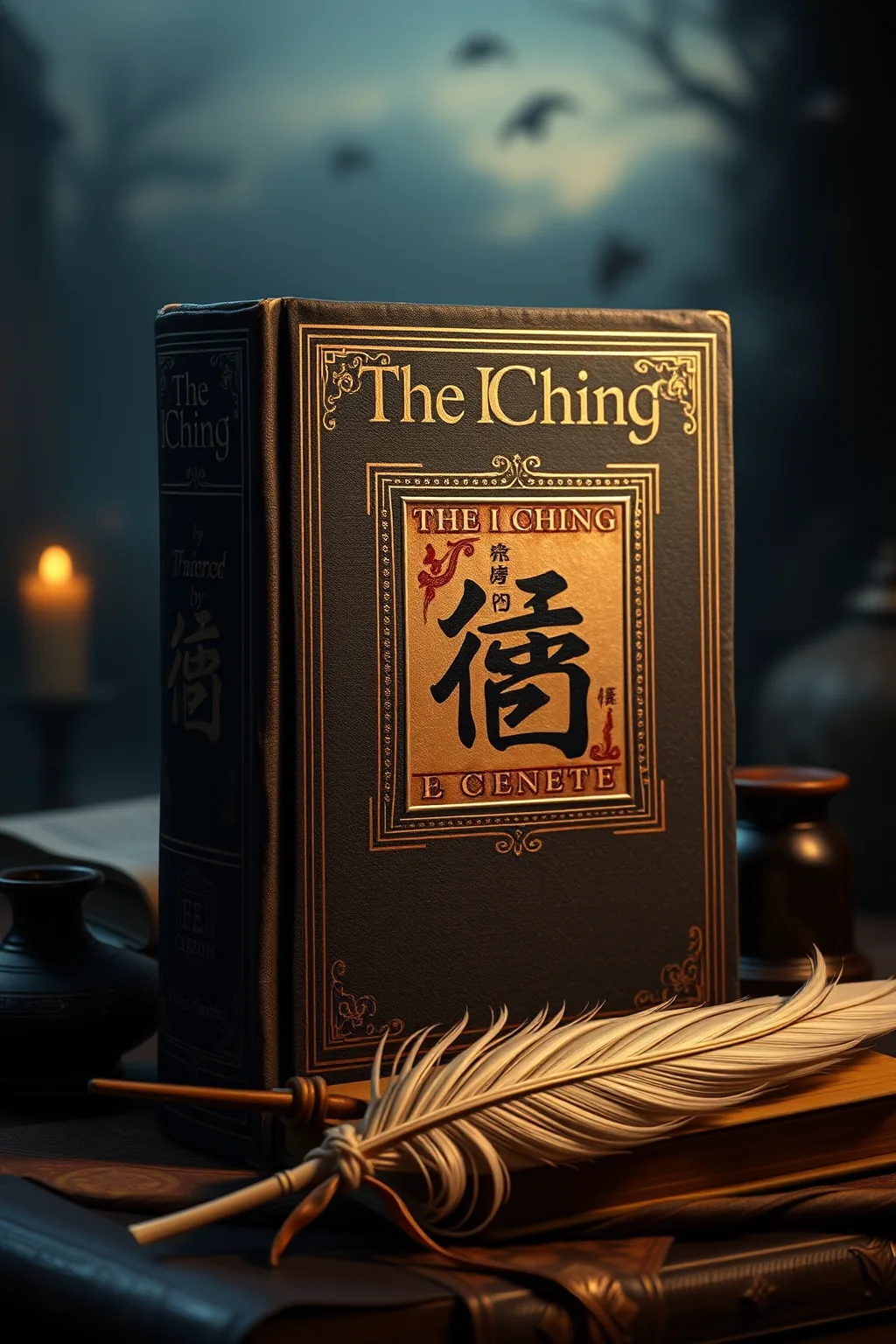
The I Ching
 95
95

The I Ching



Lorelei Sage (Contemplative Literature Editor) — 'The I Ching' stands as an unparalleled testament to the enduring power of ancient oracular systems. Its profound insights into the nature of change and cosmic harmony resonate deeply, offering a sophisticated framework for understanding life's complexities. The elegance of its symbolism, particularly the interplay of Yin and Yang within the hexagrams, provides a rich field for esoteric exploration. This text is indispensable for anyone seeking a deeper connection to universal patterns or a guide for navigating personal transformation. Its wisdom transcends mere prediction, offering a profound philosophical lens through which to view the world.
📝 Description
95
The I Ching, compiled over centuries, uses sixty-four hexagrams to map cyclical change.
The I Ching, or Book of Changes, is an ancient Chinese text that presents a system of sixty-four hexagrams. Each hexagram is composed of six lines, which can be either solid (Yang) or broken (Yin). These symbols represent a vast array of situations and transformations, serving as a framework for understanding the dynamics of existence.
The text describes the interplay of Yin and Yang, the fundamental forces believed to shape the universe. It offers a perspective on how these forces interact and lead to constant change. The I Ching is not merely a tool for divination but a philosophical work that encourages contemplation on the patterns of life and the cosmos.
Its language is rich with metaphor and allegory, inviting readers to engage in deep thought about interconnectedness and the forces that influence events. The book suggests a way to align oneself with these cosmic patterns, fostering self-understanding and spiritual awareness.
Originating in ancient China, the I Ching is a foundational text within East Asian esoteric traditions. It is closely associated with Taoism and Confucianism, influencing both philosophical thought and divination practices for over two millennia. Its hexagrammatic system is seen as a map of universal processes and human affairs, intended to guide individuals toward harmony with the natural order. The text is often consulted for advice and insight into the unfolding of events, viewing change as the only constant.
💡 Why Read This Book?
Unlock the secrets of cosmic balance and personal evolution. 'The I Ching' offers a unique lens for understanding life's inevitable transformations, guiding you through challenges and opportunities with profound wisdom. Ideal for seekers of esoteric knowledge, practitioners of divination, and scholars fascinated by ancient philosophy, it provides a practical yet deeply spiritual path to self-awareness and harmonious living.
⭐ Reader Reviews
Honest opinions from readers who have explored this book.
❓ Frequently Asked Questions
What is the I Ching?
The I Ching, or Book of Changes, is an ancient Chinese divination text and philosophical classic. It comprises 64 hexagrams, each representing a fundamental situation or archetype, and is used to gain insight into the present and future.
How is the I Ching used for divination?
Divination is typically performed by casting coins or yarrow stalks to generate hexagrams. The resulting hexagram and its changing lines are then interpreted using the text's accompanying explanations and commentaries.
What is the philosophical significance of the I Ching?
Philosophically, the I Ching emphasizes the constant flux of the universe and the importance of adapting to change. It explores the interplay of Yin and Yang, the two fundamental opposing yet complementary forces.
Is the I Ching difficult to understand?
While the core concepts can be grasped, mastering the nuances of the I Ching requires dedicated study and contemplation. Its symbolic language and layered meanings offer a lifetime of exploration.
Who is considered the author of the I Ching?
The I Ching is traditionally attributed to a collective authorship spanning centuries, with contributions from figures like King Wen, the Duke of Zhou, and Confucius, alongside earlier shamanic traditions.
🔮 Key Themes & Symbolism
The Principle of Change
Fundamentally, , 'The I Ching' posits that change is the only constant in the universe. It meticulously maps the cyclical nature of all phenomena, from the rise and fall of empires to the subtle shifts within the human psyche. Understanding these patterns allows for proactive adaptation rather than reactive struggle, fostering a profound sense of flow and resilience in the face of life's inevitable transformations. This theme encourages a philosophical acceptance of impermanence, viewing each transition not as an ending, but as a necessary prelude to a new beginning, thereby cultivating inner peace and wisdom.
Yin and Yang: The Cosmic Duality
The fundamental energetic forces of Yin (passive, receptive, feminine) and Yang (active, creative, masculine) are the bedrock of 'The I Ching's' philosophy. Their dynamic interplay, represented by broken and unbroken lines within the hexagrams, governs all existence. The text illustrates how these seemingly opposite forces are interdependent, constantly influencing and transforming into one another. Mastery lies not in favoring one over the other, but in achieving a harmonious balance between them, reflecting the natural order of the cosmos and promoting equilibrium within oneself and one's circumstances.
The Hexagrams as Archetypal Situations
Each of the 64 hexagrams in 'The I Ching' serves as a symbolic representation of a universal archetype or a fundamental human situation. These ideograms are not static pronouncements but dynamic frameworks that capture the essence of a given moment or challenge. By consulting the I Ching, one can identify the dominant archetypal forces at play in their life, gain clarity on their current predicament, and receive guidance on the most auspicious course of action. The hexagrams act as profound mirrors, reflecting the inner and outer landscapes of the querent with remarkable accuracy and depth.
💬 Memorable Quotes
Direct passages from the work, attributed to the author.
“The superior man understands the changes of things.”
— This highlights the I Ching's emphasis on adaptability and foresight, suggesting that true wisdom lies in recognizing and responding to the natural flow of events.
“The Book of Changes is not a book of superstition.”
— This asserts the text's profound philosophical and ethical underpinnings, distinguishing it from mere fortune-telling and positioning it as a guide for moral and spiritual development.
“In a time of disorder, the wise man does not show himself.”
— This illustrates the I Ching's counsel on navigating difficult periods, emphasizing prudence, discretion, and the importance of self-preservation until opportune moments arise.
“The superior man is active and untiring.”
— This speaks to the virtue of perseverance and diligence, encouraging a proactive approach to life's endeavors and a relentless pursuit of one's goals.
💡 Key Ideas
Editorial paraphrase of the work's core concepts — not direct quotes.
When you have an aim, you will be able to make a plan.
This quote underscores the practical application of the I Ching's wisdom, linking clear intention with effective strategy and purposeful action.
🌙 Esoteric Significance
Tradition
The I Ching is a foundational text within the Taoist and Confucian traditions, deeply intertwined with Chinese esoteric philosophies. It is central to the study of *Li* (principle) and *Qi* (vital energy), providing a framework for understanding the universe's fundamental forces. Its principles are also echoed in various Neidan (internal alchemy) practices, where the hexagrams are seen as maps of energetic transformations within the practitioner's subtle body, guiding the cultivation of spiritual essence.
Symbolism
The core symbolism of the I Ching lies in its sixty-four hexagrams, each formed by six lines, either solid (Yang) or broken (Yin). These lines represent the dynamic interplay of cosmic forces. The trigrams (three-line combinations) like Heaven (☰), Earth (☷), Water (☵), and Fire (☲) are elemental symbols. The transitions between hexagrams represent the continuous flow of change, offering symbolic insights into cause and effect, opportune moments, and the consequences of actions, serving as a visual language for the universe's inherent order.
Modern Relevance
In contemporary times, 'The I Ching' remains remarkably relevant as a tool for psychological insight, ethical guidance, and spiritual development. Its emphasis on adaptability and understanding cyclical patterns offers profound wisdom for working through the complexities of modern life, from personal relationships to global challenges. Esoteric practitioners utilize it for divination and meditation, while psychologists and philosophers draw upon its archetypal wisdom. Its enduring appeal lies in its ability to provide a holistic perspective, fostering resilience, self-awareness, and a deeper connection to the universal currents of existence.
👥 Who Should Read This Book
This monumental work is essential for seekers of profound wisdom, spiritual practitioners exploring ancient divination systems, and scholars of Eastern philosophy and metaphysics. Beginners will find it a challenging yet rewarding introduction to fundamental cosmic principles. Experienced practitioners and seasoned mystics will discover layers of meaning that deepen their understanding of universal patterns. Anyone interested in self-discovery, aligning with natural cycles, or gaining clarity on life's complex situations will find invaluable guidance within its pages.
📜 Historical Context
Originating in ancient China, 'The I Ching's' roots stretch back over three millennia, evolving from early shamanic practices and divination rituals into a complex philosophical and cosmological system. Its development spanned numerous dynasties, with significant contributions attributed to legendary figures like King Wen, the Duke of Zhou, and the philosopher Confucius, who is believed to have authored many of its commentaries. During the Zhou Dynasty (c. 1046–256 BCE), it became a central text for governance and spiritual guidance. Later, during the Han Dynasty (206 BCE–220 CE), it was enshrined as one of the Five Classics of Confucianism, solidifying its place as a foundational pillar of Chinese intellectual and spiritual life, influencing not only philosophy and religion but also art, medicine, and statecraft across East Asia and beyond.
📔 Journal Prompts
Reflect on a recent situation where you felt out of balance. Which hexagram might represent this state?
Consider the interplay of Yin and Yang in your daily life. Where do you see these forces manifesting most strongly?
What does the concept of 'change' mean to you? How does the I Ching's perspective on change resonate with your own experiences?
If you were to consult the I Ching for guidance on a specific challenge, what question would you pose?
How can the archetypal situations presented in the hexagrams help you understand your own personal journey?
🗂️ Glossary
Hexagram
A figure composed of six stacked horizontal lines, either solid (Yang) or broken (Yin). Each of the 64 hexagrams represents a fundamental archetypal situation or cosmic principle.
Yin
The passive, receptive, dark, and feminine principle in Taoist philosophy, often represented by a broken line (--) in the I Ching.
Yang
The active, creative, light, and masculine principle, represented by a solid line (—) in the I Ching.
Trigram
A figure composed of three stacked horizontal lines, forming one of the eight basic elemental symbols (e.g., Heaven, Earth, Water, Fire) from which hexagrams are derived.
Oracle
A source of divine or prophetic counsel; in the context of the I Ching, it refers to the text's function as a guide for understanding the present and future.
This book appears in 3 collections
🔮 Readers Also Liked
Browse all →








From the “Tarot” Collection
View all →








More Free Divination & Tarot Books
View all →