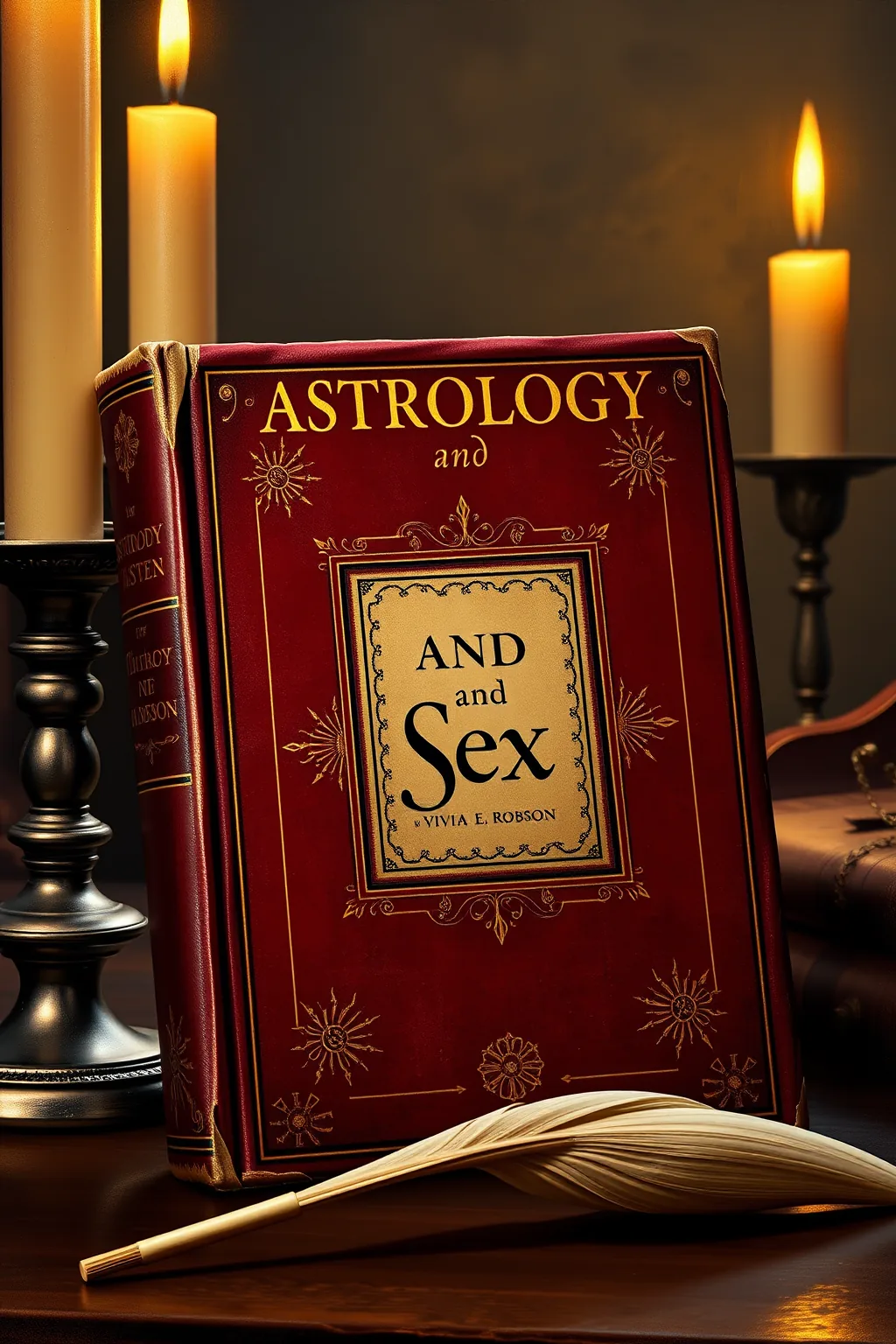
Astrology and Sex
 79
79

Astrology and Sex
Vivian E. Robson's "Astrology and Sex" (1928) is a departure from the often-generalized relationship advice found in popular astrology. Robson’s strength lies in his rigorous, almost clinical, dissection of synastry. He doesn't shy away from technicalities, assessing the overall weight of two charts, the fertility of inner planets, and the condition of the seventh house. The detailed comparison of houses to planets and vice versa offers a sophisticated framework. A limitation, however, is the book's dense prose, which can be challenging for newcomers to astrological terminology. The discussion on the 'fertility of the inner planets' exemplifies Robson's detailed approach, moving beyond simple conjunctions to analyze specific placements and their implications for sexual compatibility. It's a scholarly work for the dedicated astrologer, not the casual reader.
📝 Description
79
Vivian E. Robson published "Astrology and Sex" in 1928, detailing astrological approaches to sexual compatibility.
Vivian E. Robson's 1928 book, "Astrology and Sex," moves beyond simple planetary pairings to analyze the sexual dynamics between two individuals through their birth charts. Robson emphasizes assessing the overall harmonic and disharmonic potentials present in the combined astrological configurations, rather than relying on superficial comparisons. The work is aimed at serious students of astrology who desire a technical understanding of synastry, focusing on the detailed interplay of planetary positions and house placements as they relate to intimacy and attraction. It provides a more in depth analysis than what is found in standard horoscopes.
Robson meticulously examines several key astrological factors relevant to relationships. These include the mutual reception of planets, the condition and significations of the seventh house which traditionally governs partnerships, and the indicators of fertility derived from the placements of inner planets. The book advocates for a holistic evaluation of the entire birth chart, rather than focusing on isolated aspects, to achieve a comprehensive view of a couple's potential compatibility. This approach offers a structured method for interpreting the astrological underpinnings of sexual and relational dynamics.
Published in 1928, "Astrology and Sex" emerged during a period where psychological and sexual theories, influenced by figures like Freud and Jung, were gaining prominence. This era also saw a renewed interest in occult studies and esoteric traditions. Robson's work contributed to the development of psychological astrology, applying astrological principles to understand human behavior and relationships with a greater technical depth than previously common. It represents an effort to integrate astrological interpretation with contemporary psychological thought, aiming for a more scientific and analytical approach to charting human connection.
💡 Why Read This Book?
• Learn how Robson evaluates the 'overall weight of the two charts' in synastry, a technique that provides a more holistic view of relationship dynamics than isolated aspects. • Understand the specific astrological indicators of sexual compatibility Robson outlines, including the 'fertility of the inner planets' and the condition of the 7th house. • Gain insight into the historical development of astrological relationship analysis, drawing on techniques Robson refined in the early 20th century.
⭐ Reader Reviews
Honest opinions from readers who have explored this book.
❓ Frequently Asked Questions
When was Vivian E. Robson's 'Astrology and Sex' originally published?
Vivian E. Robson's 'Astrology and Sex' was first published in 1928, a period marked by significant advancements in psychological and astrological thought.
What astrological concepts does Robson discuss regarding sexual relationships?
Robson delves into synastry, analyzing the overall weight of charts, the fertility of inner planets, the condition of the 7th house, and comparing planetary placements with house significations.
Is 'Astrology and Sex' suitable for beginners?
While comprehensive, the book's technical depth and dense prose may be more suitable for intermediate to advanced astrology students seeking detailed analysis.
What is synastry according to Robson?
Synastry, as presented by Robson, is the astrological study of how individuals relate to each other, specifically examining the dynamics of attraction and compatibility within relationships.
Does the book offer practical advice for improving relationships?
The book focuses on astrological diagnosis rather than prescriptive advice. Understanding the astrological dynamics is presented as the primary goal, with practical application left to the reader.
What is the significance of the 7th house in Robson's analysis?
In Robson's framework, the 7th house is crucial for analyzing partnerships, and its condition, along with planetary placements within it, offers significant clues about relationship dynamics and compatibility.
🔮 Key Themes & Symbolism
Synastry Mechanics
Robson's work systematically breaks down the mechanics of synastry, moving beyond simple aspect patterns. He emphasizes evaluating the 'overall weight of the two charts,' a principle that suggests a holistic integration of astrological factors. This includes detailed comparisons of planetary placements to houses, and vice versa, aiming to provide a comprehensive map of interpersonal astrological dynamics. The fertility of specific planets and houses is also a key consideration in assessing relationship potential.
Sexual Compatibility Indicators
The book focuses on specific astrological signatures that indicate sexual attraction and compatibility. Robson examines the condition of the 7th house, traditionally associated with partnerships, and its rulers, as well as the placement and condition of inner planets. The 'fertility of the inner planets' is a concept explored to understand the inherent sexual energies and propensities of individuals and how they interact when charts are compared.
Chart Weight and Balance
A central theme is the 'overall weight' of the two individual charts in a synastric comparison. Robson argues against focusing solely on one person's planets aspecting another's, advocating instead for a balanced assessment of both charts' strengths and weaknesses. This involves considering the dominion of planets by house and sign, and the general astrological complexion of each individual chart before assessing their interaction.
Comparative Astrological Analysis
Robson's methodology is inherently comparative. He details how to compare 'her planets to his planets' and 'his houses to her houses.' This dual approach ensures that both the individual energies (planets) and the environmental/relational contexts (houses) are considered from each person's perspective, creating a dynamic interplay that defines the relationship's astrological signature.
💬 Memorable Quotes
Direct passages from the work, attributed to the author.
“Synastry is the branch of astrology that tells us how we relate to other people.”
— This foundational statement defines the scope of synastry, positioning it as the astrological lens through which interpersonal connections and relational dynamics are understood and analyzed.
“He studies the overall weight of the two charts.”
— This highlights Robson's emphasis on a holistic approach to synastry, suggesting that relationship compatibility is determined by the comprehensive astrological picture of both individuals, not just isolated points of interaction.
“the fertility of the inner planets”
— This phrase points to Robson's specific focus on the generative and energetic capacities of Mercury, Venus, and Mars within a natal chart, and how their condition influences sexual and relational expression.
“the condition of the 7th house”
— Robson uses the 7th house not just as a signifier of marriage, but as a critical indicator of the overall quality and dynamics of partnerships, assessing its planetary occupants and rulership.
💡 Key Ideas
Editorial paraphrase of the work's core concepts — not direct quotes.
He compares her-planets-to-his-planets as well as his-houses-to-her-houses.
This quote illustrates Robson's detailed methodology, emphasizing a dual comparison that considers both individual planetary influences and the relational context provided by the houses from each partner's perspective.
🌙 Esoteric Significance
Tradition
Robson's work falls within the Western Esoteric tradition, specifically the lineage of psychological astrology that gained prominence in the early 20th century. It draws upon traditional astrological principles but applies them with a modern psychological and analytical rigor, influenced by the intellectual currents of its time. It departs from purely predictive or fatalistic interpretations, focusing instead on the psychological and relational implications of astrological configurations.
Symbolism
Key symbols include the 7th house, representing partnership and marital relations, and the inner planets (Sun, Moon, Mercury, Venus, Mars) which Robson identifies as crucial for understanding sexual energy and compatibility. The 'fertility' of these planets and houses is a symbolic language indicating generative potential and the ease or difficulty of harmonious sexual expression within a relationship.
Modern Relevance
Modern psychological astrologers and synastry practitioners continue to draw upon Robson's foundational work. His emphasis on evaluating the overall chart dynamics, rather than isolated aspects, informs contemporary relationship astrology. Thinkers in relationship counseling and evolutionary astrology often echo his principles when discussing the complex interplay of energies between two individuals.
👥 Who Should Read This Book
• Dedicated astrology students seeking to deepen their understanding of synastry beyond basic horoscopes. • Astrologers interested in the historical development of psychological astrology and its application to relationships. • Individuals curious about the technical astrological factors that may influence sexual compatibility and relational dynamics.
📜 Historical Context
Vivian E. Robson's "Astrology and Sex," first published in 1928, emerged during a vibrant period for astrological and psychological inquiry. The era saw the integration of Freudian and Jungian psychoanalytic concepts into various fields, including esoteric studies. Robson's work contributed to the growing body of psychological astrology, which sought to explain human behavior and relationships through the lens of celestial mechanics. This period also witnessed a flourishing of occult societies and publications, with authors like Aleister Crowley exploring similar themes of sexuality and esotericism. While Robson's approach was more technical and less sensational than some contemporaries, his detailed analysis of synastry offered a sophisticated framework for understanding relational dynamics, distinguishing it from more general astrological advice.
📔 Journal Prompts
The overall weight of the two charts: how do your own chart's dominant themes manifest in relationships?
Fertility of the inner planets: reflect on how your Venus and Mars placements might influence your approach to intimacy.
The condition of the 7th house: explore how your 7th house placements describe your expectations and experiences in partnerships.
Comparing planets to houses: how might your partner's planets interacting with your houses create unique relational dynamics?
Robson's approach to synastry: consider how your own astrological chart might predict your compatibility with another.
🗂️ Glossary
Synastry
The branch of astrology concerned with comparing two individual birth charts to understand the dynamics and compatibility of their relationship.
Overall weight of the two charts
Robson's concept of assessing the collective astrological influences and strengths of each individual's complete birth chart when analyzing a relationship.
Fertility of the inner planets
An astrological assessment of the generative and sexual energies indicated by the placement and condition of Mercury, Venus, and Mars within a birth chart.
Condition of the 7th house
The astrological analysis of the 7th house, including its sign, planetary occupants, and ruler, to understand the nature and quality of partnerships.
Her-planets-to-his-planets
A method in synastry where one person's planetary placements are compared against the other person's planetary placements.
His-houses-to-her-houses
A method in synastry where one person's house placements are compared against the other person's house placements, indicating how relational contexts interact.
Mutual Reception
A condition where two planets are in each other's sign rulership, considered to create a harmonious and reciprocal exchange of energies.