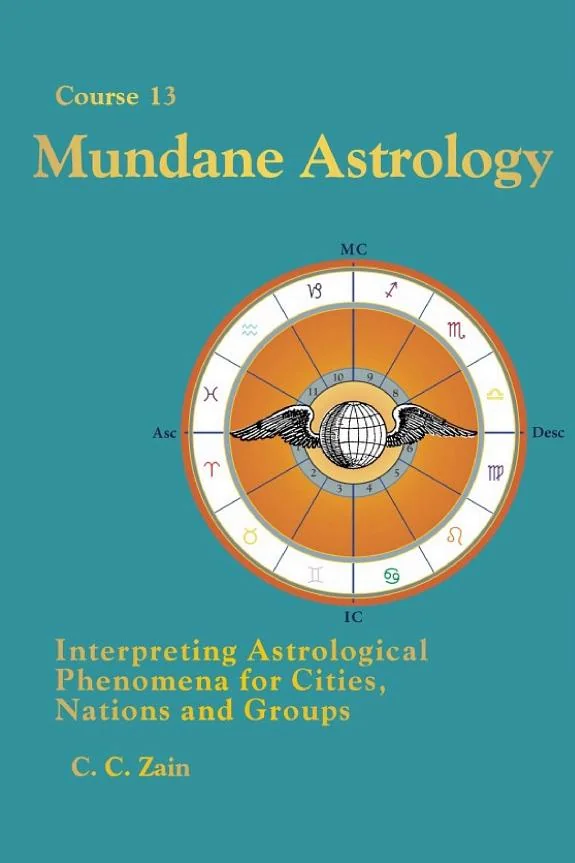
CS13 Mundane Astrology
 78
78

CS13 Mundane Astrology
C. C. Zain's CS13 Mundane Astrology provides a rare technical manual for a subject often treated with broad generalizations. The strength of this work lies in its systematic approach to a complex field, offering charts and methodologies for understanding collective astrological influences. However, the prose can be dense, demanding considerable focus from the reader. A particularly striking concept is the use of major planetary cycles to map the rise and fall of national fortunes, a sophisticated application of astrological principles. While its age shows in some of the specific historical examples, the underlying interpretive framework remains robust for those willing to engage with its technical demands. It’s a valuable, albeit challenging, resource for serious astrological researchers.
📝 Description
78
C. C. Zain's CS13 Mundane Astrology, published in the early 20th century, details astrological influences on collective entities.
This volume, CS13, is part of C. C. Zain's 21 Course series from the Brotherhood of Light, focusing on Hermetic Sciences. It specifically addresses mundane astrology, a branch that examines how celestial cycles affect nations, cities, states, and corporations, rather than individual horoscopes. The book provides a technical system for analyzing these collective astrological influences.
It is written for serious astrology students who want to move beyond personal charts. Those interested in geopolitical forecasting, societal patterns, or the astrological basis of world events will find it useful. The text assumes a basic understanding of astrological principles and aims to give readers practical methods for studying collective human affairs through an astrological lens.
CS13 Mundane Astrology comes from the Brotherhood of Light's curriculum, a system of esoteric education developed by C. C. Zain in the early 20th century. Zain's work aimed to organize and teach occult knowledge, drawing from established Western traditions. The Brotherhood's courses provided a structured approach for students of the occult, paralleling movements like Rosicrucianism and the Hermetic Order of the Golden Dawn.
💡 Why Read This Book?
• Learn to interpret major planetary cycles for national and global trends, moving beyond personal horoscopes as outlined in the "mundane cycle charts" section. • Gain a technical understanding of how astrological influences are applied to collective entities like nations and cities, a core tenet of mundane astrology. • Explore C. C. Zain's specific methodologies for analyzing world affairs through astrology, a direct engagement with his unique contribution to esoteric studies.
⭐ Reader Reviews
Honest opinions from readers who have explored this book.
❓ Frequently Asked Questions
What is mundane astrology according to C. C. Zain?
C. C. Zain defines mundane astrology in CS13 as the study of how astrological influences impact collective entities such as nations, cities, states, communities, and corporations, distinct from personal horoscopes.
What specific astrological tools are used in CS13 Mundane Astrology?
The book primarily utilizes mundane cycle charts of the major planets to study local and world trends, providing a technical manual for this specialized astrological application.
Who authored the Brotherhood of Light Courses, including CS13?
The 21 Brotherhood of Light Courses, including CS13 Mundane Astrology, were authored by C. C. Zain, a notable figure in early 20th-century esoteric and occult literature.
What other subjects are covered in the Brotherhood of Light Courses series?
The series encompasses a wide range of Hermetic Sciences, including Astrology, Alchemy, Tarot, Kabbalah, and general Occult studies, with CS13 focusing specifically on mundane astrology.
When was CS13 Mundane Astrology first published?
CS13 Mundane Astrology, as part of the Brotherhood of Light Courses, was first published on April 27, 2014, though the original courses were developed over a longer period.
Is CS13 Mundane Astrology suitable for beginners in astrology?
No, CS13 Mundane Astrology is a technical manual for those with a foundational understanding of astrological principles, focusing on collective rather than personal chart interpretation.
🔮 Key Themes & Symbolism
Astrology of Nations
This volume fundamentally shifts the astrological focus from the individual to the collective. It posits that the same celestial mechanics influencing personal lives can be observed on a grand scale, affecting the destinies of countries, cities, and global communities. The work provides specific techniques for constructing and interpreting charts designed to reveal the cycles and trends of geopolitical entities, moving beyond natal astrology to a macrocosmic view of human civilization's unfolding.
Hermetic Science Synthesis
As Course 13 in the Brotherhood of Light series, this book is part of C. C. Zain's larger project to synthesize and present esoteric knowledge. Mundane astrology is framed within the broader context of Hermetic Sciences, linking celestial mechanics to principles found in alchemy, Kabbalah, and occult philosophy. The aim is to demonstrate the interconnectedness of all phenomena and provide a structured, systematic approach to understanding the divine order through applied esoteric disciplines.
Planetary Cycles and Trends
The core methodology presented involves the study of major planetary cycles. These long-term transits and conjunctions are interpreted not as personal influences but as indicators of significant shifts in global affairs. The book offers practical guidance on how to track these cycles and correlate them with historical events and societal developments, serving as a tool for forecasting and understanding the underlying astrological drivers of world history.
Technical Application
Unlike more philosophical treatises on astrology, CS13 Mundane Astrology functions as a technical manual. It provides specific instructions and analytical frameworks for practitioners. The emphasis is on 'how-to,' equipping students with the tools to perform mundane astrological analyses. This practical orientation is crucial for understanding the Brotherhood of Light's educational philosophy, which prioritizes systematic study and verifiable application of esoteric principles.
💬 Memorable Quotes
Direct passages from the work, attributed to the author.
“Mundane astrology is the study of how astrological influences affect nations, cities, states, communities, corporations and groups.”
— This foundational definition clearly demarcates the scope of mundane astrology, setting it apart from personal horary or natal chart readings and establishing its focus on collective phenomena.
“Local and world trends can be studied through the use of mundane cycle charts of the major planets.”
— This highlights the primary methodology employed in the text, emphasizing the use of long-term planetary cycles as a predictive and analytical tool for understanding macro-level societal shifts.
“This book is one of the rare technical manuals covering the astrology of world affairs.”
— This statement underscores the unique value proposition of the text, positioning it as an uncommon resource for those seeking practical, systematic methods to apply astrology to global events.
“Course 13 in the 21 Brotherhood of Light Course series on the Hermetic Sciences.”
— This contextualizes the book within a larger curriculum, identifying its place in a structured system of esoteric education that covers a wide array of mystical and occult subjects.
💡 Key Ideas
Editorial paraphrase of the work's core concepts — not direct quotes.
It teaches the student to apply astrological principles to world events.
This paraphrase points to the pedagogical goal of the course, indicating that the focus is on practical application and skill development in analyzing collective human affairs through an astrological lens.
🌙 Esoteric Significance
Tradition
This work belongs to the Western Esoteric Tradition, specifically within the Hermetic lineage espoused by the Brotherhood of Light. C. C. Zain sought to codify and systematize Hermetic knowledge, presenting astrology not merely as divination but as a key component of a larger cosmic science. It fits within this tradition by emphasizing the correspondence between the macrocosm (universe) and the microcosm (humanity and its collective endeavors), viewing astrological cycles as divine patterns governing terrestrial affairs.
Symbolism
While CS13 focuses on technical application, the underlying symbolism of planetary archetypes remains central. The major planets, such as Jupiter and Saturn, are interpreted not just as celestial bodies but as potent forces influencing national characteristics, economic cycles, and political structures. Their conjunctions and oppositions symbolize critical junctures and shifts in collective consciousness and historical momentum, serving as symbolic keys to understanding the unfolding destiny of societies.
Modern Relevance
Contemporary practitioners of mundane astrology, geopolitical analysts with an esoteric bent, and researchers of Western esotericism continue to engage with C. C. Zain's methodologies. His systematic approach provides a foundation for modern studies in electoral forecasting, economic cycles, and the astrological interpretation of international relations. Thinkers exploring the cyclical nature of history and the potential for astrological insights into societal patterns find value in the technical frameworks he established.
👥 Who Should Read This Book
• Students of Western Esotericism seeking to understand the Brotherhood of Light's curriculum and C. C. Zain's systematic approach to Hermetic Sciences. • Astrologers interested in expanding their practice beyond natal charts to analyze collective phenomena, national trends, and world events. • Researchers of occult history and comparative religion looking for primary source material on early 20th-century esoteric movements and their cosmological frameworks.
📜 Historical Context
CS13 Mundane Astrology emerges from the prolific output of C. C. Zain and the Brotherhood of Light, a significant esoteric organization active from the early to mid-20th century. Zain's extensive series of 22 courses aimed to systematically teach Hermetic Sciences, including astrology, alchemy, and Kabbalah, often drawing from and synthesizing earlier traditions like Rosicrucianism. The Brotherhood's approach was characterized by a desire for structured, progressive esoteric education, contrasting with more ad-hoc or initiatory systems. While the exact reception of individual Brotherhood courses is not widely documented in mainstream academic circles, their consistent circulation and republication suggest a dedicated readership within esoteric communities. Zain's work operated within a landscape populated by other occult authors and movements, such as Theosophy and later interpretations of Western esotericism, contributing to a broader discourse on spiritual and mystical understanding.
📔 Journal Prompts
The application of mundane cycle charts to national trends.
Analyzing the influence of major planets on collective entities.
C. C. Zain's synthesis of astrology within the Hermetic Sciences.
The distinction between personal and mundane astrological interpretation.
Identifying historical events correlated with specific planetary cycles mentioned.
🗂️ Glossary
Mundane Astrology
The branch of astrology concerned with the study of astrological influences on collective human affairs, such as nations, cities, states, and international relations, as opposed to individual horoscopes.
Mundane Cycle Charts
Astrological charts specifically designed to represent the cycles and influences affecting nations or large groups, typically focusing on the movements of major planets.
Hermetic Sciences
A broad category of esoteric disciplines, including astrology, alchemy, Kabbalah, and Tarot, rooted in the teachings attributed to Hermes Trismegistus, aiming to understand the fundamental principles of the cosmos.
Brotherhood of Light
An esoteric organization founded by C. C. Zain, offering a structured curriculum of 21 courses covering various aspects of Hermetic Sciences and occult philosophy.
Major Planets
In the context of mundane astrology discussed in CS13, typically refers to planets with longer orbital periods (e.g., Jupiter, Saturn, Uranus, Neptune, Pluto) whose cycles significantly impact collective trends.
World Affairs
The political, economic, and social events and trends occurring on a global scale, which mundane astrology aims to analyze and understand through celestial influences.
Esoteric Literature
Writings concerned with the hidden or inner knowledge of spiritual and mystical traditions, often exploring subjects like occultism, mysticism, and secret doctrines.
This book appears in 1 collection
🔮 Readers Also Liked
Browse all →









From the “Mundane Astrology” Collection
View all →









More Free Astrology & Cosmology Books
View all →