Paracelsus
Paracelsus was a pioneering Renaissance physician, alchemist, and philosopher known for his observational approach and influence on toxicology and prophecy.
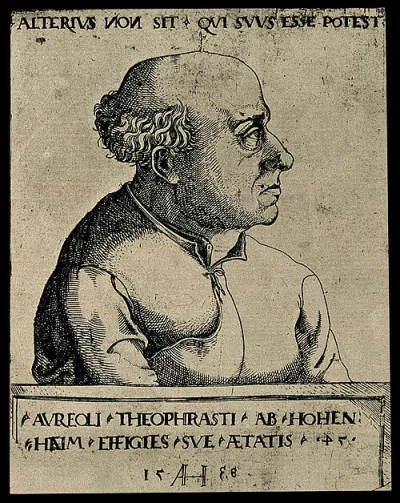
Theophrastus von Hohenheim, known as Paracelsus, was a Swiss physician, alchemist, and philosopher of the German Renaissance, born in 1493. He revolutionized medicine by emphasizing empirical observation alongside traditional knowledge, earning him the title 'father of toxicology'. Beyond his medical contributions, Paracelsus was also recognized for his prophetic abilities, with his 'Prognostications' being studied by Rosicrucians. His ideas and teachings inspired the early modern medical movement known as Paracelsianism.
Paracelsus's early life was shaped by his physician father and his own extensive education, which included humanistic and theological studies. Dissatisfied with academic limitations, he traveled widely across Europe, serving as an army surgeon and engaging in extensive study. This period of exploration led him to develop his unique philosophical and medical principles, often reflecting on fundamental questions about life, death, and the human place in the cosmos. His later career saw him establish practices in various cities, often facing opposition from established medical authorities due to his unconventional methods and outspoken criticism.
Philosophical and Esoteric Pursuits
Paracelsus harbored a deep desire for universal knowledge, believing it could not be found solely within books or academic institutions. This led him on extensive travels throughout Europe and possibly beyond, during which he served as an army surgeon and honed his understanding of the natural world. His early medical writings, such as 'Elf Traktat' and 'Volumen medicinae Paramirum', reveal his contemplation of profound issues including the meaning of life and death, the origins of disease, and humanity's connection to the universe and the divine. His influential works like 'Paragranum' and 'Opus Paramirum' further explore his medical philosophy, suggesting a holistic view that integrated spiritual and natural elements. His prophetic writings, such as 'Prognostications', also garnered significant attention, influencing later esoteric traditions like the Rosicrucians.
Medical Revolution and Opposition
As a physician, Paracelsus was a key figure in the Renaissance medical revolution, championing the importance of direct observation and practical experience over rote adherence to ancient authorities. He famously declared, 'The patients are your textbook, the sickbed is your study.' His critical stance towards established medical practices and his public burning of classical medical texts like Avicenna's Canon of Medicine in Basel demonstrated his radical approach. This defiance, coupled with his outspoken nature and criticism of fellow physicians and apothecaries, often led to conflict, political turmoil, and threats to his safety. He was compared to Martin Luther for his challenges to authority, though Paracelsus himself rejected the comparison, asserting his independence. His career was marked by periods of itinerant practice, facing exclusion and persecution from medical professionals and faculties.
Key Ideas
- Emphasis on empirical observation in medicine
- Rejection of unquestioned reliance on ancient medical authorities
- Holistic approach integrating natural philosophy, alchemy, and theology
- Concept of disease originating from internal imbalances or external forces
- Belief in universal knowledge accessible through direct experience
Notable Quotes
“I leave it to Luther to defend what he says and I will be responsible for what I say. That which you wish to Luther, you wish also to me: You wish us both in the fire.”
“The patients are your textbook, the sickbed is your study.”
Books by Paracelsus
24 free public domain books · Read online or download