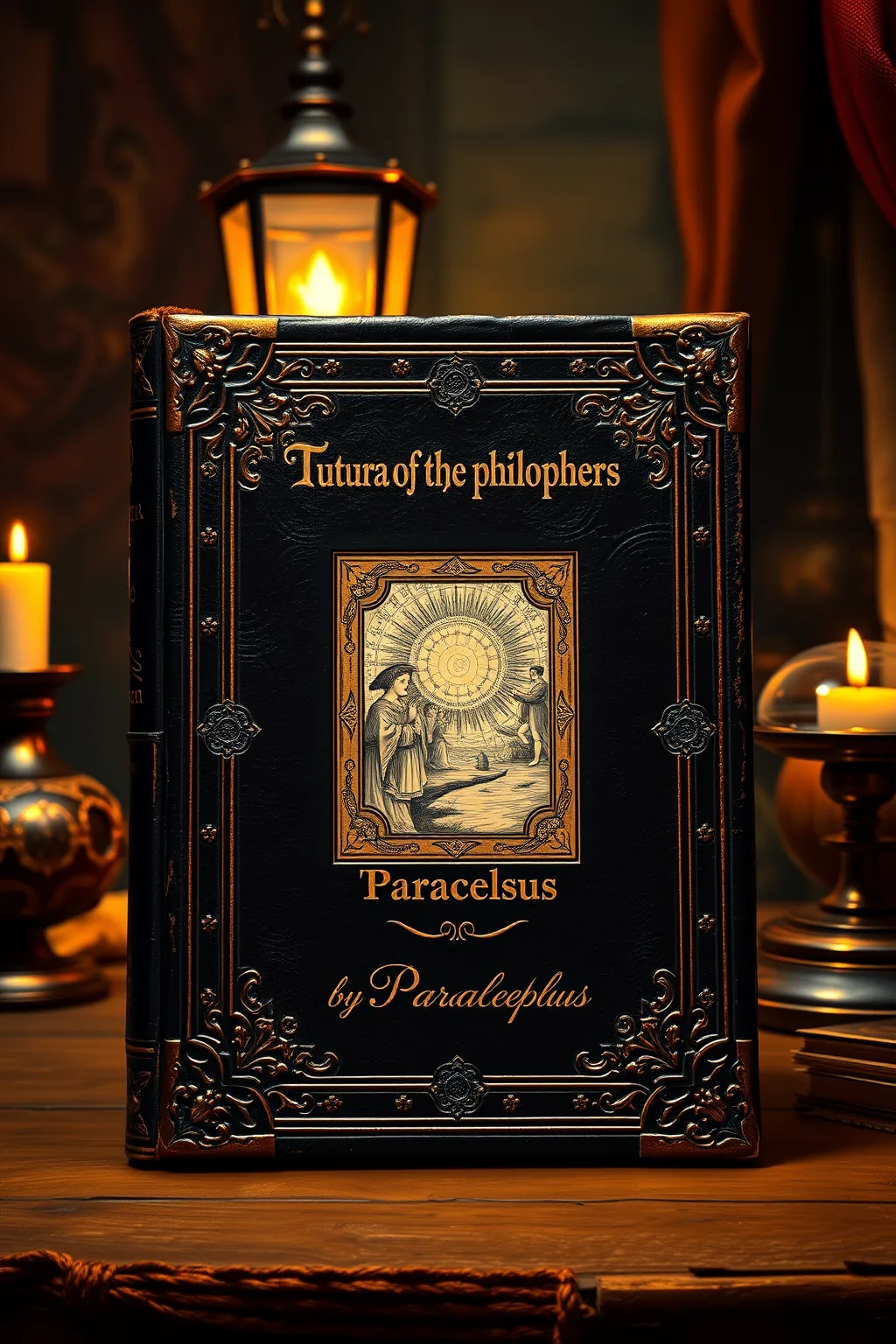
The Aurora of the philosophers by Paracelsus
 74
74

The Aurora of the philosophers by Paracelsus


Aurelia Blackwood (Occult Philosophy Critic) — Paracelsus' 'The Aurora of the Philosophers' remains an indispensable cornerstone for any serious student of Western esotericism. This edition, meticulously presented, illuminates the profound philosophical and spiritual dimensions of alchemy, moving beyond rudimentary interpretations. Paracelsus masterfully interweaves theological, astrological, and natural philosophical concepts, revealing alchemy as a path to divine reintegration. The text's strength lies in its dense symbolism and its audacious claim of divine origin for all arts, linking Adam's primal knowledge to the enduring quest for wisdom. Highly recommended for advanced practitioners and scholars seeking to grasp the foundational principles of Hermetic science.
📝 Description
74
Published in 1572, Paracelsus' 'The Aurora of the Philosophers' discusses the spiritual transformation inherent in alchemy.
Paracelsus' 'The Aurora of the Philosophers' details his alchemical philosophy, moving beyond simple material change. He argues that the alchemical process mirrors a spiritual awakening and cosmic renewal. The work outlines the necessary steps and principles for this transformation, which he believed was accessible to those who understood the underlying divine order.
He presents alchemy not just as a craft for altering metals, but as a method for purifying the self and aligning with natural laws. The text emphasizes the importance of the 'philosophical mercury' and 'philosophical sulfur' as key principles in this transformative work. Paracelsus sought to reveal a hidden order in nature, accessible through alchemical practice and contemplation.
This work is situated within the Hermetic tradition, which views the universe as a divinely ordered system accessible through symbolic interpretation and practice. Paracelsus, influenced by figures like Hermes Trismegistus, sought to understand the macrocosm (the universe) through the microcosm (humanity and material processes). His approach synthesized Neoplatonism, Christian mysticism, and practical alchemy, aiming to uncover the 'anima mundi,' or world soul, and its role in creation and transformation.
💡 Why Read This Book?
Uncover the divine origins of knowledge and the universal principles of transformation. 'The Aurora of the Philosophers' offers a profound exploration of alchemy as a spiritual discipline, revealing hidden truths about creation and human potential. Ideal for serious seekers, scholars of esoteric traditions, and practitioners aiming to integrate cosmic understanding into their alchemical work.
⭐ Reader Reviews
Honest opinions from readers who have explored this book.
❓ Frequently Asked Questions
What is the primary focus of 'The Aurora of the Philosophers'?
The book's primary focus is the philosophical and spiritual underpinnings of alchemy, presenting it as a divine art originating from Adam's primordial knowledge and a means of understanding cosmic creation and transformation.
Is this book suitable for beginners in alchemy?
While foundational, Paracelsus' language is dense and symbolic, making it more accessible to those with some prior exposure to esoteric philosophies or alchemical concepts.
What does Paracelsus mean by 'Adam's knowledge'?
Paracelsus refers to Adam's pre-Fall state, possessing complete and intuitive knowledge of all divine and natural arts, which he believes laid the groundwork for all subsequent wisdom and scientific inquiry.
How does this text relate to Hermeticism?
It is a key text within Hermeticism, emphasizing the interconnectedness of the macrocosm and microcosm, the divine spark within all things, and the pursuit of spiritual perfection through understanding natural laws.
What kind of 'transformation' does Paracelsus discuss?
Paracelsus discusses not only physical transmutation of metals but, more importantly, the spiritual and intellectual transformation of the alchemist, leading to a higher state of consciousness and divine understanding.
🔮 Key Themes & Symbolism
The Divine Origin of Arts and Knowledge
Paracelsus posits that all true arts and sciences, particularly alchemy, are not human inventions but divine revelations bestowed upon humanity from its very inception. He traces this lineage back to Adam, the first man, who possessed an innate, uncorrupted understanding of the cosmos. This theme challenges the notion of progress as solely linear human achievement, instead framing it as the rediscovery and refinement of primordial truths. The implication is that genuine knowledge is a sacred inheritance, a reflection of the divine order, and its pursuit is a return to a lost state of grace and wisdom.
Alchemy as Spiritual Transformation
Beyond the common misconception of transmuting base metals into gold, Paracelsus presents alchemy as a profound path of inner purification and spiritual regeneration. The alchemical process mirrors the journey of the soul, from its fallen state towards divine perfection. The alchemist, through diligent study and practice, aims to distill the divine essence within themselves, shedding the impurities of ignorance and materiality. This inner opus is seen as the true 'Great Work,' leading to enlightenment, divine union, and the recovery of humanity's original spiritual inheritance.
The Language of Symbolism and Nature
Paracelsus emphasizes that the secrets of the universe are not revealed through empirical observation alone but through the interpretation of divine symbols embedded in nature and scripture. He advocates for a holistic understanding, where the created world acts as a living text, containing allegorical representations of cosmic laws and spiritual truths. This hermeneutic approach requires intuition, faith, and a deep connection to the divine architect, enabling the seeker to decipher the hieroglyphic language of creation and unlock its profound mysteries.
💬 Memorable Quotes
Direct passages from the work, attributed to the author.
“From this cause, too, it came about that his successors erected two tables of stone, on which they engraved all natural arts in hieroglyphical characters.”
— This signifies the ancient efforts to preserve divine knowledge through symbolic inscription, highlighting the enduring human desire to pass down esoteric wisdom across generations.
“in order that their posterity might also become acquainted with this prediction, that so it might be heeded, and provision made in the time of danger.”
— This underscores the prophetic and cautionary nature of ancient wisdom, suggesting that knowledge of cosmic cycles and potential cataclysms was preserved for the survival and guidance of humanity.
“Subsequently, Noah found on”
— This fragment implies a continuous thread of preserved knowledge, suggesting that Noah inherited and continued the tradition of safeguarding crucial esoteric teachings for future generations.
“The Aurora of the Philosophers...”
— This title itself evokes the dawn of a new understanding, a spiritual illumination, and the revelation of profound, hidden truths within the alchemical tradition.
💡 Key Ideas
Editorial paraphrase of the work's core concepts — not direct quotes.
ADAM was the first inventor of arts, because he had knowledge of all things as well after the Fall as before.
This quote establishes the divine origin of all human knowledge and arts, tracing them back to Adam's perfect, uncorrupted understanding of the cosmos before and after the Fall.
🌙 Esoteric Significance
Tradition
This work is a seminal text within the Hermetic and Alchemical traditions of Western Esotericism. It draws heavily on the Hermetic principle of 'As Above, So Below,' viewing the physical world as a reflection of divine and spiritual realities. Paracelsus integrates astrological, theological, and philosophical elements, positioning alchemy not merely as a chemical pursuit but as a sacred science aimed at understanding the macrocosm and achieving spiritual perfection, mirroring the microcosm of the human being.
Symbolism
The text is rich with potent symbolism, often derived from biblical narratives, natural phenomena, and alchemical processes. The 'Aurora' itself symbolizes the dawn of divine light and understanding. References to Adam, Noah, and the engraved tables speak to the ancient, sacred origins of knowledge. The implied alchemical processes represent stages of purification and transformation, leading from a corrupted state to a renewed, divine essence. The hieroglyphic characters represent a universal, esoteric language meant to convey profound truths beyond ordinary discourse.
Modern Relevance
In an age often characterized by materialism and fragmentation, 'The Aurora of the Philosophers' offers a powerful counterpoint, reasserting the interconnectedness of all things and the spiritual dimension of existence. Its emphasis on inner transformation and the pursuit of divine knowledge appeals to contemporary seekers interested in holistic well-being, consciousness studies, and the integration of ancient wisdom into modern life. The text encourages a deeper, symbolic interpretation of reality and the potential for profound personal evolution.
👥 Who Should Read This Book
This profound text is essential for serious students of alchemy and Hermeticism, offering foundational philosophical insights into the Great Work. Scholars of Western Esotericism will find it useful for understanding the historical development of alchemical thought and Paracelsus' unique contributions. Spiritual seekers yearning for a deeper connection to the divine and the underlying principles of creation will discover rich contemplative material. Practitioners of esoteric arts will benefit from its dense symbolism and its emphasis on the spiritual dimension of transformation, guiding them towards a more integrated and profound practice.
📜 Historical Context
Written during the tumultuous yet intellectually vibrant period of the Renaissance (roughly 14th-17th centuries), Paracelsus' 'The Aurora of the Philosophers' emerged from a milieu where classical learning was being rediscovered, but often reinterpreted through a mystical and esoteric lens. This era saw a resurgence of interest in Hermeticism, Neoplatonism, and Kabbalah, influencing thinkers who sought to reconcile ancient wisdom with emerging scientific inquiry. Paracelsus, a physician, alchemist, and astrologer, embodied this syncretic approach, challenging established medical doctrines and advocating for a more holistic, divinely inspired understanding of nature and man. His work reflects the period's fascination with hidden knowledge, divine intervention in human affairs, and the potential for human beings to achieve a higher state of being through the study of cosmic principles and the practice of spiritual arts.
📔 Journal Prompts
Reflect on the concept of 'primordial knowledge' as described by Paracelsus. How might this knowledge manifest in your own life or understanding of the world?
Consider the idea of alchemy as a path of inner transformation. What aspects of yourself do you feel need 'transmuting' or purifying?
Paracelsus suggests that nature speaks in a symbolic language. What natural phenomena have spoken to you recently, and what deeper meaning might they hold?
Explore the connection between divine origin and human endeavor. How can we approach our own creative and intellectual pursuits with a sense of sacredness?
Contemplate the 'prediction' mentioned in the text regarding world destruction. How does understanding cycles of creation and destruction influence your perspective on life and the future?
🗂️ Glossary
Hermeticism
An ancient esoteric tradition based on the writings attributed to Hermes Trismegistus, emphasizing divine wisdom, the interconnectedness of all things (macrocosm/microcosm), and the pursuit of spiritual enlightenment through understanding natural laws.
Alchemy
An ancient proto-scientific and philosophical tradition aiming at the transmutation of metals, but also encompassing spiritual purification, the search for the elixir of life, and the understanding of cosmic principles.
Macrocosm
The universe or the greater world, seen as a complex, ordered whole, often paralleled with the microcosm.
Microcosm
The human being or a smaller system, seen as a miniature reflection of the macrocosm, embodying its principles and structures.
Opus
In alchemy, the Great Work or 'Major work,' referring to the entire process of alchemical transformation, both material and spiritual, leading to the philosopher's stone or enlightenment.
This book appears in 3 collections
🔮 Readers Also Liked
Browse all →









From the “Hermeticism” Collection
View all →







More Free Alchemy & Hermeticism Books
View all →