NASA Technical Reports Server (NTRS)
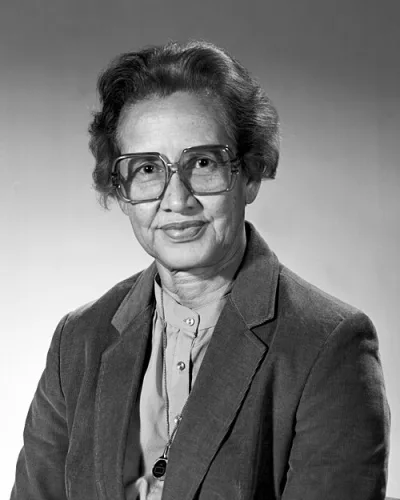
Katherine Johnson was a pioneering mathematician whose orbital mechanics calculations were crucial for early US space missions.
Creola Katherine Johnson, born in 1918, was an American mathematician whose precise calculations were fundamental to the success of numerous United States crewed spaceflights. Over a 33-year career at NASA and its predecessor, the National Advisory Committee for Aeronautics (NACA), she became renowned for her expertise in complex manual calculations and contributed to the growing use of computers in scientific endeavors. Johnson's work was vital for Project Mercury, including the flights of Alan Shepard and John Glenn, and extended to the Apollo lunar missions and the early Space Shuttle program. Her contributions were recognized with prestigious awards, including the Presidential Medal of Freedom, and she was posthumously inducted into the National Women's Hall of Fame.
Early Life and Education
Born Creola Katherine Coleman in West Virginia in 1918, Katherine Johnson displayed exceptional mathematical talent from a young age. Due to limited educational opportunities for African Americans beyond the eighth grade in her county, her family arranged for her to attend high school on the campus of West Virginia State College (WVSC). She excelled academically, graduating high school at 14 and subsequently attending WVSC, where she pursued every available mathematics course. Mentored by professors like Angie Turner King and W. W. Schieffelin Claytor, who even created new courses for her, Johnson graduated summa cum laude with degrees in mathematics and French at 18. She was the first African-American woman to attend graduate school at West Virginia University, integrating the program following a Supreme Court ruling.
Career at NACA and NASA
Johnson began her professional career as a mathematician in the Guidance and Navigation Department at NACA's Langley Memorial Aeronautical Laboratory. Initially working in a pool of female "computers" who performed manual calculations, she was eventually assigned to assist an all-male flight research team. Her analytical geometry skills proved invaluable, leading her to be permanently integrated into the team. Despite the era's racial and gender segregation, Johnson was assertive, demanding inclusion in meetings and ensuring her contributions were recognized. She was the first woman in her division to have her name appear on a research report. After NACA became NASA in 1958, Johnson continued her work, calculating trajectories for Project Mercury and verifying computer calculations for John Glenn's orbit. Her meticulous work was critical for mission success, including calculating rendezvous paths for the Apollo missions and backup procedures for the Apollo 13 return. She later contributed to the Space Shuttle program and plans for Mars missions.
Recognition and Legacy
Katherine Johnson's significant contributions to space exploration earned her widespread recognition. In 2015, she was awarded the Presidential Medal of Freedom by President Barack Obama. NASA honored her with a Silver Snoopy Award and a Group Achievement Award in 2016. Her life and work were notably depicted in the 2016 film "Hidden Figures." The U.S. Congress awarded her the Congressional Gold Medal in 2019, the same year NASA named its Katherine Johnson Independent Verification and Validation Facility in her honor. In 2021, she was posthumously inducted into the National Women's Hall of Fame, cementing her legacy as a pivotal figure in American space history and a trailblazer for women and African Americans in STEM.
Key Ideas
- Calculations of orbital mechanics critical for early US crewed spaceflights.
- Pioneering use of computers in conjunction with manual calculations.
- Assertiveness in overcoming racial and gender barriers in the workplace.
Notable Quotes
“We needed to be assertive as women in that days—assertive and aggressive—and the degree to which we had to be that way depended on where you were.”
“I had to be.”
“In the early days of NASA women were not allowed to put their names on the reports—no woman in my division had had her name on a report.”
“So Ted left Pearson with no choice; I finished the report and my name went on it, and that was the first time a woman in our division had her name on something.”
“Everybody was concerned about them getting there. We were concerned about them getting back.”
Books by NASA Technical Reports Server (NTRS)
0 free public domain books · Read online or download