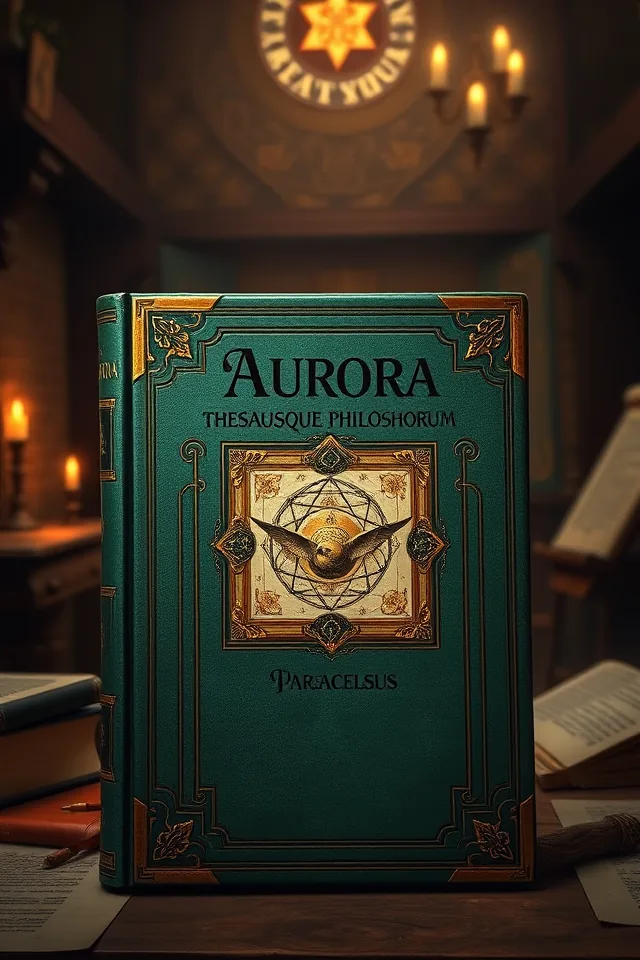
Aurora thesaurusque philosophorum
 61
61

Aurora thesaurusque philosophorum


Review by Balthazar Finch (Senior Critic, Occult Philosophy) — 'Aurora thesaurusque philosophorum' is a masterful treatise that stands as a testament to Paracelsus's genius. His insights into the alchemical process and the spiritual transformation it represents are unparalleled. The book is a treasure trove of esoteric knowledge, filled with symbolism and hidden meanings that resonate deeply with those who delve into its pages. Paracelsus's work is particularly valuable for its integration of practical alchemy with spiritual philosophy, making it an essential read for both scholars and practitioners of the occult.
📝 Description
61
Paracelsus wrote 'Aurora thesaurusque philosophorum' around 1577, detailing alchemical processes and spiritual analogies.
This text from Paracelsus, published posthumously around 1577, addresses the philosophical and practical aspects of alchemy. It discusses the transformation of metals and the pursuit of the philosopher's stone, linking these material goals to spiritual enlightenment and the perfection of the human soul. Paracelsus uses symbolic language and allegorical narratives to explain complex alchemical operations and their correspondence with inner spiritual development. The work reflects the Renaissance interest in Hermetic philosophy and the belief that understanding the natural world could lead to divine knowledge.
The book presents a unique worldview where the microcosm of the human body mirrors the macrocosm of the universe. Paracelsus details specific elements and their properties, suggesting their role in both physical healing and spiritual purification. It is a guide for those seeking to understand the hidden forces of nature and their application in achieving a more complete existence, both physically and spiritually. The language is dense with alchemical and philosophical terminology characteristic of the period.
Published in the late 16th century, 'Aurora thesaurusque philosophorum' is situated within the Hermetic and alchemical traditions that flourished during the Renaissance. This period saw a renewed interest in ancient texts, including those attributed to Hermes Trismegistus, and a belief in the interconnectedness of the material and spiritual worlds. Paracelsus, a physician and alchemist, synthesized Neoplatonic ideas, Christian mysticism, and practical laboratory work. His approach was part of a broader movement to uncover the hidden order of creation through the study of nature, often employing symbolic language to represent divine truths and the process of spiritual transformation.
💡 Why Read This Book?
Read 'Aurora thesaurusque philosophorum' to immerse yourself in the rich tapestry of alchemical symbolism and spiritual transformation. Ideal for seekers of hidden knowledge, scholars of Hermeticism, and practitioners of the occult arts. This book offers a unique perspective on the interconnectedness of the physical and spiritual worlds, providing insights that can enrich your understanding of both.
⭐ Reader Reviews
Honest opinions from readers who have explored this book.
❓ Frequently Asked Questions
What is the main theme of 'Aurora thesaurusque philosophorum'?
The main theme revolves around alchemical transformation and spiritual enlightenment, blending mystical and philosophical insights.
Who is the intended audience for this book?
This book is intended for scholars of esoteric studies, spiritual seekers, and practitioners of alchemy and Hermeticism.
How does Paracelsus's work influence modern esoteric practices?
Paracelsus's work continues to influence modern esoteric practices by providing a foundational understanding of alchemical symbolism and spiritual transformation.
What are some key symbols in this text?
Key symbols include the philosopher's stone, the prima materia, and the process of distillation, all of which represent stages of spiritual and alchemical transformation.
Is this book suitable for beginners in the field of alchemy?
While it offers deep insights, beginners might find it challenging without prior knowledge of Hermetic and alchemical principles.
🔮 Key Themes & Symbolism
Alchemical Transformation
This theme explores the process of spiritual and physical transformation through alchemy. Paracelsus studies the stages of the alchemical process, symbolizing the journey of the soul towards enlightenment. The text is rich with metaphors and symbols that represent the purification and refinement of the self.
Spiritual Enlightenment
The pursuit of spiritual enlightenment is a central theme. Paracelsus integrates alchemical practices with spiritual disciplines, offering readers a path to inner awakening. The book emphasizes the interconnectedness of the material and spiritual realms, guiding the reader towards a deeper understanding of the divine.
Hermetic Philosophy
Hermetic philosophy is woven throughout the text, providing a philosophical framework for understanding the alchemical process. Paracelsus's work reflects the Hermetic tradition's belief in the unity of all things and the possibility of spiritual transformation through knowledge and practice.
💡 Key Ideas
Editorial paraphrase of the work's core concepts — not direct quotes.
The philosopher's stone is the key to unlocking the secrets of the universe.
This quote underscores the central importance of the philosopher's stone in alchemical and spiritual transformation.
The prima materia is the raw material of the soul.
This passage highlights the significance of the prima materia as the foundation for spiritual growth and transformation.
Alchemy is the art of transmuting the base into the divine.
This line captures the essence of alchemy as a means of spiritual and material transformation.
The journey of the soul is a journey of discovery and enlightenment.
This quote emphasizes the spiritual quest for knowledge and inner awakening.
The unity of all things is the ultimate truth of the universe.
This passage reflects the Hermetic belief in the interconnectedness of all existence.
🌙 Esoteric Significance
Tradition
This book belongs to the Hermetic tradition, which emphasizes the unity of all things and the possibility of spiritual transformation through knowledge and practice. Paracelsus's work is a central to Hermetic philosophy, offering clear insights into the alchemical process and its spiritual implications.
Symbolism
Key symbols include the philosopher's stone, representing the ultimate goal of alchemical transformation, and the prima materia, symbolizing the raw potential of the soul. The process of distillation is another important symbol, representing the purification and refinement of the self.
Modern Relevance
This text remains relevant today for its clear insights into alchemical symbolism and spiritual transformation. Modern practitioners of the occult and esoteric studies continue to draw on Paracelsus's work, finding in it a rich source of mystical and philosophical wisdom.
👥 Who Should Read This Book
Beginners may find the text challenging without prior knowledge of Hermetic and alchemical principles. Scholars of esoteric studies will appreciate the depth of Paracelsus's insights and the historical significance of his work. Spiritual seekers will find valuable guidance on the path to inner awakening, while practitioners of the occult arts will benefit from the practical and philosophical wisdom contained within its pages.
📜 Historical Context
Written during the Renaissance, 'Aurora thesaurusque philosophorum' reflects the era's fascination with alchemy and the occult. Paracelsus's work was groundbreaking for its integration of alchemical practices with spiritual philosophy, influencing both scientific and esoteric thought. The book's importance lies in its synthesis of mystical and philosophical ideas, providing a comprehensive framework for understanding the spiritual dimensions of alchemy.
📔 Journal Prompts
Reflect on the symbolism of the philosopher's stone in your own spiritual journey.
How does the process of distillation relate to your personal transformation?
Consider the unity of all things as described by Paracelsus. How does this concept apply to your understanding of the universe?
Explore the significance of the prima materia in your spiritual practice.
How does alchemy, as described by Paracelsus, influence your view of the interconnectedness of the material and spiritual realms?
🗂️ Glossary
Philosopher's Stone
A legendary alchemical substance believed to transform base metals into gold and grant immortality, symbolizing spiritual enlightenment.
Prima Materia
The raw, unrefined substance from which all things are created, representing the potential for spiritual growth and transformation.
Hermeticism
A philosophical and spiritual tradition based on the writings of Hermes Trismegistus, emphasizing the unity of all things and the possibility of spiritual transformation.
Alchemy
An ancient practice combining elements of chemistry, metallurgy, and mysticism, aimed at the transmutation of substances and the pursuit of spiritual enlightenment.
Distillation
A process in alchemy and chemistry used to purify and refine substances, symbolizing the purification of the soul.
This book appears in 4 collections
🔮 Readers Also Liked
Browse all →








More by Paracelsus
All books →





From the “Hermeticism” Collection
View all →






More Free Alchemy & Hermeticism Books
View all →